Tim Bruns
Managing Executive Editor
Nathan Hope
News Editor
All-time Boston Marathon winner Clarence DeMar helped found the Keene State College, then Keene Normal School, track and field team over 85 years ago. However, to this day, there is still no dedicated track facility at the college.
While there may not be a dedicated facility, the college has made several efforts in the past to bring one to campus – but to no avail. Although, the idea of having a facility is still in discussion.
‘Timing is everything’
In April 2022, The Equinox reported Keene State College President Melinda Treadwell announced an “inflatable dome track facility” was in its infancy stage. At the time Treadwell said she would go to the University System of New Hampshire (USNH) Board of Trustees with a $8 million investment proposal for the facility. At the time, Treadwell said the project could cost approximately $43 million in total, with hopes to have it complete for the 2023-2024 academic year.
The idea was to have a 300-meter flat track placed at the Krif Road Owl Athletic complex.
Since then, The Equinox reported in October 2022 that then-Director of Athletics and Recreation Phil Racicot expressed concerns over costs for the project going into the fall semester.
“There’s a significant amount of inflation that we’re surrounded by, so there were some concerns at the Trustee level about how much things might cost this year to keep all the campuses running,” Racicot previously told The Equinox in October 2022.
Eventually, the proposal did make its way to the Board of Trustees, but it was shot down.
Treadwell said at the time the college was running a budget deficit and was projected to have a budget deficit over the course of a few years.
A near decade beforehand, Plymouth State University – a part of USNH – constructed a track facility, known as the Active Living, Learning, and Wellness (ALLWell) North facility.
An article published in the Plymouth Magazine from 2016 indicates the facility was built in November 2015.
Treadwell said somewhere between 2009 and 2011, Plymouth State proposed the ALLWell North facility to the board. However, what makes it different from Keene State’s situation in 2022 is that administrators from Plymouth State went to the board when the university had higher enrollment and had between 40 and 50% of the funding already raised for the project.
“It was just timing and so the board rightly, I believe, said we’re not going to do this right now,” Treadwell said.
David Westover, volunteer assistant coach for the teams and KSC-alumni-elected USNH trustee, said in a recent interview with The Equinox, “There was discussion of a of a track being built at Keene State as part of that last [five-year capital planning cycle], and then as you know, timing is everything, sometimes it works either for you or against you.”
Westover noted the onset of the COVID-19 pandemic saw the campuses within USNH needing to tackle deferred maintenance issues, rather than invest in new projects, like a track facility.
Instead, Westover said, the college received some funding from the board to do feasibility estimates and to research locations for a possible location.
The estimates found the athletic complex on Krif Road, being situated on a floodplain, would prevent the college from sustainably placing an indoor track facility there, according to Westover.
Treadwell similarly said it is not doable to put a track on those locations. However, she noted it was possible to put an outdoor track on Joyce Field, but doing so would be, “Skirting on the edge of compensatory storage and water protection. That doesn’t feel mission-aligned for me from a sustainability perspective.”
Previous attempts have been made to secure a facility in the past.
Treadwell said during her time as provost, she worked with then Interim-President and Vice President for Finance and Administration Jay Kahn from around the years 2011 to 2013, the college had a parcel of land on Gilbo Ave. She said the college transferred it to Main Street America Group.
“The entire plan was for us to build a track and a human performance space there on that site, and we got well down the road on it,” Treadwell said.
However, later on, then-President Anne Huot entered into the role, and the project was “tabled” in place of the Living and Learning Commons, Treadwell said.
Injuries, inconveniences and more
The Equinox emailed an anonymous survey on March 6, with a follow-up on March 27 to all 68 members of the teams, out of which 31 responded.
Many on the track and field and cross country teams, both men’s and women’s, find not having a dedicated facility impedes their athletic capabilities through minor injuries and inconveniences. However, team morale is the glue that keeps them together.
In total, The Equinox received responses from 10 first-year students, 13 sophomores, four juniors and four seniors. Some responses included mention of more than one category on the survey.
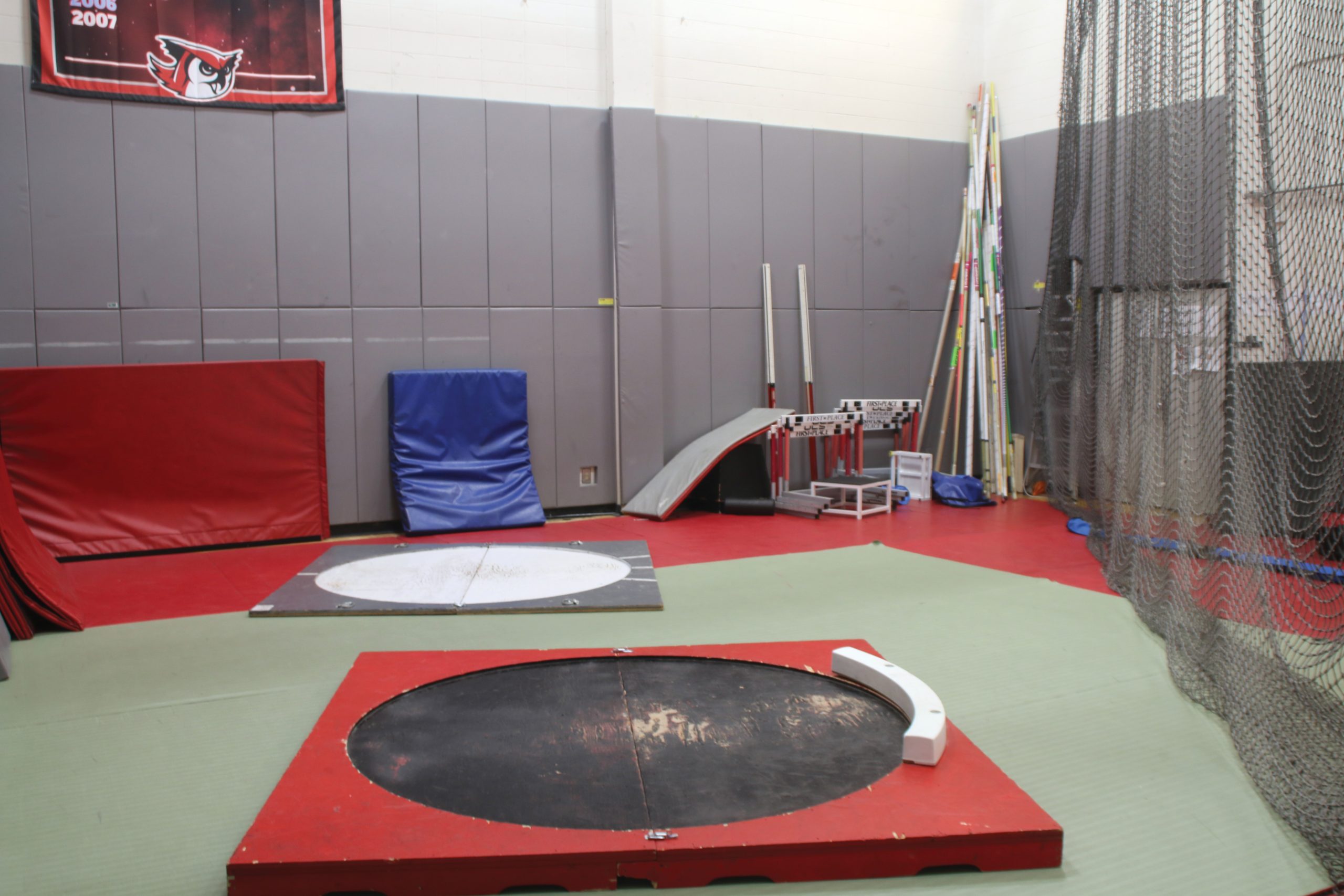
Responses ranged from complaints surrounding the limited indoor practice space to the increased risk of injuries because of the current state of the facilities. Additionally, responses detailed inconveniences with outsourcing their practices to Keene High School.
In total, 20 responses noted a general inconvenience or inconsistency that goes with needing to use the high school space along with the limited Keene State-owned resources.
Practicing at the high school in particular has proven challenging for some on the team. First-year sprinter Keith O’Donnell said in an interview that most people will carpool to get to the high school. However, sometimes it causes people to be left behind.
“We have run into a few issues with carpooling before where someone will get left behind. It happened literally yesterday [April 18] where someone got left behind,” O’Donnell said.
Scheduling conflicts, while O’Donnell said they are not common, do arise. During the winter season, there was one instance where the team had to make a few phone calls to the high school before they were allowed to practice.
In addition, first-year sprinter and jumper Logan Guillette said in an interview there were also issues previously revolving around students getting ticketed for parking at the high school.
“They got parking violations for parking at the high school. I think we did resolve that however, but we can only practice at five [p.m.] or later because we have to wait for them to finish up,” Guillette said.
For distance runners, they run to Keene High as a part of their warm-ups.
Multi and sophomore Eric Carlo said this year the team is more frequently utilizing the high school space than during his first year on the team.
“We’ve gone to the track pretty much every week for our pre-meet before we go compete on the weekends and I think that’s helped a lot of people improve their performance,” Carlo said.
Though the high school has been beneficial in some ways, Carlo said morale can decline based on its inconsistency.
“That added-on aspect of planning everything out, it takes away from some people’s motivation because it’s a lot of effort to get over there and train with other people,” Carlo explained.
However, Carlo said the shared experience of the lack of facilities also aids team spirit.
“Sharing a space with especially other athletes, I think it helps the team bond over [it] since we all [have] to do the same thing in the same place and [it] helps just to get stuff over with,” Carlo said.
As for other inconveniences, the use of outdoor resources can present difficulties. Distance runner, first-year Maya Wedge said that during the winter because of the cold they can only be outside for so long.
During cross-country season and outdoor track season, Wedge said rain can be a factor in whether they can use the cross-country course and surrounding areas. While she said it is her favorite out of the courses she has run, it floods and gets muddy.
“I know last year one of the girls got a concussion on the course,” she said.
Three responses to the survey said the current facilities had no large impact on them and three responses noted the outdoor throwing circles on Krif Road needed upgrades.
Two responses said the indoor practice area’s size was detrimental to them and two responses were not applicable.
Additionally, five responses specifically mentioned a risk of injury, particularly shin splints, stemming from the indoor surfaces they practice on.
According to the Mayo Clinic, shin splints are a common injury among runners where they experience pain along the shin bone. It is caused by overworking the muscles, tendons and tissues. The Mayo Clinic also notes that running on hard surfaces increases the risk of shin splints.
Cassie Cyr, former athletic trainer at Keene State, previously told The Equinox in an article published February 18, that she had seen a large number of track and cross country athletes come to her with shin splints.
“It definitely doesn’t help that we don’t have a track so they’re running on the suspension track or outside on the frozen ground pavement,” Cyr said at the time.
Guillette said he and other sprinters grapple with one sharp turn in particular on the suspension track.
“When we’re doing full-on sprint workouts, that can lead to a lot of either slowing down or even injuries when they hit that turn,” Guillette said.
In addition, Guillette said this has personally impacted him.
“I took a sharp turn and it put a lot of pressure on my leg so that bugs me a bit and then running on the concrete for a while does lead to a lot of strain,” he said.
As a jumper, Guillette said there is a difference between landing on a mat versus landing in a sand pit.
“We can’t do a lot without sand pits because we can’t really learn how to do the actual landings,” he said.
Besides issues with learning proper landing techniques, fighting for gym space is another issue he brought up.
“If we’re doing long jump run-throughs, there’s always the fear that someone’s going to miss a basketball shot and then we’ll end up tripping over the ball and injuring ourselves,” Guillette said.
After an ACL injury during her soccer season, first-year Allison Kenyon can’t run on the suspension track.
“I have trouble running on the oval track [suspension track] because it hurts my knee,” Kenyon said. “Instead of doing a run for warm-up, I actually have to cycle, so it was recommended that I don’t run up there.”
She said her strength and conditioning coach specifically advised her not to utilize the suspension track.
She noted her teammates also struggled with completing warm-up exercises because of shin-related injuries.
Getting creative
Recruiting without a dedicated facility has put coaches in the position to think creatively.
Bill Edson, assistant coach for throws, who also handles recruitment, said it is undeniable that some athletes may have been lost in the process, but the team still performs nevertheless.
“It does create an optic challenge for new recruits but once they realize that we never had a track and we have a history of bringing athletes to nationals at the highest level they realize ‘OK, well maybe that’s not such an issue,’ as far as considering our program, right?” Edson said.
Additionally, Edson said a dedicated facility may help athletes progress at a faster pace, but it is hard to tell concretely if it would cause athletes to perform better.
Dan Roark, head coach of the track and field and cross country teams, said a facility would help with recruiting, but said he thinks the program can be appealing in other ways.
“Our history, our coaching staff and our culture, I think those are the big three things,” Roark said. “But culture is a big thing … I think our culture is the best in the [Little East Conference] LEC and some of the best going forward.”
When it comes to other LEC schools, Westover said the University of Southern Maine (USM) is one of the program’s biggest competitors when recruiting.
“[USM] have an indoor track and if you’re a recruiter and you’ve got a kid coming to your campus and you show them the track and ‘Well, guess what we practice all winter in climate-controlled temperatures,’ … You know, obviously it’ll help their recruiting but I don’t want to take anything away from our athletes because they’re very resilient. They figure ways out,” Westover said.
According to USM’s website, the school is equipped with a 200m six-lane indoor track, which was built in 1998 but updated in 2018 and can accommodate 750 spectators.
In a March 27 email to The Equinox from USM’s Director of Athletic Communications Christina Cracolici, she noted the school, similar to KSC, does partner with a local high school during the outdoor season.
Currently, USM is edging out KSC in the LEC standings, but the two remain in close contention for the top spot.
Westover said KSC’s program has maintained success though, dating back to when he ran for the team in the 70s.
“Anybody that’s been around our program for any length of time will kiddingly tell you that [Keene State’s] home track is Baker Street,” Westover said, noting rows to the right on the street come close to matching an 800m loop.
Roark said with the success of the program, in its history, it has 11 national champions and hundreds of All-Americans.
At the end of the day they have been successful without a facility he said.
With the possibility of having nearly 90 athletes in the fall, Roark said he feels supported by the administration and is working towards making sure they can accommodate that large of a roster. When Roark started at the college in March 2022, he said there were around 30 athletes. Roark added that they just hired a new assistant coach in January and could hire more. Additionally, he said they would add to the budget and other resources at the team’s disposal.
“There might be some bumps in the road as you go, but I think we will be successful and find out some of those things as we go. But absolutely I think we’re prepared for the future,” Roark said.
Going forward
Despite previous failed attempts at constructing a facility for the team, KSC administrators are still working on making that dream a reality.
Marty Testo, director of athletics, said there have been continued conversations surrounding a facility since taking the helm of the department in the fall of 2023 and during his onboarding process.
“It’s on our radar. We’re always exploring ways to see what’s the best way we can bring this facility to the school, to the community and make it work. These type of facilities we’re talking about are quite expensive,” Testo said.
Testo kept the details of the conversations vague but said some topics included funding, exploring partnerships, potential locations and the type of facility that could be built.
Similarly, Treadwell said conversations surrounding a track facility for the college are also ongoing.
“It is one of my priority projects,” Treadwell said.
Treadwell said what could potentially make a difference since the last time the school went to the board is that KSC has been hitting all of its investment targets. Treadwell said when the time comes she plans to bring a proposal to the board with everything in order. This includes a potential partner, location and money raised for the project.
Treadwell said some locations are being considered for a track facility, one of which being on Roxbury Street at an old industrial complex in Keene. She said since the City of Keene is looking to develop that part of the city more, it would be a good spot for it. However, it is a brownfield, so the property would have to be remediated.
According to the United States Environmental Protection Agency, a brownfield is a property where it could be difficult to redevelop because of potentially hazardous contamination.
Treadwell said the idea is that they would remediate the land and not have to draw water from it.
“We could safely build a track structure above that and be a part of the city’s beautification on that side of town,” she said.
She said revitalizing that location would draw more people to the area and open up the potential for more restaurants near the site.
Additionally, she said the college was looking at other locations in Keene and even slightly outside of Keene.
Treadwell said she hopes to have it accomplished in the next few years.
Tim Bruns can be contacted at
Nathan Hope can be contacted at