

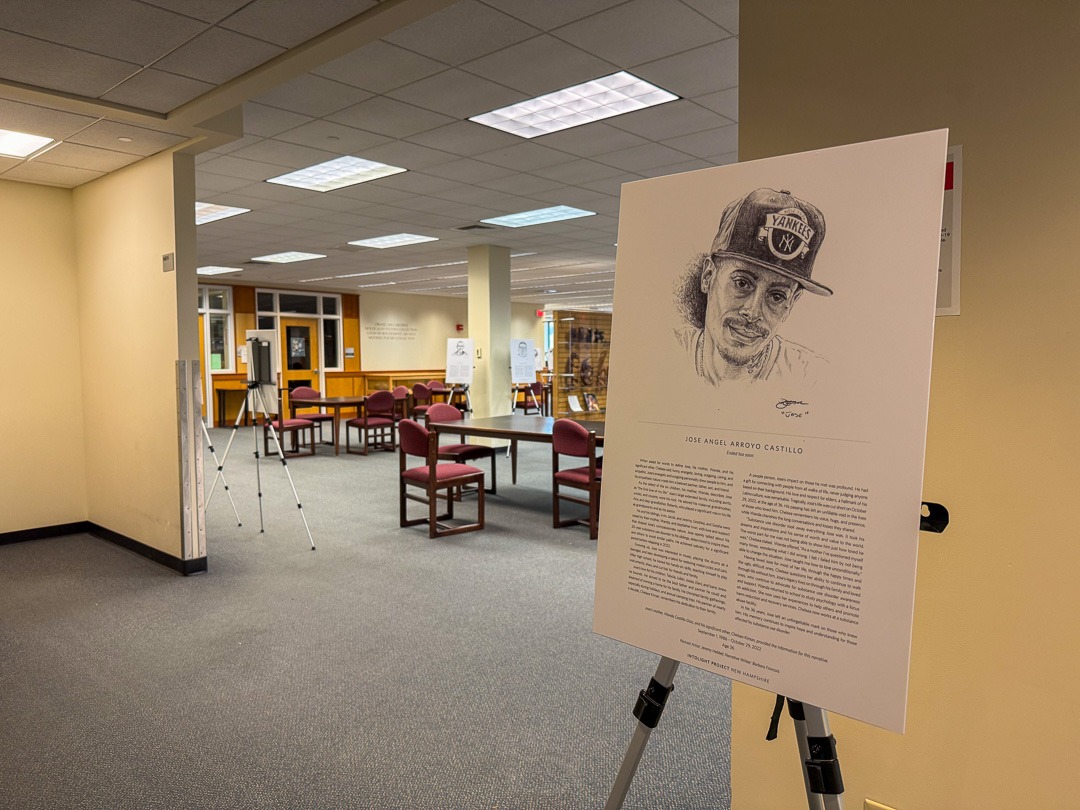


Students and faculty filtering in and out of the Mason Library this past week may have come across the various displays of hand-drawn portraits with stories accompanying them that are currently occupying the right wing of the building. Those who stopped to take in these displays know that they are not random; they are part of a structured exhibit provided by the Into Light project to display the faces and stories of people who lost their lives to drug addiction.
Into Light is a national non-profit organization founded by North Carolina-based artist Theresa Clower after she took to portrait work to process her grief when she lost her son to a fentanyl overdose. According to the project website, “Each INTO LIGHT Project exhibition—Drug Addiction: Real People, Real Stories—consists of 30 original graphite portraits of people who have died from drug addiction in the state where the exhibit is held. Each portrait is accompanied by a professionally written narrative about the lives of the individuals in the exhibit.”
Margaret Smith, professor of Health Sciences with a specialty in addiction, has worked at Keene State for 26 years. Smith assisted in the process of bringing Into Light to campus and spreading the word of the exhibit through email alongside Assistant Dean of Students Kat Dougherty and Senior Coordinator of Student Involvement Emily Alexander.
“My previous job before coming to campus was an addiction counselor and prevention specialist,” Smith shared. “When working with clients and teaching about addiction, it’s amazing how much misinformation, stigma, discrimination and prejudice there are for people who have addictions.”
“I think oftentimes people think of it as a choice or a willpower issue,” Smith continued. “And I’m hoping that with attending Into Light [in the Mason Library], as well as reading information from the National Institute on Drug Abuse or National Institute of Alcohol Abuse and Alcoholism, that people can learn more about addiction and the fact that it’s a chronic disease.”
Smith spoke on how stigma and misinformation surrounding drug addiction have fatal consequences for those afflicted. “Discrimination, prejudice and stigma all contribute to abuse and addiction in and of itself,” Smith said. “If you have an addiction, the messages that you hear about people with addiction can lead to you internalizing and feeling worse about yourself. The more hopeless you feel, the more likely you are to continue using substances.”
Smith spoke on why it often proves hard for people to foster empathy for those with addiction. “It’s multiple things. Sometimes people grow up in it, and it can be very hard for them to deal with. There’s also not enough information about how it is a brain disease. But really, I do think that people often think of addiction as a choice, and think a person with an addiction is just making bad choices.”
“If someone were to start the use of alcohol, other drugs or gambling, for example, the initial use might be a choice, like ‘oh, I’m just going to try it,’” Smith said. “But usually that happens in young adulthood when the brain isn’t fully developed.”
“If there’s a predisposition to addiction or other circumstances, they might develop an addiction,” Smith continued. “People think of that as a choice, when it’s actually a disease. Once the brain’s reward center gets hijacked by alcohol or other drugs, a person has a relapsing disease. It’s just like other health conditions where people relapse.”
“People think, like, ‘How can someone do all that stuff to themselves and then have it affect family, friends, work and community?” Smith shared. “But I don’t think anyone gets up in the morning and says, ‘Gosh, I feel like being an alcoholic or an addict today.’”
Smith said learning about addiction in the wrong way and the lack of education people receive about how to help someone with an addiction contribute to a fundamental misunderstanding of addiction as a disease, but education alone cannot bear the weight of helping those with addiction and eradicating stigma.
“There has to be changes within the community, changes within the states and the country in terms of policies, laws, rules and public opinion,” Smith said. “Sometimes we think we’ll just educate people and then everything will be okay, but many of us know things about alcohol, cigarettes, drugs, etc. and yet we still do them. Education is an aspect, but there needs to be a bigger approach to helping the issue of addiction within society.”
“I hope [those who attend the Into Light exhibit] see how human the people in those pictures are,” Smith said. “I hope it touches them. Oftentimes when we say someone died of an addiction, that’s all we say. People say ‘that’s the alcoholic, that’s the gambler, that’s the addict.’ We forget that this person was a whole person. They had a life and a family and a career, and they were bigger than their addiction. That’s what I hope people will see–the humanity of the people in those portraits so they are able to walk away and think and talk differently about addiction.”
Celia Rabinowitz, assistant vice president of academic engagement and director of the Mason Library, spoke on hosting the project on the first floor of the library. “When Emily Alexander, Margaret [Smith] and Kat Dougherty from the Dean of Students Office sent me the email, I was really excited about it.”
“I really think of libraries and our library here as a sort of community space. I wanted to know how many portraits there were and about how big [they were] just to see whether it was something that we could support in the space that we have.”
“The nice thing about it being in the library is that people might come here intentionally because it’s here to look around and see it. We’re open seven days a week, and we’re open really late at night for the students, but on the weekends for other folks. There’s a lot of access here that there wouldn’t be in other buildings on campus that close at 4:30 in the afternoon.”
“But I also think because of where the exhibit is, students are coming in and out. A lot of students are walking through to go to the Cohen Institute for classes, and even if they didn’t know the exhibit was here, they’re going to see those portraits as soon as they walk in.”
“That’s something that I like that libraries do a lot,” Rabinowitz continued. “We sometimes call it ‘serendipity.’ Let’s say sometimes you go up to look for a book in the bookshelves, but you stop for a second and look around on the shelf and spot something even better. I think our students in particular probably encountered the exhibit without knowing they were going to.”
“You can interact with [the exhibit] as literal or as much as you want,” Rabinowitz said. “If you find yourself really emotionally affected by it, you could maybe look at one or two, then leave and come back and look at some more. But I have seen people walk through and be very deliberate about looking at every single one.”
Rabinowitz praised the portraits in the exhibit. “They’re just beautiful.”
“When we were putting the exhibit up, a student actually came in and we had a portrait of his uncle on display,” Rabinowitz said. “I think one of the things that people don’t think about is that there are people here who are a part of our community that know some of the people [in the portraits].”
“Often the way [people with addictions] are identified is by the condition they were in at the point where this terrible thing happened to them,” Rabinowitz said. “These are portraits that remind us that these people were people.”
Rabinowitz remarked that in examining the portraits, she observed that a lot of the men in them have baseball caps.
“The descriptions were written by their families. I think the intent is to remind people that these are people across different age ranges that were at different points in their lives. They were parents, they had jobs, they were students. This terrible disease affects a lot of people in lots of different ways,” Rabinowitz said.
“I think especially for college students, if you grew up in an area of being sent these messages in school, there’s a message that’s delivered here, but it’s delivered in a much different way, and I think in a way that helps us think differently about people who are grappling with this disease.”
Access Services Manager of the Mason Library, Jeff Kazin, sees people go in and out of the space Into Light currently occupies in the library each day while doing work at the front desk.“I think it’s a moving display,” Kazin said. “I hope it will get people thinking about addiction as a disease.”
“Going in and seeing the portraits and reading the stories…I myself find it hard because you know that these people have passed,” Smith shared. “But it’s also kind of beautiful to be able to read about all the positive things in their lives. All the things they loved and the people they loved–all of it.”
“Somebody used the word ‘moving,’ and as somebody who has worked with addiction, who teaches about addiction, that just touched me so deep in my heart,” Smith continued. “I hope it touches other people as well.”
Serena Taylor can be contacted at
staylor@kscequinox.com