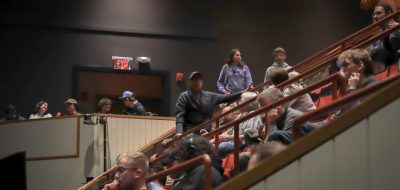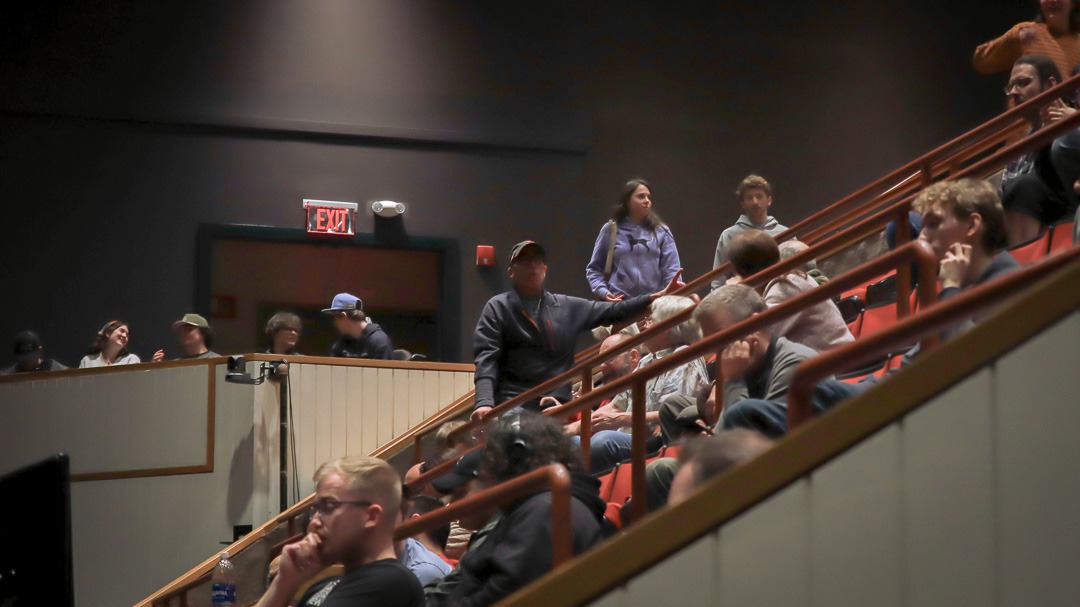



From the director of the Redfern Arts Center at Keene State to an audience member all the way from California, viewers of the silent film “The Cabinet of Dr. Caligari” said the movie’s impact on them makes up for its lack of sound.
On Wednesday, Oct. 21, The Anvil Orchestra played the score for the 1920 German silent film “The Cabinet of Dr. Caligari” as part of the Redfern Presenting Series. The Anvil Orchestra is an ensemble with members Terry Donahue and Roger Clark Miller. According to their website, they are based in southern Vermont, perform live scores for silent films, and also compose scores for various other films.
Donahue said they stumbled upon this line of work “completely by accident.” He described how they started when a film programmer was looking to score the film “The Cabinet of Dr. Caligari”. According to Donahue, they had previously been working with disco rock artists like Freddie Mercury, but “didn’t think disco rock was appropriate for a 1920 German film.” Donahue said he and some friends were asked to play the score of the movie, so they put together something for it.
Donahue said the first night there were 50 people there, the second night there were about 150 and the third show was sold out with 650 audience members filling the seats. He said that is when they knew they were onto something.
Donahue said that a few months later they sold out three shows, and even started looking for other movies to accompany. From there they played all over; Donahue mentioned places like Finland, Slovenia and the Louvre.
“Some films are more specifically scored, and some are less specifically scored,” Donahue said about how the pair go about their performance. He added that the first time they accompanied “The Cabinet of Dr. Caligari”, it was live. He explained how they had each watched the film on their own and during the performance just “played off of each other and off of the scenes…it was magical.”
Even for the more specifically scored films, Donahue said, “We are always slaves to the scene.”
Donahue said that personally, as a drummer, he always felt like he was “something more,” and could play harmonies and melodies too.
Miller said he has a different path that led him to this career, because he originally started by playing accompaniments for a dance company his girlfriend at the time was a part of.
Miller said that he is mostly known as a guitar player and has multiple albums. He was in a rock band in 1969 when he was only 18, and played guitar for them. He said that the album he made with that band is “very psychedelic and trippy.”
However, Miller said he plays the keyboard in his little ensemble and even included some piano in his solo album that is mostly guitar.
Miller also mentioned how when he and Donahue perform the score of “The Cabinet of Dr. Caligari”, they improvise everything. “I don’t have a single note to look at,” Miller said.
“It was great to see early stages of cinematic history alongside live music,” said first-year film major Jackson Davis, who attended the Redfern performance. “Truly an astounding performance.”
Karin Hauck, who is from California but was visiting a friend in Connecticut, said she used to be Donahue’s girlfriend. She said they lived together for 12 years, but it was a long time ago. She added that attending the performance was like “a little family reunion,” as she was accompanied by her sister-in-law and brother.
“The set design was so cool! It was trippy with all the curlicues,” said Hauck.
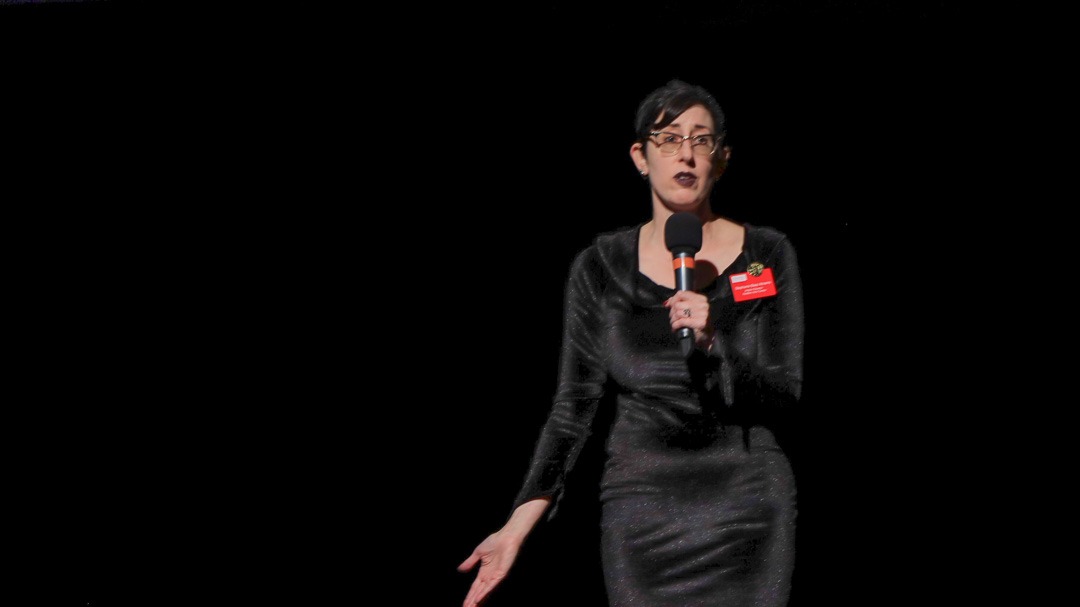
Before the performance, Redfern Artistic Director Stephanie Bass Abrams said that the film was very important to her because it heavily influenced her as a teenager. “I was a mime and circus artist in my career, and I started doing that when I was 13,” Abrams said. “I was already studying mime and was very into physical theater and silent storytelling.”
She said that is how she found an interest in silent movies; she liked “studying mime from a silent acting perspective.”
“I found it fascinating the expressions the actors would use; there’s very detailed technical training on it,” said Abrams.
She said “The Cabinet of Dr. Caligari” was one of the first horror movies ever made, “and the acting style, specifically for that genre, is so overdramatic but yet it comes across as being very eerie.”
Abrams said she is also interested in what was going on in Germany at the time the film was made. She explained how even though people may think there were a lot of old-fashioned values back then, that is not exactly true. She said at that time “there was a lot of risk-taking happening,” such as more horrific or provocative scenes being shown in films.
Abrams also described how Tim Burton took a lot of inspiration from films like “The Cabinet of Dr. Caligari”. This resonated with her because, as a child, she said she loved films like Tim Burton’s Batman and Beetlejuice. She also said she saw Cesare, a character from “The Cabinet of Dr. Caligari”, reflected in Edward Scissorhands, a Tim Burton character.
Abrams mentioned that the Anvil Orchestra did a workshop prior to their performance, where students got to learn about the performers and ask questions.
“All the students got to come up on stage and experiment with various instruments,” she said. “The students actually got to work hands-on with the performers.”
She mentioned how The Anvil Orchestra told the students how they mostly improvise the score when they accompany “The Cabinet of Dr. Caligari”, and “the students were pretty impressed by the whole concept.”
Abrams mentioned how back in the early 20th century, silent films would not be scored. When they were shown in a theater, there would always be a live organist or someone like that who would play live, so it was different every time. “Live music was always part of that experience, but we don’t get to experience that anymore,” Abrams added.
“Our goal and mission with the Presenting Series is not only to draw in the students, faculty and staff from campus, but also to have people from our community,” Abrams said. “People of all different walks of life come here to engage and experience the arts. Whatever draws them here for various reasons is always really interesting to explore.”
“Everyone I’ve spoken to so far that has come to the performances felt really inspired,” Abrams added.
Alex Perry can be contacted at
alex.perry@keene.edu