

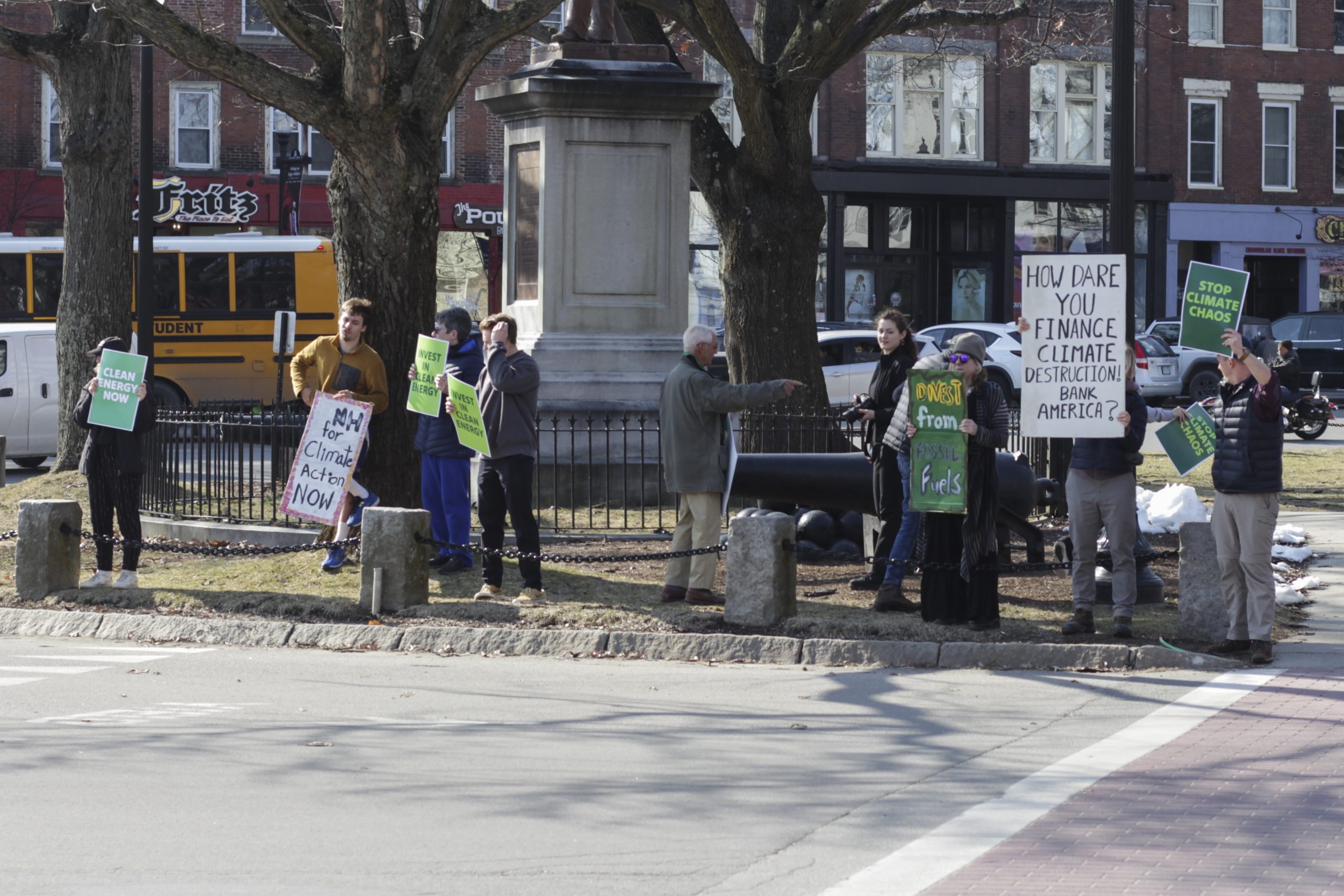
Car horns honked in support as nearly 40 protesters from the Keene area gathered in Central Square to protest banks’ investments in fossil fuel companies.
The protest, held on Tuesday, March 21, was part of a national day of action by Third Act, a climate activism group that mobilizes those over the age of 60 to advocate for renewable energy. Associate Pastor Robert Grabill of the United Church of Christ in Hanover, N.H. said he was encouraged to see people of all ages gathering for the cause. “This is billed as a Third Act demonstration…but I love the fact that we have college students here as well because it’s coalition building across all ages that I think is a sign that the climate movement is strengthening,” Grabill said.
Grabill explained how his role as a pastor informs his activism. “Climate justice is the work of the church and I think that the church can be very effective,” he said. “The Bible is very clear. Everyone gets welcomed, love your neighbor…love your neighbor means love your planet as well.”
Keene State Environmental Studies Professor Karen Seaver brought students from her senior seminar class with her. One of Seaver’s students, senior Taylor Cilley, said she came to spread awareness.
“There are four banks in America that are funneling billions of dollars into fossil fuels, so right now we’re trying to get more people aware of that,” Cilley explained.
“Not a lot of people know how these banks, how these large corporations have the power that they do. They don’t understand how much money is being funneled into fossil fuels and how they’re funding that by having banks with them,” Cilley said.
A Banking on Climate Chaos report from 2022 compiled by various climate groups named four American-based banks atop their “Dirty Dozen” list of fossil fuel contributors. The four banks were JPMorgan Chase, Citi Bank, Wells Fargo and Bank of America. The report shows the four banks’ combined contributions account for over $1.1 trillion since the 2015 Paris Climate Agreement. Senior Brendan Dana also attended the protest and said that he hopes banks will divest from fossil fuel investments. “Right now, we just want to see them, if they’re out there investing our money…we just want them to be investing it in stuff that’s not detrimental to our planet,” Dana said.
Following the demonstration, attendees were encouraged to gather around the gazebo bandstand and listen to three speakers give speeches, calling for renewable energy use. Seaver was one of the three, and she encouraged attendees to “vote with your dollars” as a way of showing disapproval against banks and corporations that invest in fossil fuels.
Co-owner of RGBC Associates and EMF Inc. Bethany Caldwell also spoke on the bandstand about how she was able to transition her businesses to solar energy. “We’re convinced that what we do about our carbon footprint is more important than what we say,” Caldwell said. She went on to explain how tax credits and the financial benefits of installing solar panels on her business and home made the transition easier. “[The credits] act as a deferred discount on the total project cost, and when you do a
large solar project, it adds up a lot,” Caldwell explained.
The rally took place directly adjacent to Bank of America’s Keene location, which co-coordinator of the protest Matthew Boulton made note of in his speech. “What we’re saying to Bank of America – everybody wave to Bank of America – is no more funding of fossil fuel projects,” he remarked.
Boulton listed three demands toward Bank of America: No new fossil fuel projects, a public plan to unwind involvement from current projects and to increase investment in renewable energy.
“The world will be run by renewable energy in the end, by 2100 it will all be renewable, my question is, will we do it fast enough to save the ecosystems we care about, the people we care about?” Boulton asked.
Nathan Hope can be contacted at
nhope@kscequinox.com