

In 2020, an estimated 23 percent of college students experienced food insecurity, according to the U.S. Government Accountability Office’s (GAO) analysis of the Department of Education’s National Postsecondary Student Aid Study (NPSAS). The number represents roughly 3.8 million food-insecure students nationwide, with 2.2 million experiencing “very low food insecurity,” meaning there were multiple instances of students eating less than they should or skipping meals because of an inability to afford food, according to the GAO’s analysis.
The NPSAS is typically conducted every three to four years, with the most recent data coming from the 2020 survey, which saw a participation of 100,460 students, of which 80,760 were undergraduates.
Some advocates for expanded resources and services to address food insecurity on college campuses referred to the results as “sobering,” such as The Hope Center for Student Basic Needs at Temple University in Philadelphia.
“Unfortunately, the data in many ways confirm what we know: rates of food insecurity are unacceptably high across the country, particularly among marginalized populations and students attending underserved and underfunded institutions,” stated a July 25, 2024, article posted on the center’s policy and advocacy website.
Nestled in rural southwestern New Hampshire is Keene State College: a small, regional public liberal arts institution with an undergraduate student body of 2,718, according to data released in the college’s 2024-2025 Factbook. The Granite State ranks last in the U.S. when it comes to higher education funding, according to a 2025 analysis by the New Hampshire Fiscal Policy Institute, which showed the state appropriated $4,629 per full-time student. The institution arguably fits the framework of “underfunded” as laid out in the Hope Center article, which leads to the question: how much of an issue is food insecurity at KSC?
While data relating to KSC in particular is limited, a 2019 survey of 371 students, which represented approximately 10% of the student body at the time, showed 36% of respondents reporting that hunger had impacted their academic performance. Forty-seven percent of respondents said they would consider taking advantage of an on-campus food pantry.
On-campus food pantries have become a widely implemented resource in recent years, with many colleges providing nonperishable food offerings at no cost to their respective campus communities.
In 2017, KSC started its own on-campus pantry: The Hungry Owl. In the eight years since then, much has changed at the pantry — notably, The Hungry Owl has moved locations twice, now being situated in the heart of campus next to the Bookstore on the first floor of the L.P. Young Student Center.
The pantry has also since added online ordering via Google Form, satellite locations across eight campus spaces and introduced fresh produce, refrigerated items and hygiene products to its weekly stock, according to previous reporting from The Keene Sentinel.
Senior Coordinator of Student Involvement and Well-Being Emily Alexander, who has overseen day-to-day operations at The Hungry Owl since the summer of 2024, said the resource continues to be a critical way for the college to combat food insecurity.
“People in general are maybe less likely to, or sometimes resistant to using community resources because they don’t want to take from somebody else who might need them, even if they’re not and there’s plenty to go around,” Alexander said. “Having an on-campus food pantry removes some of that stigma that people might feel of going and accessing free food and resources, especially because it’s peer-run.”
Currently, The Hungry Owl has nine to 10 student volunteers, which Alexander said is sufficient to meet the operating needs of the pantry, with two volunteers typically present during open hours at each shift.
As of the fall 2025 semester, the pantry’s student center location is open for eight hours each week, split up into two-hour shifts on Monday, Tuesday, Thursday and Friday.
Alexander said the shift times were created based on historic peak traffic periods and as a way to ensure students would almost always have a time when they could stop in and pick up food.
As part of her duties in overseeing the pantry, Alexander shops and stocks food for The Hungry Owl – purchasing from grocery stores and local farms, as well as picking up the pantry’s monthly delivery from the New Hampshire Food Bank.
A portion of the funding that keeps the pantry stocked runs through the state’s most recent NH Feeding NH grant, which is run out of the state’s food bank. The grant seeks to help the food bank’s 308 partner agencies supply locally grown fruits, vegetables, dairy and protein throughout the state, according to the food bank’s website.
The current grant that The Hungry Owl is utilizing began in May but is slated to end on Dec. 31, Alexander said. In addition to the grant, the pantry has a gift fund for monetary donations made out to The Hungry Owl.
“We don’t have a consistent source of funding through the college, so it does cause some stress knowing that we don’t have – unless people are donating and we’re fundraising – we don’t have that constant stream of income guaranteed year-to-year,” Alexander said.
Though consistent, reliable funding remains a challenge for the pantry, Alexander said another issue, the accessibility of its main location, has been alleviated.
Toward the end of the summer and the beginning of the fall semester, The Hungry Owl moved its main location from the Joslin House to the L.P. Young Student Center. The move came as a result of the college leasing the Joslin House space to Granite Valley Preparatory, a public charter high school. In addition to the pantry, the building was also previously used to host classes within the Health Sciences Department.
Since the pantry’s move to the student center, the number of shoppers has nearly doubled from 362 in the fall of 2024 to 720 thus far in the fall of 2025, according to data shared by Alexander on Nov. 10.
The pantry also tracks the number of pounds of food distributed each semester, which shows a nearly 34 percent decrease in pounds distributed, though Alexander attributes this to the pantry’s lack of “produce pop-ups,” a previous fixture of The Hungry Owl where volunteers tabled in and around the student center and gave away produce.
Alexander said the pantry stopped the pop-ups as a result of only receiving 1/4th of the grant funding from the NH Feeding NH grant compared to its previous cycle.
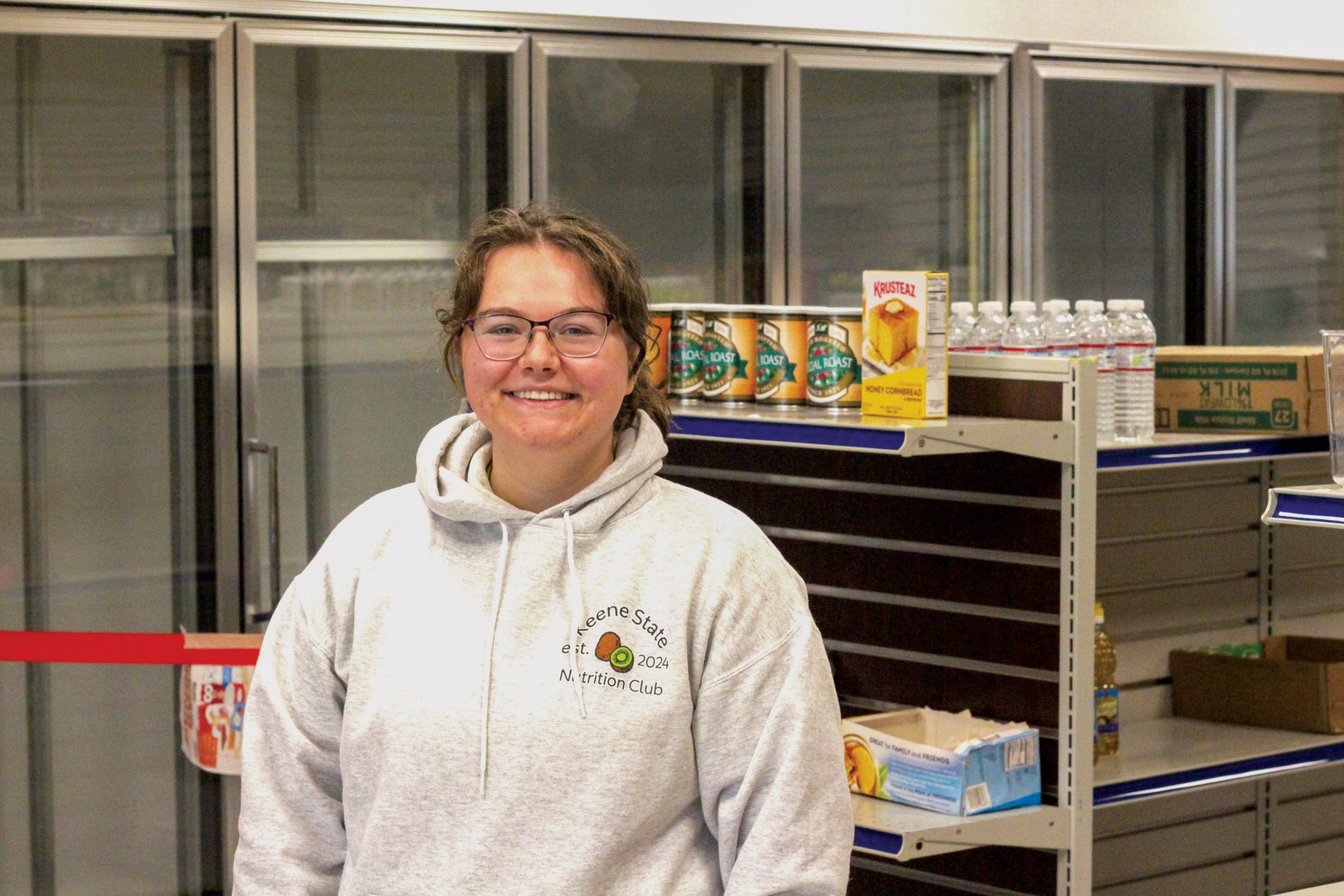
Senior Grace Baldwin, a student employee of The Hungry Owl, described the impact of the location change.
“Everybody walks past us every day,” Baldwin said.
Although the pantry’s physical visibility has increased, Baldwin said making its presence known is something that the team constantly works on.
“Even now, it’s November and I have people come in saying, ‘Hey, this is my first time,’” Baldwin said.
As part of her weekly responsibilities, Baldwin stocks the campus’s satellite locations along with a separate student volunteer. Recently, Baldwin said a refrigerator was installed as part of the Mason Library’s satellite location, which will allow her to stock produce there.
Baldwin also spoke about her interactions with students who utilize the pantry.
“They’re just like normal students. If you look at them, you can’t tell that they’re food insecure,” Baldwin said. “Some of them probably aren’t extremely food insecure – they [may] just need a couple extra things for their groceries and they come in and get it.”
A 2022 graduate of the University of Wisconsin-Madison, Baldwin said she went back to college at KSC to pursue her passion for addressing food insecurity.
In addition to her role at The Hungry Owl, Baldwin also works with KSC’s chapter of the Food Recovery Network, a national nonprofit organization that seeks to mobilize campuses to reduce food waste by recovering perishable food leftover from catered events.
The college’s chapter is relatively new, having begun in the fall 2024 semester and conducting its first recovery in February.
According to publicly available numbers on the nonprofit’s website, the KSC chapter conducted a total of five food recoveries in the spring semester, totalling 167.25 pounds of food, the vast majority of which was pizza. The numbers also detail that the chapter has $320 of available funding that lasts from July 1 to June 30, 2026, with $300 of that funding from the national organization.
KSC community members can sign up for notifications on a Microsoft Office Form to see when recovered food is delivered to The Hungry Owl or to volunteer with the chapter.
KSC Sustainability Coordinator Kate Witte serves as the advisor to the chapter and discussed how her positions intersect with each other.
“Obviously, I care a lot about food waste, but I also care a lot about people and so it’s sort of combating those two issues [food waste and food insecurity] at the same time,” Witte said. “[By] working with Chartwells, we are able to reduce food waste because we’re keeping food out of the compost and then also sending that food to students.”
Chartwells is the contracted dining service provider for KSC, so working with the company and the local leadership is crucial to conduct food recoveries, Witte said.
However, due to administrative and staff turnover this semester, the chapter has been unable to conduct any food recoveries, according to Witte.
“Continuity of staff is really important because people have to know that the program’s in place know to save the food and there were also some changes from Chartwells nationally, as a corporation, because so many other colleges and universities are getting into food recovery,” Witte said of the challenges.
Witte said Chartwells has recently introduced a liability waiver and “clear rules” for food recoveries on campus and the chapter has been working to figure out how best to move forward given the change.
“I’m hoping moving into the next semester we’ll actually be able to start doing more of the recoveries,” Witte said.
Witte added that liability is traditionally an obstacle for food recoveries generally, with companies sometimes shying away from participating or partnering with food recoverers due to concerns around food safety. Witte said students who work with the Food Recovery Network in particular have to be ServSafe certified, meaning they have to know the basics of food safety, to participate in the work.
Another obstacle Witte is seeking to solve is the chapter’s current lack of student volunteers.
Currently, there are three paid student recovery leaders, but no additional volunteers with the chapter. The KSC Sustainability Office posted a call to attract potential volunteers in an Oct. 3 Instagram post, but Witte said she has seen little interest so far from potential student volunteers.
“I don’t think social media has been a great outlet for us to recruit volunteers or to let people know about the food availability. I think word of mouth has been much more effective,” Witte said.
Witte said volunteering is important to keep the chapter’s work going.
“Food Recovery Network is a great way to volunteer and to help your fellow students on campus access ready-to-eat hot meals,” Witte said.
Regional Director of Operations at Chartwells Bobbie Walker said the KSC Dining team will prioritize working with the Food Recovery Network chapter going into the spring semester, now with a new Director of Dining Services, Sam D’Angelo, at the helm.
“I know [D’Angelo] has time over the winter break to plan for the spring semester [to] put this on our top priority list for next semester to make sure we connect any dots that we need to and make sure that that [Food] Recovery Network program can continue,” Walker said.
Nathan Hope can be contacted at