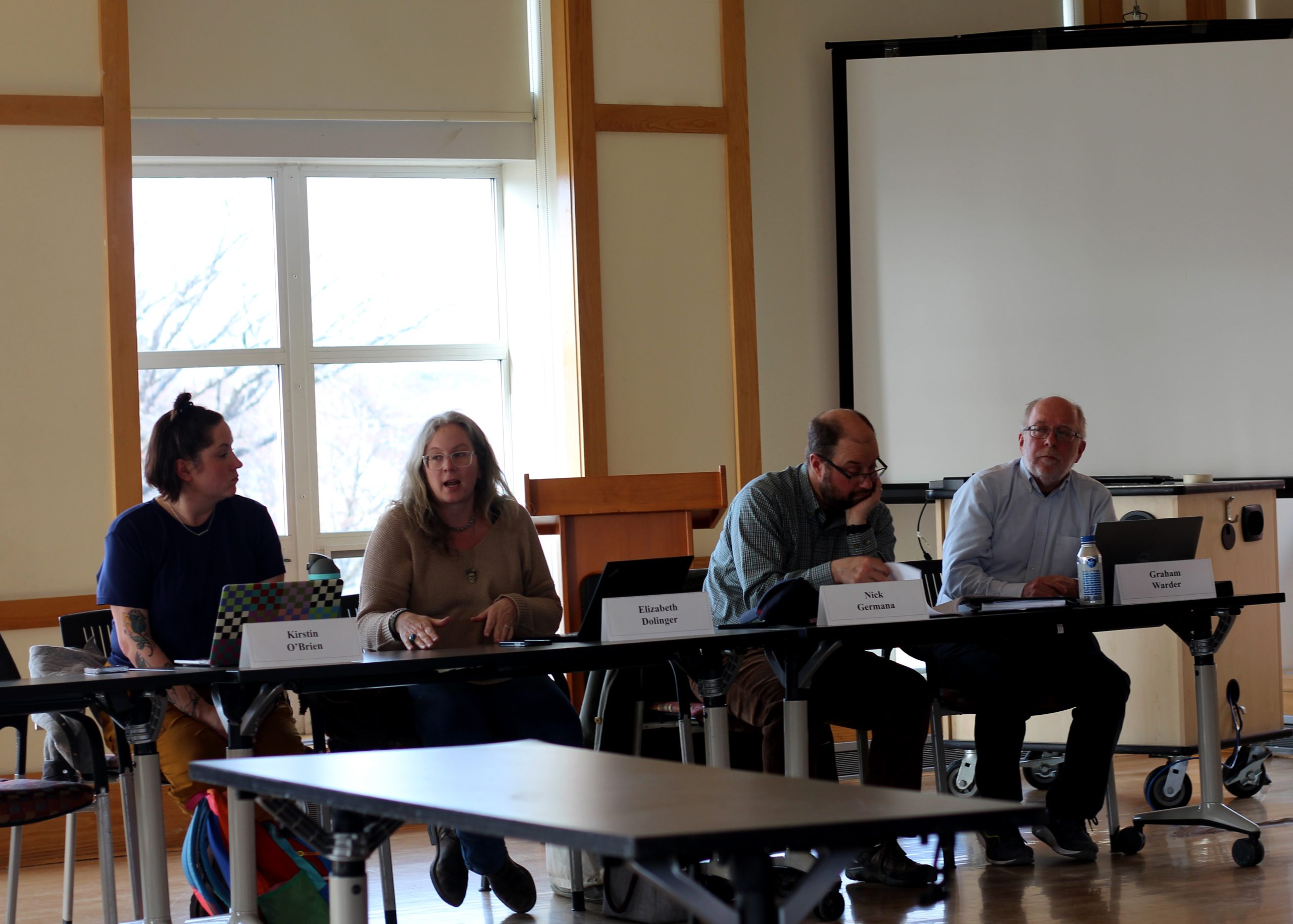
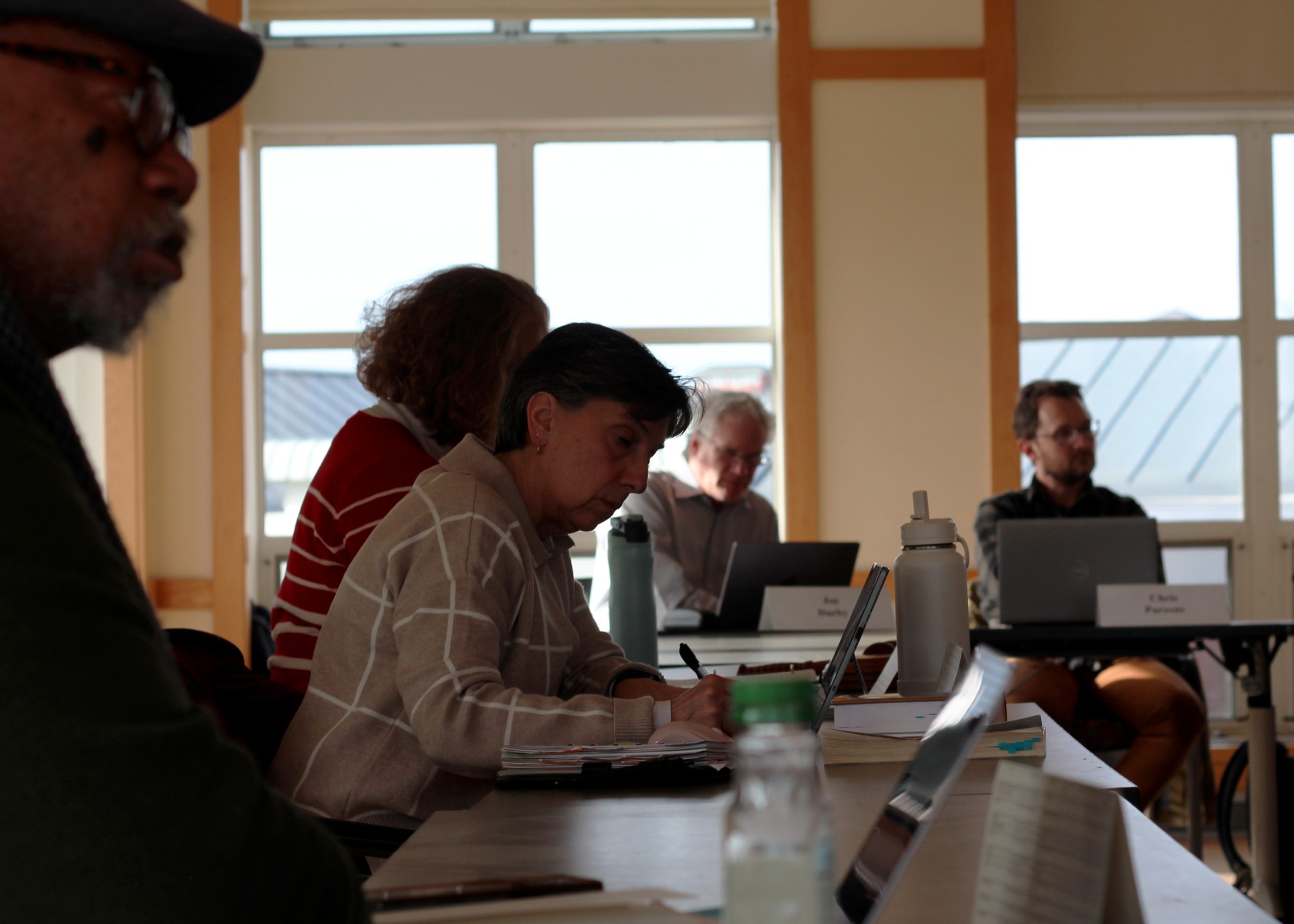


The Keene State College Senate voted 15-5 to approve revisions to the 2025-2026 bylaws, which govern the body, as well as voting unanimously to approve the revised academic program review guidelines and calendar.
At the senate’s regular monthly meeting on Wednesday, March 12, senators discussed the proposed bylaw revisions that had been brought forth at previous meetings. These revised bylaws include a subcommittee restructuring and changed language regarding who may serve as chairs of the subcommittees, according to previous reporting by The Equinox.
Discussion of the revised bylaws reached the 15-minute maximum, then requiring a vote or a motion to continue the discussion. No such motion was made. The vote on the revised bylaws was conducted by ballot as called for by Associate Professor of Mathematics and Senate Chair Karen Stanish. A request from Carle Hall Community Director and Senator Isabelle Handy for a roll call vote, which would have required each senator’s name to be recorded in the meeting minutes alongside their vote, failed in a separate vote.
During the discussion period for the revised bylaws, some senators raised concerns about details and proposed friendly amendments to fix them. One friendly amendment from Professor of Communication and Philosophy and Senator Amber Davisson changed the description of ex-officio positions held on both the newly merged Academic Policy and Standards Committee (APS) and the newly formed College Wide Academic Policy Committee (CAP) from “representative from the Provost Office” to “Provost Appointee” with consideration to the number of staff members the office has available. Another friendly amendment, also from Davisson, created an ex-officio position on the CAP for the director of the center for research and writing in the Mason Library, a role currently held by Professor of Communication and Philosophy Kate Tirabassi. Both friendly amendments were accepted and added to the revised bylaws, effective immediately.
One of the other bylaw revisions that sparked discussion was the change requiring senate committee chairs to be tenured full-time faculty members. The senate body currently consists of both full-time and adjunct faculty, as well as staff members and students.
Senior and Senator Jacob Favolise, who serves on the senate executive committee (SEC), said he was the only voting committee member out of four total to oppose the revised bylaws. He said that although he believes each senator who supports the bylaw revisions has a good-faith rationale for doing so, he held concerns about how the new requirements surrounding chair eligibility would impact the unique strength and diversity of the senate and its opportunities for leadership.
“I am incredibly proud to have served the past three years on this body on equal footing with faculty and staff colleagues and my fellow student colleagues,” Favolise said.
Favolise added that many college senates have far less student representation than KSC’s senate.
“I hope that I have the opportunity in … a month and a half now to leave behind a senate with just as many opportunities for student, staff and faculty members, tenured, full-time or otherwise, to be elected to leadership positions, whether as the chair of a subcommittee or chair of the senate.”
Professor of History and Senator Nick Germana responded to Favolise’s comments, referencing his own past as a KSC student who served on the senate for three years.
“I fought for more representation in the senate. Back then, we had two student senators … I was deeply engaged in those battles when I was a student,” Germana said. “I was really glad when I came back here as a faculty member to see that more had been done to get more representation on the senate.”
Germana concluded that, “having seen it on both sides” of the issue, he maintained his support for the bylaw revisions.
Professor of History and Senator Greg Knouff raised a question about how the upcoming senate election process will proceed following the restructuring provided in the revised bylaws. Stanish answered the SEC would discuss the matter at the committee’s next meeting.
Knouff, as the chair of the Academic Policy Committee (APC) that has now been merged into the ASC, also brought forth the motion to approve the revised program review guidelines and calendar.
According to the program review handbook found in the senate’s agenda packet, “The purpose of the Program Review Process is to periodically evaluate programs, assess quality and determine support needed as we strive for excellence, and align curriculum/services to the Strategic plan … Program Review entails self-analysis by members of the program, external peer review and an analytical response from the administration.”
Additionally, Knouff clarified the role the committee took on in revising these materials.
“This was brought to us because this review procedure goes through the senate, but [neither] APC nor the senate have any oversight of how academic program review is conducted,” Knouff said. “We just have a say on how the guidelines were articulated.”
Davisson raised a concern about the lack of review taking place for college-designated courses lacking a specific program, including independent studies, teacher assistant work and first-year seminars.
“At this point, we have a KSC course that, unless you’re a transfer student, functionally every single student on this campus is required to take, which makes that a pretty big impact academically, and we have no place to my knowledge that is being reviewed,” Davisson said. “I know that we just moved KSC courses under [the CAP]. Is that committee going to be responsible for program assessment, and how is that happening?”
Knouff said KSC courses were not part of the APC’s discussion of the revised program review materials. Stanish confirmed the SEC will be responsible for charging the CAP with clarifying the review process for KSC courses next academic year.
Charlotte King can be contacted at
cking@kscequinox.com