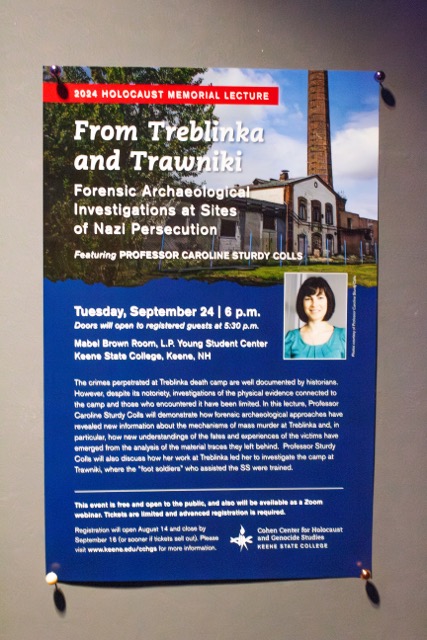
The 2024 Holocaust Memorial Lecture, an installment of KSC’s “Forensics and Genocide” lecture series was held on Tuesday, Sept. 24, at the L.P. Young Student Center’s Mabel Brown Room. The guest speaker, University of Huddersfield Professor of Holocaust Archeology and Genocide Investigation Caroline Sturdy Colls, was brought to New England from the United Kingdom via a joint effort of KSC’s Cohen Institute for Holocaust and Genocide Studies and Salem State University’s Center for Holocaust and Genocide Studies. Sturdy Colls gave a lecture at Salem State on Thursday, Sept. 26.
Sturdy Colls’ lecture discussed the use of forensic archeological approaches, and how these approaches have led to better understandings of the Treblinka extermination camp, as as the Trawniki training camp. “A lot of the work I do is looking at sites that have changed dramatically since the Holocaust. These days, unless you know what you’re looking for, there’s often very few physical traces of buildings or graves, which indicate that there may be buried or hidden remains nearby,” said Sturdy Colls.
“As archeologists, we’re always looking for subtle traces that may clue us in to where these structures and remains may have been. We have advanced and modern techniques available now that help us to detect those remains,” added Sturdy Colls. Sturdy Colls said that forensic archaeology and research can help expand the understanding of sites of persecution that haven’t been preserved to the same degree as others.
“Many of these sights fell into obscurity, and the traces were overlooked, sometimes deliberately. There’s still more evidence left to find, and so much more buried remains that have been forgotten and yet to be found. That’s where archeology can make such an important contribution to filling the gaps in the historical narrative,” said Sturdy Colls.
KSC Associate Professor of Holocaust and Genocide Studies and Chair of Holocaust and Genocide Studies Dr. Ashley L. Greene attended the event and said preserving physical evidence of genocidal atrocities is critical, especially in regards to a dwindling population of living survivors.
“We’re moving into a time in our history where living survivors of the Holocaust are passing, and we won’t always have the opportunity to hear from living witnesses. Knowledge and uncovering the reality of genocide and identity based violence takes a very long time, and there are aspects of crimes of this magnitude that aren’t uncovered until decades later,” said Greene.
“The continuing work that Dr. Sturdy Colls is doing helps to not only contribute to our knowledge of these atrocities, but also to provide information and closure to families,” added Greene.
Junior Theresa McMackin said she follows Sturdy Coll’s work and found the lecture insightful.
“I think the event was excellent and very informative. I’ve been following Dr. Sturdy Colls for a number of years, and being able to see her in person and hear from her has been a wonderful opportunity,” said McMackin.
“This area of Holocaust Studies is so innovative, and I’m excited to see where things go in terms of the Holocaust, as well as other genocides,” added McMakin.
Ryan Pacheco can be contacted at
rpacheco@kscequinox.com