
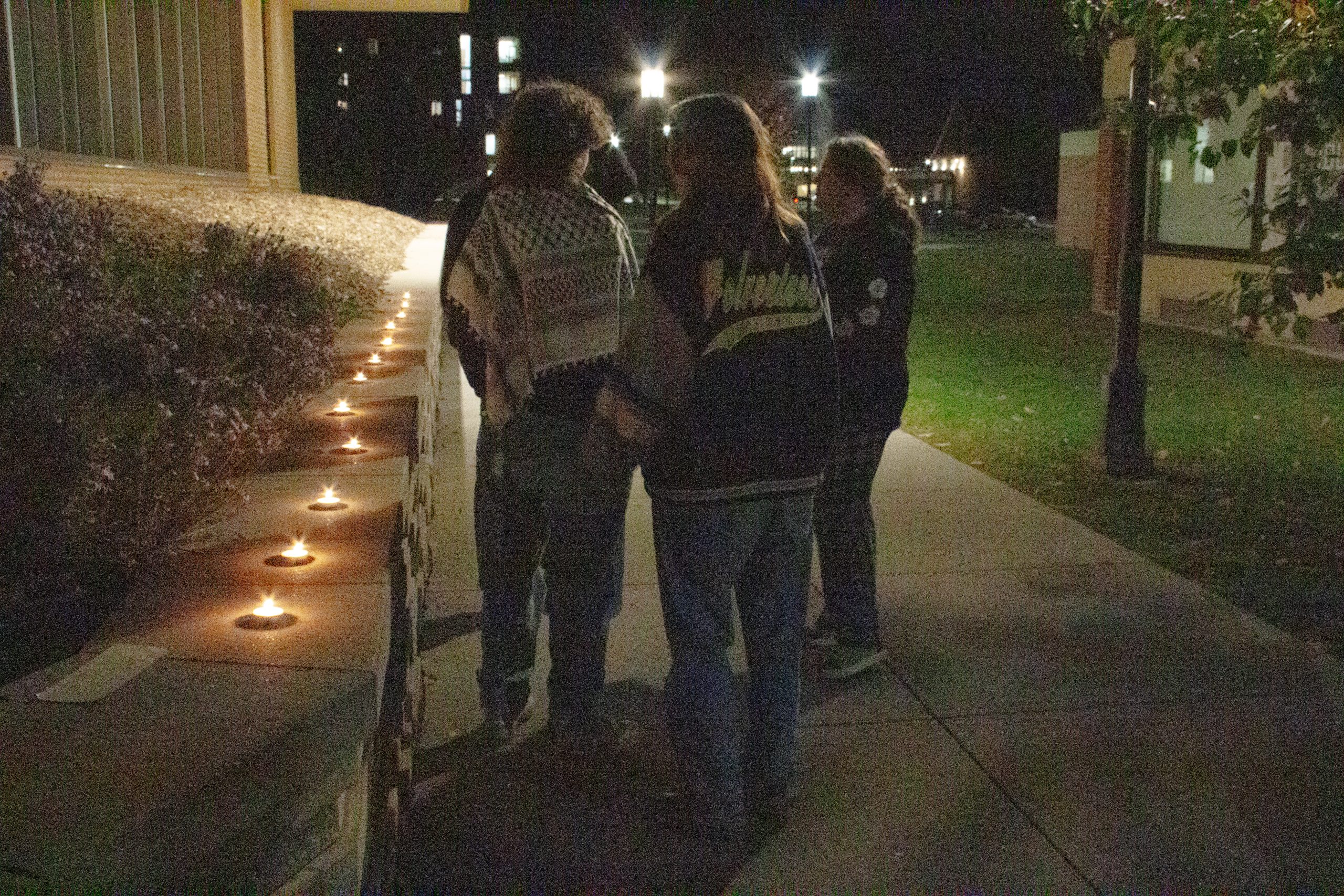
Signs and candles set the stage, as students gathered on Appian Way to show their support for Palestine one year after the start of the war.
The candlelight vigil was organized by the Monadnock Autonomous Student Union, a student activist group, and was held on Monday, Oct. 7.
One MASU representative, junior Fynn Stauber, a psychology and sociology major at Keene State, spoke to the importance of being seen on campus, saying, “I think that a massive factor is visibility, having people just realize that we are here and doing things on campus and that we aren’t the only ones who feel the way that we do.”
In late April, students gathered at the student center lawn to show support for Palestine. At this protest concerns from the attendees were made clear about the lack of acknowledgment from Keene State’s Cohen Center regarding the ongoing conflict.
One student, who asked to remain unnamed, attended both the April protest and the candlelight vigil on October 7, saying, “To still be waiting on any form of acknowledgment from the school is honestly baffling.”
The student continued, “Having Genocide Studies on the front of the building yet tucking tail as one unfolds in front of the world is frankly disgusting and inexcusable.”
Stauber also touched on disappointment surrounding the lack of a new statement on the war after a year given the center’s mission.
“We think it’s really hypocritical that they are not willing to make a statement on this, especially with the amount of expertise this center claims to have about the concept of genocide.”
Stauber also called into question the motives behind the Cohen Center’s lack of discussion about the ongoing conflict since its beginning in 2023.
“Maybe discuss how there’s definitely some kind of a profit incentive, and how it’s much easier to maintain the status quo and stay silent about it – and to stay complacent is just very hypocritical,” Stauber said.
Stauber went on, stressing the importance of speaking up when you believe in a cause.
“It’s really a preventative measure to come out first and say ‘Hey what you are doing to these people – what you’ve been doing to these people for generations is wrong,’” he concluded.
Another MASU representative, who asked to remain unnamed, identifying themselves as a KSC alum with a degree in political science, said, “Firstly, I think it’s really important to push the boundaries for what peaceful, non-destructive resistance looks like and the sort of bureaucratic red tape around how you are supposed to protest here.”
The graduate continued, saying the nature of day-to-day life at Keene State is complacent.
“It frustrates me that campus is this Barbie-Ken doll experience of nothing goes wrong, nothing’s political, as long as you keep your head down and do your homework you don’t have to think about anything,” the graduate said.
The graduate also voiced frustration with the mistreatment and eventual loss of valuable courses.
“Because it’s beyond just doing stuff for Palestine, everything intersects- it’s the basis of intersectionality which people would know about if they hadn’t gotten rid of a lot of the women and gender studies courses, and reduced it from a major,” they continued.
The alleged hypocrisy of the Cohen Center’s latter half of its title was a common concern among attendees, including the previously quoted MASU representative, who went on to claim that the very Holocaust and genocide courses held in the Cohen Center would – by their curriculum – identify the ongoing conflict in Palestine as a genocide.
The graduate stressed the importance of organized protest, regardless of the quantity of voices.
“It’s so important to demonstrate that a small group of individuals can do a lot, and can be visible, and can show people that we actually care,” they concluded.
The Cohen Center did not respond to request for comment by print deadline.
Parker Bartlett can be contacted at
pbartlett@kscequinox.com