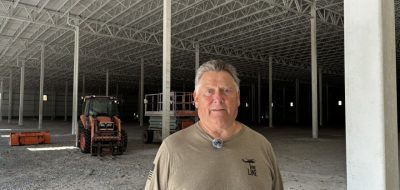

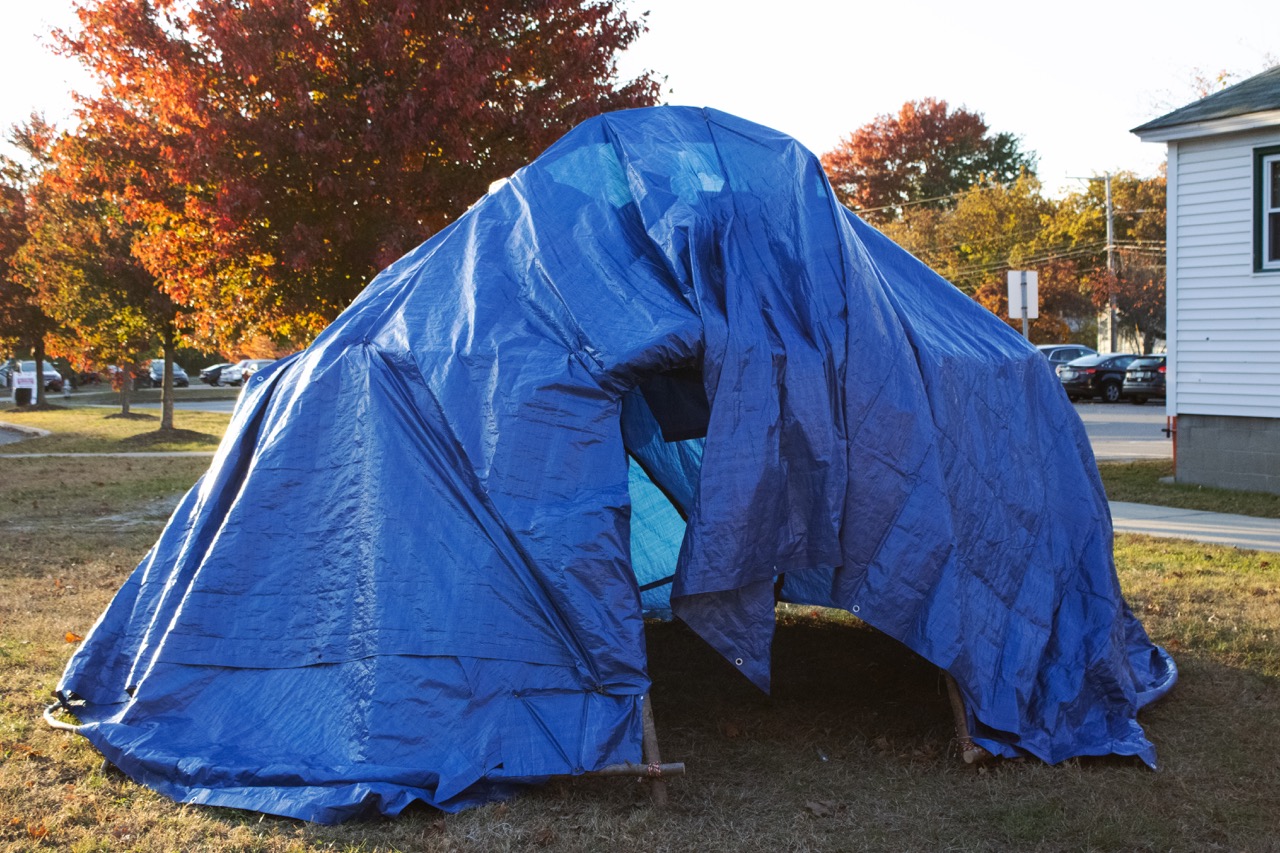
Professor Paul Fowler is overseeing the construction and testing of both a wigwam (a dome-shaped shelter traditionally used by Native Americans) and an adobe clay hut. The wigwam, located next to the cultural center and built with branches and tarps, was constructed based on purely visual instructions, with the idea that anyone could use the instructions to create shelter for themselves regardless of what language they speak, Fowler said.
“I built a wigwam that we did research on two years ago, and I had a thought of what if other people in refugee camps or that needed shelter in emergency situations could have instructions they could potentially make something from,” Fowler said. “They are based on IKEA [instructions] to some level.”
Fowler said the students who built the wigwam did so independently, with his presence being a resource and safety measure, but nothing more.
“It’s a team of students that I’m not managing. I’m just sort of in the background,” Fowler said. “They’re learning all of those lovely problems with teamwork and people committing to things.”
Similar tests are being done on both the wigwam and the adobe hut relating to temperature and moisture content, Fowler said. The goal is to see if these traditional types of shelter can “achieve modern comfort.”
Junior Jude Ashworth, one of the students involved in the construction of the wigwam, said he joined the project after Fowler reached out to the sustainable product design and architecture department looking for interested students. He said he worked with a team of fellow students each Friday until the wigwam was completed.
Ashworth said the experience of working on the wigwam was beneficial because it helped him build his resume.
The wigwam is expected to stay up for around a month, but Fowler said its use has largely already been achieved.
“We tested the directions. We know the directions work or [that they] don’t and then take it down,” Fowler said.
The adobe hut is a more long-term project and will remain in place for about a year at least, according to Fowler.
“We want to have a full cycle of warm and cold, so we’ll test the heat and the cold and all of the humidities that happen through the winter now into the spring and into next summer,” Fowler said. “And at some point next summer or fall, we’ll again have a conversation with [KSC Facilities Services].”
Fowler also expressed his appreciation for the facilities department, saying the staff was helpful when finding and preparing spaces for both projects to be constructed. He added the adobe hut remains at greater risk of structural failure because of adobe clay’s sensitivity to water, which it is more likely to encounter in New England than in the southwest United States where the material is traditionally used.
Senior Zachary Punch, the student who constructed the adobe hut, said he mixed shredded grapevine into the adobe clay for the bottom section of the structure, then switched to cardboard cellulose when he ran out of grapevine. He added there is an electrical box inside the hut which is powering equipment measuring temperatures inside the structure, outside the structure and in the interior of the clay bricks.
Punch said he will be giving a presentation about the research on the hut at the Council of Public Liberal Arts College (COPLAC) conference on Saturday, Oct. 26. He added he thinks adobe clay has the potential to be used in building projects as a more sustainable alternative to fire bricks and that future students can hopefully build upon the research he has worked on, which has also resulted in a final research paper.
“The real future of the project is going to be the next step with future students building different structures out of different materials, and then [we will] be able to look at all that data and combine them in ways that I don’t even know of right now,” Punch said.
Sustainable Product Design and Architecture Department Chair Fernando del Ama Gonzalo, a co-author of the paper alongside Punch and Fowler, said he presented the paper at the International Conference on Sustainability, Technology and Education in Budapest, Hungary.
“I showed everything that we did over the summer. The hut was not completed, so we had a very small prototype,” del Ama Gonzalo said. “In research, we don’t build the big stuff before making sure that it’s going to work, because it would be a waste of time [and] money.”
del Ama Gonzalo said architectural research has become more established at Keene State in recent years. He added research is a good experience for students to practice having patience and working on something less immediate than coursework to ensure they get good results.
“We have to be patient, working, analyzing data and then if something goes really good, we can have a good experience,” del Ama Gonzalo said. “If [students] show what they have done as undergraduate students in terms of research, they will get more [of a] chance to get accepted in graduate school.”
Charlotte King can be contacted at
cking@kscequinox.com