

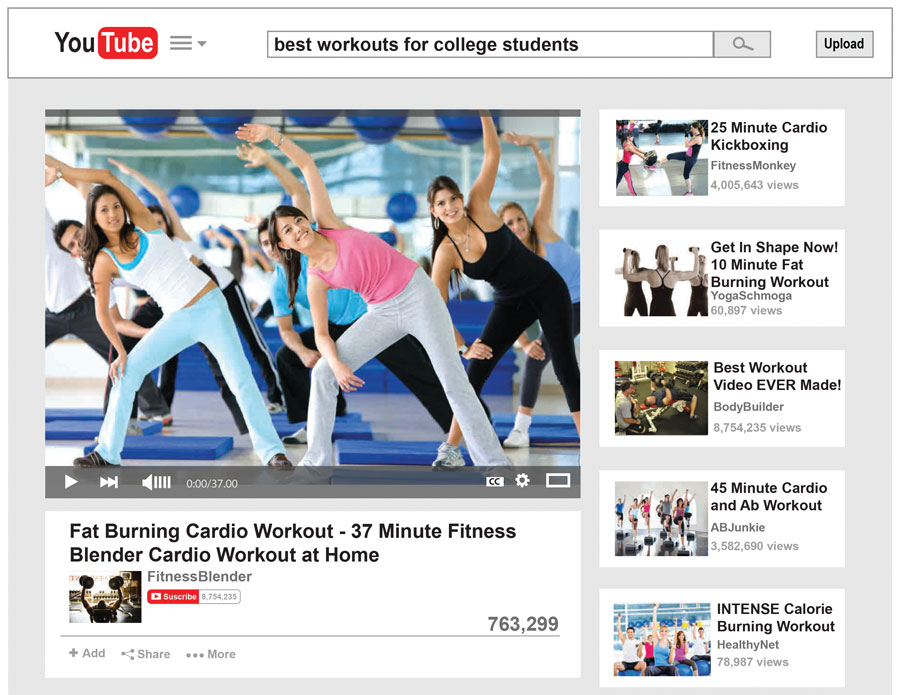
From Fitness Blender workouts to #foodie to DIY healthy snacks, there are many health related options available online for the public. Some would agree they are fun and informative, while others might question their credibility. And some might see certain pieces of information as offensive.
Earlier this month, comedian Nicole Arbor shared a video with the public about fat-shaming. Arbor claimed that “fat-shaming…is the race card with no race,” but that this video is not directed towards people with specific health conditions. Viewers were highly offended.
KSC student Tasia Macie, questioned if Arbor hates fat people. Macie said, “I could see how some of what she was saying was true, but still.”
KSC senior Amie Gagnon said, “[Arbor] briefly acknowledges that sometimes weight gain cannot be helped, but she also implies that obese people aren’t doing anything to combat their illness, which is very presumptuous.”
As a Health Science major, Carli Davis said she is well aware of online health existence and its impact on the public.
Cassie Barron /Equinox Staff
“I think everyone has a different story; I don’t think anyone should be quick to judge,” she said.
She also said, “It’s easy to find exercise videos such as yoga activities and specifics for that, like flexibility or strength training.”
Another popular website is Buzzfeed, which Jordan Medeiros, sophomore and recently established vegan, uses to find recipes.
“I was inspired by my professor in my Food Health Environment class to go vegan; it’s nice that the Dining Commons has options,” she said.
“I know some people use these [online] resources to keep motivated, or look for variations in their workouts and/or diets. As far as blogs go, people tend to just either share their own stories or the stories of people they know. In that way, the information may be authentic and well-meaning, but still entirely wrong,” Gagon said.
When asked if there are other dangers in looking exclusively online, Davis said people might be too excited at first and hurt themselves in the beginning, then not want to continue after being sore the next day.
There may also be the issue of something being offered that is too good to be true.
“Programs like these displayed by Biggest Loser, and many other rapid-weight-loss[programs] can be vastly unhealthy in their methods, and not properly educate those wishing to lose weight and continue a healthy lifestyle thereafter,” Gagnon said.
Justin Westra, 2012 KSC graduate, said he tries to be conscious of online information.
“For the most part, I think weight loss marketing makes a lot more promises than it can deliver. In a lot of ways, they’re very irresponsible in setting unrealistic expectations as a well as failing to provide long term, continuous weight loss and wellness,” he said.
He went on to say that it’s a lifelong process to keep the weight off; one has to keep working toward a goal.
Westra mentioned how social media can help by holding someone accountable. If one were to post something on Facebook, then people would see it.
“Social media may not be the best place for tips, but it’s an excellent place to develop a support network to keep [one] going through a new lifestyle,” he said.
As for Twitter, Gagnon said, “People may not be going around hashtagging #methlove, but people aren’t hashtagging #obesitylove either.”
Gagnon said it’s a real struggle, “In our culture especially, fat is often equated with being unhealthy and unhappy, and though obviously there are adverse effects to being obese, being fat doesn’t necessarily equate to being unfit. I think the online presence of health can help educate people that fitness and health come in all shapes and sizes.”
Kayleigh Burke, sophomore at KSC, said she used Instagram for a lot of her nutritional and workout choices. “I follow a lot of pages on instagram dedicated to step-by-step workouts to help me learn new exercises,” Burke said.
She said her favorite pages are the ones about tea detox.
She said she learns a lot of great foods to add into her water to help her boost her metabolism.
“Instagram is a great way to get motivation. There are so many pictures of people with great bodies, doing insane workouts. It only inspires me to go to the gym and do those same workouts. Plus, it’s a great place to get free workout advice. So many people are paying hundreds of dollars on workout plans, but there are thousands of people on Instagram who want to share their routines and recipes through social media,” Burke said.
There are hundreds of workout programs that people can purchase, but Burke questions if it’s worth it to spend money on exercise when they have social media.
Carli Davis said she knows to be cautious as a Health Science major and that “[People] should feel comfortable to seek out their own health. If they’re ashamed, if people put them down, how are they ever going to want to go out in public and ask for help?”
Coordinator of Wellness Education Tiffany Mathews, said that it’s better to use a credible source when checking for health advice.
“We have a number of resources online (Center for Health and Wellness), that are reliable sources. I check the credibility, expertise bias and funding source. I often rely on certain health agencies and reputable health and medical organizations,” Matthews said.
She also said that if someone wants to be healthier long-term, it’s helpful to consult with a health professional who can help figure out an individual’s goals and limitations.
Certain websites do offer that advice and training, and some may argue an online community can be more cohesive for an individual who is intimidated to go out and ask for help in public.
“The way we treat and talk to each other is often emulated by our peers and children, giving all of us an opportunity to encourage more positive behaviors and healthy lifestyles, in our society,” Matthews said.
Dorothy England can be contacted at dengland@kscequinox.com