

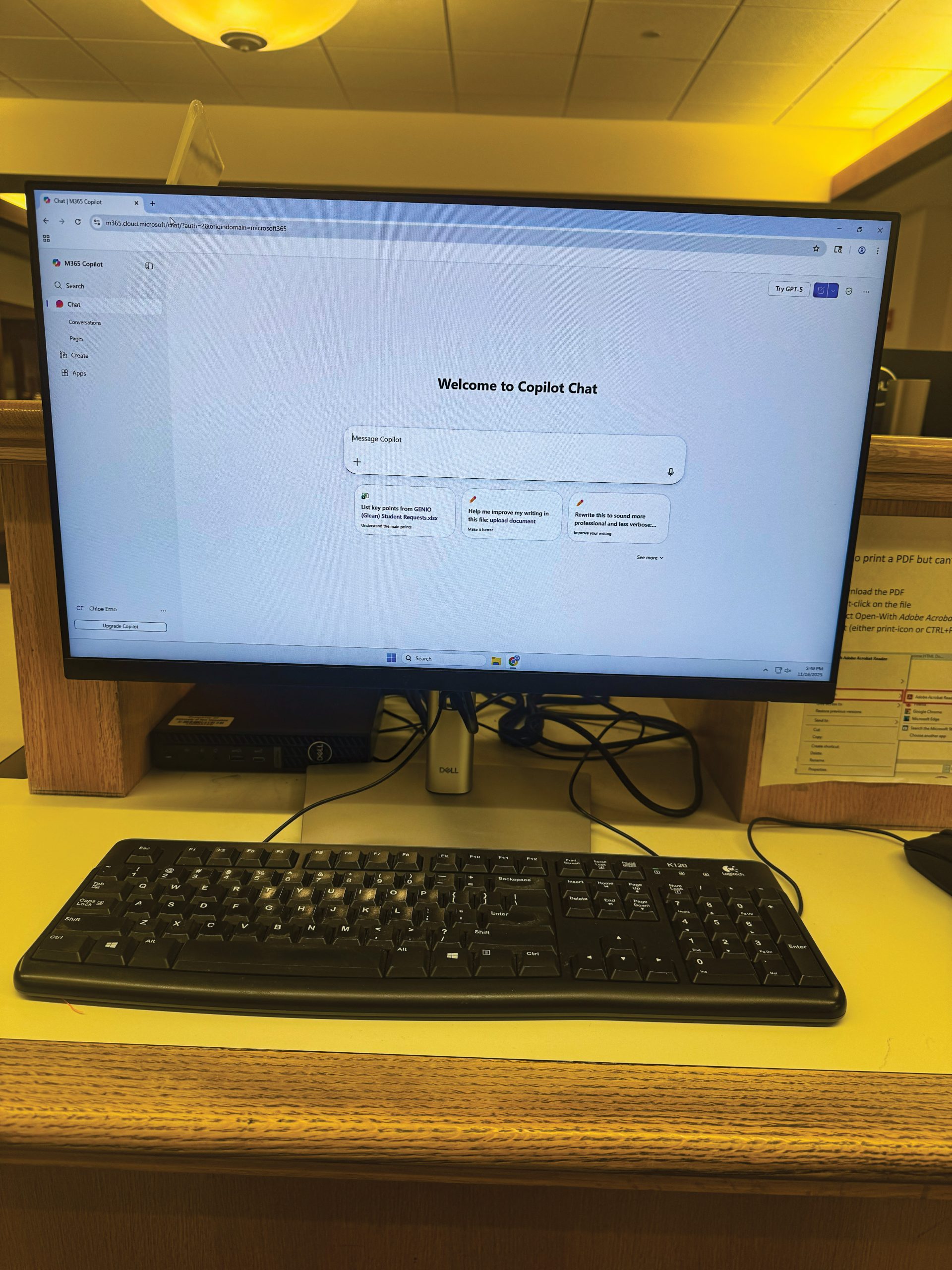
In the spring semester, The Equinox reported on the increasing prevalence of Artificial Intelligence both on campus and in our society. As AI continues to improve, professors have needed to adjust to the role that it plays in secondary education.
Chris Parsons, associate professor of English education, provided his thoughts on how AI will affect campus life going forward.
“It’s definitely more socially and culturally prominent than what it was for a while,” Parsons said. “I don’t think it’s gotten worse [on campus]. I don’t mean by the numbers of its use, or if it’s gotten harder to detect, in part because I don’t think along those terms. One thing I think has really improved is the faculty’s thinking and response to it.”
Parsons touched on the dynamics of the new technology and how it has impacted faculty thinking.
“When things are new, like [generative] AI, people don’t know about it or there’s even fear of it, so I think that faculty and instructors have come to have a greater understanding of what’s possible with generative intelligence,” Parsons added.
Parsons clarified that the policy on academic honesty, just like last spring, allows professors to make the final call on whether AI is welcome to be used by students in the classroom. He also reinforced that students should check in with teachers if they aren’t sure if it’s allowed, as “the baseline is you can’t use it.”
Parsons addressed what he thinks will happen as AI becomes more prominent in our society.
“I think more and more schools, like public schools and colleges or universities, are starting to consider whether we’re trying to prepare our students for jobs, professions, and life in which generative artificial intelligence plays an increasingly prominent role,” Parsons said. “Then we have to examine what our role is in preparing students, teachers, and professionals to use those tools.”
Greg Knouff, professor of history and chair of the academic policy committee, added some insight into the issue.
“AI is easy to use, but there’s always been academic dishonesty before AI,” Knouff said. “A lot of people thought that when the internet became widely available with Google searches that that might undermine academic integrity. It’s just a matter of properly citing sources.”
Knouff added that he believes that AI makes it “easier and quicker to engage in academic dishonesty,” but that it isn’t a “substantial change.”
Knouff addressed the policy that allows teachers to make their own calls on AI use in their classroom, saying that “we really encourage them [teachers] to do so,” and that “the policy itself encourages them to do so.”
Knouff also responded to the increasing prevalence of AI.
“I think like anything else, like any technological change, faculty and academics will adapt to it,” Knouff said. “I know there’s been a lot of conversations about it. But I know there’s been a lot of sharing with the faculty about what they do and how to incorporate it. I’d say there’s probably been more [since spring].”
According to the college’s policy on academic honesty, “Generative artificial intelligence (AI) is an emerging tool in teaching, learning, and workplace environments. The College strongly encourages instructors to establish and to clearly articulate course policies governing students’ appropriate use of generative AI, if any.”
Chloe Erno can be contacted at