



Across the U.S., the question of how artificial intelligence (AI) will affect everyday life going forward has been a trending topic. AI continues to evolve, and with it comes the worries of people who fear how far it will advance.
According to a poll from the Pew Research Center, “Today, 52% of Americans are more concerned than excited about AI in daily life, compared with just 10% who say they are more excited than concerned; 36% feel a mix of excitement and concern.”
Here at Keene State College, AI has developed a notable presence on campus.
The Keene State website states, “Generative artificial intelligence (AI) is an emerging tool in teaching, learning, and workplace environments. The College strongly encourages instructors to establish and to clearly articulate course policies governing students’ appropriate use of generative AI, if any. Generative AI tools may not be used in the completion of coursework unless the instructor specifically authorizes their use.”
It goes on to say, “If an instructor approves the use of generative AI for coursework, any use must be properly cited, as defined by this Academic Honesty Policy. The College encourages our entire academic community to consider the ethical implications of uploading copyrighted work to generative AI programs.”
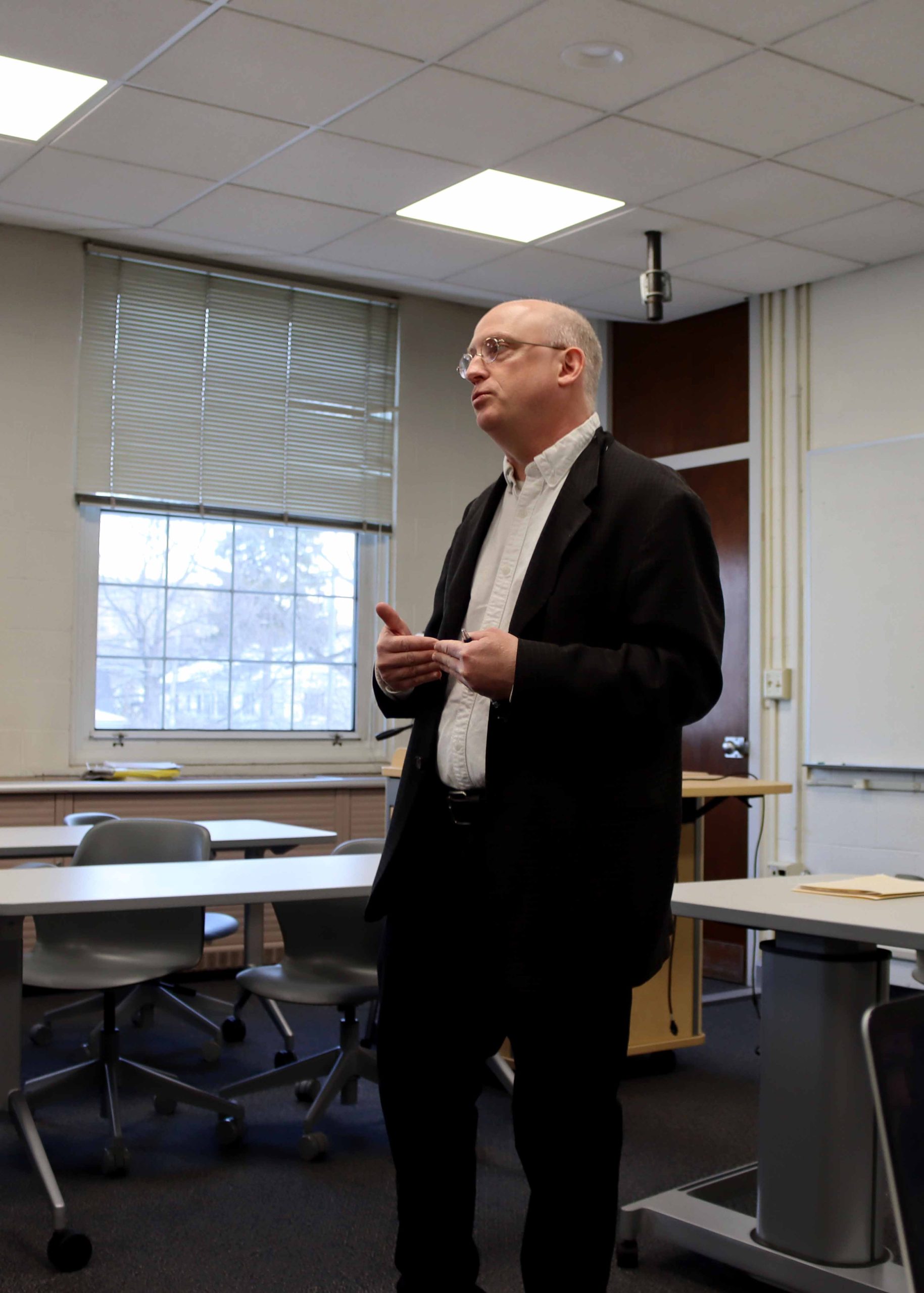
Gregory Knouff, professor of history, who works as the special assistant to the deans for academic honesty and the chair of the KSC Senate Academic Policy Committee (APC), shared how Keene is adjusting to the presence of AI on campus and in classes.
“The principles of academic honesty haven’t really changed,” Knouff explained. “There’s a wide range for how faculty members work with AI in their classroom or don’t. Some faculty across the board don’t use AI and explain they want you to use their course materials but not generative AI while other faculty have incorporated it into their classrooms.”
“On the Academic Policy Committee, we had a faculty member from the architecture department say that they use AI all the time since it’s integrated into the software,” Knouff added. “So we recognize that. We recognize that there are different expectations and we encourage faculty to be clear about what their expectations are and for students to be aware of it as well.”
Rita Augustyn, a senator for the APC and an assistant professor for sustainable product design and architecture, provided her input.
“It can be a useful tool but should never be relied upon to do the actual work,” Augustyn said. “The goal for students is to gain knowledge and experience by doing course work and gaining skills in research, writing, critical thinking, creativity, communication and so on. After graduating, students will need these skills to be successful in their professions.”
Chris Parsons, a fellow senator on the committee and an associate professor for English education, added some additional information.
“I think one way I’ve seen teachers handle it is through syllabus statements,” Parsons said. “Professors are constantly trying to figure out what they should say in their syllabus that acknowledges the presence of ChatGPT but also makes it clear enough so that students have direction on what they can and can’t do.”
“AI is going to keep changing,” Parsons went on. “There have been some professional developments for faculty on campus and one thing that’s really clear is ChatGPT and generative artificial intelligence is going to get more and more advanced and I think that means it’s more and more important that we just have open conversations about it. That seems really crucial.”
Parsons said he does not believe any singular policy on generative AI will be useful.
“I think the college saying that AI can never be used on campus would be a really simple blanket statement but at the end of the day it’s still going to be around. So I think having spaces for those conversations is important.”
Chloe Erno can be contacted at
cerno@kscequinox.com