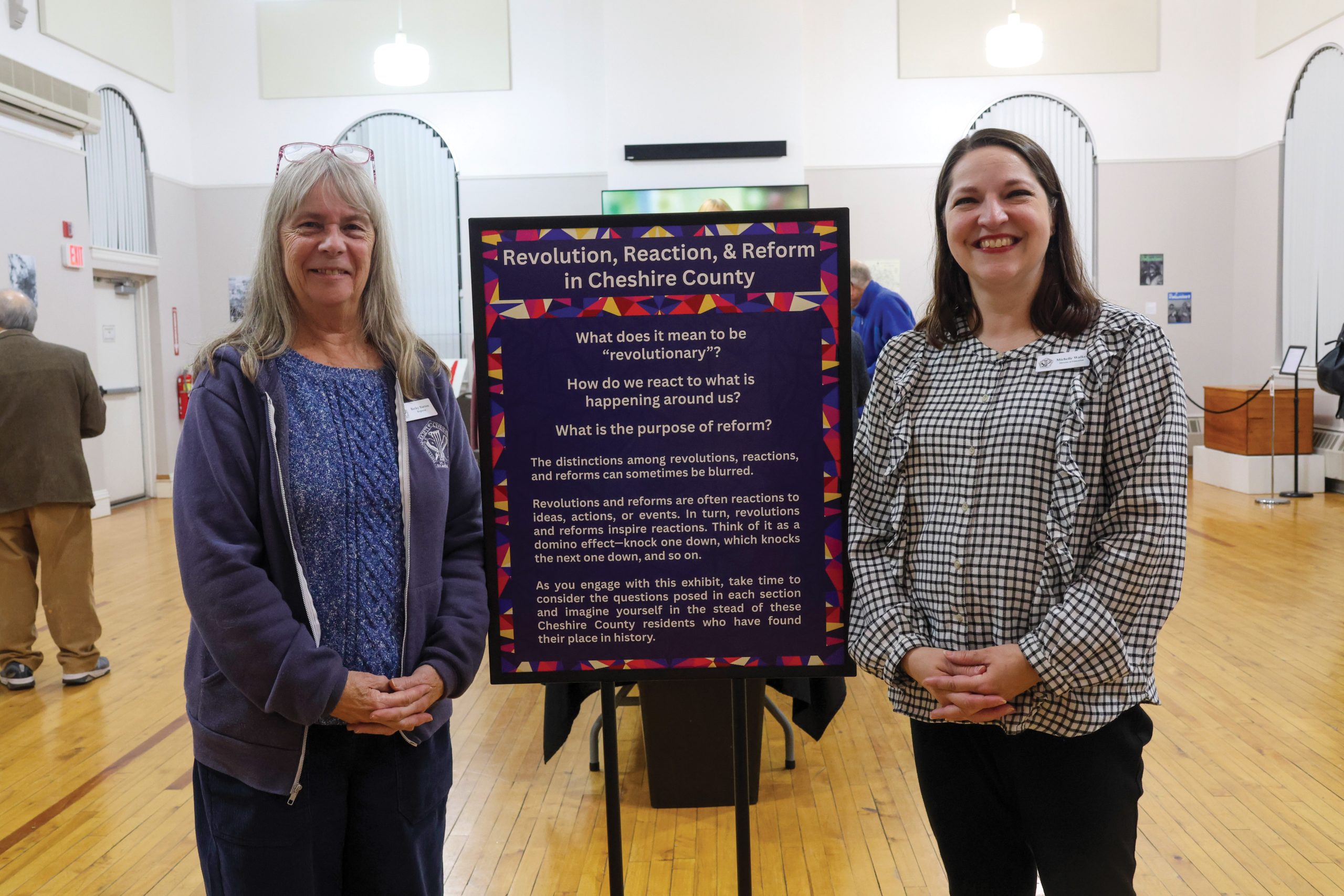


On Nov. 14, the Historical Society of Cheshire County unveiled a new exhibit titled “Revolution, Reaction and Reform.”
Michelle Walker, director of education for the historical society, provided the reasoning behind the exhibit.
“It’s based on the theme for National History Day,” Walker said. “It’s a project based learning program that encourages kids from grades 6-12 to investigate local historical sources. These projects involve research and connecting it to the annual theme.”
Walker added that there were five different categories the students could choose from: documentary, exhibit, paper, performance and website.
Walker hoped that the students’ projects could “play to their strengths” and “encourage cooperation between kids, teachers and historical societies.”
Multiple different exhibits were displayed at the event, some of which focused on the Cheshire railroad system and Colony Mill, the Winchester anti-slavery society and the U.S Army Air Corps, the latter of which included an observation post log book from the air force itself.
Fabric samples and swatches from Colony Mill were on display, alongside old brochures for Wright’s silver cream from J.A Wright’s and a journal entry from the anti-slavery society.
One piece addressed the Kinder Morgan company pipeline, which was proposed to carry natural gas from Pennsylvania to N.H. alongside other states, and spawned the “No Pipeline” cause in N.H.
Other topics included the N.H. Women’s Christian Temperance Union, the girl’s summer camp known as Camp Oahe, George Alvin Long and one of the first self-propelled automobiles and the Cheshire County Jail Building Committee.
One of the pieces from the exhibit drew attention to Albert the elephant, an elephant from the P.T. Barnum circus in the 1880s. The exhibit featured a piece of the elephant’s hide and a shell casing from one of the guns that fired the killing shots.
The elephant was killed on the bank of the Ashuelot River due to the death of one of the circus’s animal keepers, James McCormack.
According to the Keene Sentinel, “500 people gathered in another location, along the banks of the Ashuelot River where Albert had been tied to a tree” and that “Albert died immediately when the 30 shots rang out.”
On the screen at the back of the exhibit room, a video featured Jill Howard Church, who is working to restore the Keene memorial dedicated to Albert. The original marble marker had been vandalized and desecrated.
Church works as a writer, specializing in animal welfare, proofreading, editing and photography. She also works with Kim Stallwood, the creator of The Topsy Project, which seeks to rework the narrative around Topsy, a female circus elephant, who, much like Albert, was publicly executed for the death of a human.
According to The Topsy Project website, it’s “an art-based initiative dedicated to challenging her life story—currently told as a villain who killed people—to replace it with her true story, as a victim who had to defend herself from a lifetime of abuse.”
Alan Rumrill, senior historian of the historical society, added some additional information.
“The woman [Church] on the screen is a circus historian,” Rumrill said. “Souvenir hunters destroyed the original monument. She wants to restore the monument.”
“We have a preserved piece of his hide but the rest went to the Smithsonian,” added Andrea Cheeney, marketing coordinator and museum store manager.
Chloe Erno can be contacted at