

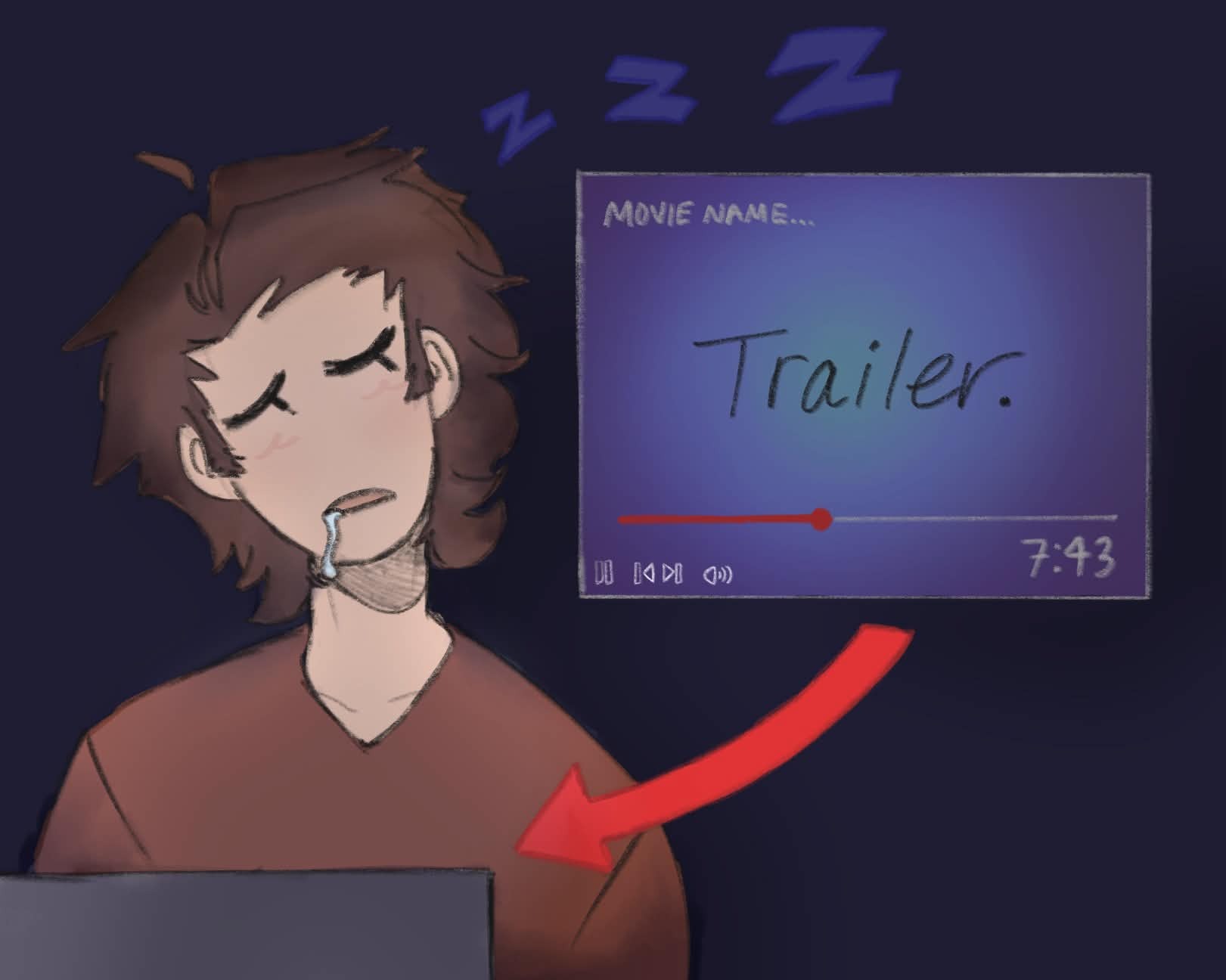
I know for a fact you have seen a movie trailer in your lifetime. If you haven’t, well, I’d wonder what planet you’re from. Trailers are the biggest way to promote a movie, both online and in theaters. However, they have recently been ridiculously revealing and unnecessarily long.
There are three types of trailers: The teasers, the theatricals and the officials/finals. Back in my day, the teasers were once the most common trailer and the main way of promoting a movie before it was put into theaters and usually until the movie was taken out to be put on DVD or Blu-Ray. They were quick snippets of the film, usually under a minute long, with just enough to not reveal too much information while still showing some impressive images and shots from the movie and usually with a joke or a humorous moment. It was effective in reeling people’s interest without bothering them for too long before watching what they actually went to see in theaters or on their TV.
Back then, depending on how far into post-production a movie was, theatrical trailers were what was played in a theater while teasers would be what was on television; but that’s not very common nowadays. Theatrical trailers would still be very short, under a minute and a half long at the absolute maximum, and give a little more about the actual plot. Nowadays, these trailers only play at theaters and are at a length that nobody needed or asked for.
The biggest example of this, and the main inspiration of this article, was when I saw a trailer for the movie that’s now in theaters, “You, Me and Tuscany,” that played before I saw “Project Hail Mary.” The runtime, you ask? Two minutes and 27 seconds. And it revealed the entire plot, which was practically a carbon copy of “While You Were Sleeping,” which was released back in 1995.
To sum it up to the best of my ability, a woman meets a random guy and falls in love with him. However, that guy fell into a coma, and to make sure the woman could visit him, the nurse told the family she was his fiancé. She couldn’t tell his family the truth, but had to at the end because she slowly fell in love with the guy’s brother.
In the case of “You, Me and Tuscany,” a woman meets an Italian man at a bar. He reveals how he has a giant villa in Tuscany that’s completely empty, probably to show her how rich he is. The woman takes it as a chance to travel and relax in the luxurious house to get away from what I assume to be a bad job as a chef or a cook job she just got fired from. But she stumbles upon a wedding ring as she’s gallivanting through the house and going through a stranger’s cupboards.
Then, what I believe to be the guy’s mother and possibly his aunt, find the woman in the house with the ring on and believe her to be his fiancé. But then the guy’s cousin shows up and she falls in love with him. Then, the trailer ends with the original guy showing up. From what I can imagine, she ends up telling the family she’s in love with the cousin, leaves in shock and then as she’s getting on an airplane to go home, the cousin shows up and proposes. In other words, I have no need to see another 103 minutes of that film. And this is a clean example of how teaser trailers have died out.
In my opinion, trailers have no need to be long unless there is a reason or the filmmakers avoid revealing too much information. I know that in the past, there have been longer and more plot-revealing trailers. The almost humorous “Captain America: Brave New World” trailer that spoiled Red Hulk as its only way to bring people into the movie was ridiculous. The entire plot is centered around this mystery of what Harrison Ford’s character, President Thaddeus Ross, was hiding. With every single clue and hint in the movie, which were sprinkled in quite often, I said to myself: “Yes, we know he’s Red Hulk. Move on.” Apparently, this mystery was the main driving force in the entire film, even with a handful of other random Marvel villains in the mix. The length didn’t matter in the trailer; it just spoiled the whole thing with no intrigue or call to the rest of the movie.
For me, it’s like there are three stages of trailers: Teaser = before theaters, theatrical = in theaters and official = after theaters.
The teaser should be no more than a minute long, and that’s being generous. It should reveal the main character(s), a hint at a plot point or give a very small clue of the central conflict. A great example of this is “The Devil Wears Prada 2.” In 51 seconds, they show lots of B-Roll and filler shots with fashion settings and clothes, as well as Anne Hathaway and Meryl Streep’s characters–the two most prominent characters in the first film. It doesn’t reveal anything about the plot, other than the fact that Hathaway is back to working with Streep. But it makes you want to know more.
The official trailer (which I talk about later in this article) has a runtime of one minute and 49 seconds, and confirms the plot point of Hathaway and Streep working together against Emily Blunt’s character, who seems to also have her own fashion magazine or something. It still doesn’t give away too much information while showing probably the biggest plot point in the movie, as you can see with how little I wrote about it.
For theatrical trailers (these can also be called official trailers if the production company only makes two instead of three; complicated, I know, but I talk more about it later), they should give away a big plot point, but not the most important. They should also show some shots that are semi-prominent in the film, the main characters and a few jokes or smaller stunts to make the trailer amusing rather than bothersome within a two-minute time frame. The time frame is crucial for me when it comes to theatrical trailers, considering there are probably a handful of other trailers also playing, and with a lot of them, a person could be stuck watching 10-15 minutes of trailers instead of getting to watch the movie they went to the theater for. By then, the popcorn bucket is empty and the drink is almost gone.
A great example of a theatrical trailer is “Toy Story.” I know, not the most relevant film nowadays, other than the fifth movie that’s on the way to being released, but it’s a movie I hope everyone is familiar with by now, to the point I can talk about it and you’ll know what I’m saying. In a minute and a half, it shows Woody, Buzz and a lot of Andy’s toys. But it never mentions Andy, Sid or anything about the plot other than Woody and Buzz’s bickering. It also hints at Buzz’s inner conflict of not believing he’s a toy, with very few shots of being outside of Andy’s room. While Buzz’s conflict is prominent in the film, there is no mention of the biggest problem: Getting back to Andy’s room before he moves out.
Lastly, there are official trailers–also known as final trailers–which I believe should be the trailer for it after it’s out of theaters. I’m a lot more lenient and understanding when it comes to the runtime of these. Keeping it within the range of 2-4 minutes makes sense to me, as these are purely to keep the movie relevant after it’s out of theaters. Since the movie’s been promoted and out there ever since the teaser came out months prior to the movie’s release, and then for the month or so it’s been in theaters, the same images can become repetitive and stale to people, so there needs to be improvement upon the theatrical trailer while staying away from spoilers. This can be by revealing more plot points or characters relevant to the film and giving some small hints at the central conflict, as well as one or two memorable shots from the film.
An example of this is “Project Hail Mary.” I hadn’t seen the official trailer before the movie, only a teaser that I cannot find on any platform.
In the official trailer, which is about three minutes long, it spoils a little bit of the end (as I’m about to do to try and explain this, so skip until you see the words “So that’s my three-stage trailer proposition” if you don’t want it spoiled for you, too). It reveals a portion of how Grace got up into space in the first place, which isn’t revealed until very close to the end of the movie, as the entire film has flashbacks to Grace’s life on Earth as he starts to remember the events leading up to him getting to space. But it gives the central conflict of the sun dying and some stunning images from the movie.
One of these shots is when he gets to the green planet, which I’m forgetting the name of, and sees all the little particle things that are trying to kill it, which I also forgot the name of. It’s the shot where it turns from Grace facing the planet and then it flicks to all the red sparkling lights, which you’ve probably seen in an edit for the movie somewhere on TikTok or Instagram. If you haven’t, go look at some because some people were cooking on those.
And it gives very little imagery of Rocky, the cute alien that Grace befriends. Funnily enough, it has less than Rocky in the official trailer than it did in the teaser and the theatrical ones.
For me, this trailer spoils an important aspect of the movie, but it’s not movie-spoiling, especially if you don’t know anything about the plot. Because of the bond Grace makes with Rocky and probably the memories he has about how he was forced up there, he decides to save Rocky and live on his planet instead of returning to Earth at the end. The information in the official trailer gave no clues to this or the thing that is killing the stars, which is probably the most important aspect of this film, but it still intrigues a person to find the movie on some streaming service and give it a try.
So that’s my three-stage trailer proposition: a simple format that’s probably already out there and being followed. Considering how long that was, I’ll use a movie that’s an example of all three and summarize it in one paragraph, for the skimmers out there.
“Iron Lung” has three trailers. The official teaser trailer, which is one minute and 14 seconds long, reveals the setting of the film and that it’s a submarine that’s a carbon copy of the one from the game. The official trailer is one minute and 34 seconds long, revealing the blood ocean, hinting at the “all of the stars and humanity are dying” conflict and the main character, Simon, without giving his name. The final trailer is one minute and 44 seconds long, and shows more of Simon, the mechanic, taking pictures, reveals the name for everything dying as “The Quiet Rapture,” the fact that there’s something in the ocean with him and it reveals the central conflict of survival.
Boom. There’s a quick summary of the three-stage trailer concept.
I did briefly mention the two-step trailer system, which relies on making a teaser and an official trailer that takes the place of both the theatrical and the official/final, meaning that the trailer they play in theaters is also the one they will continue to use once it’s out. It either makes the official more revealing than necessary, which can deter people from seeing the film itself because they can already take away the central conflict, or it reveals too little, which can fail to draw people in or interest them in the first place.
And yes, this three-stage system works well from what I’ve seen at the box office. Now, it could be because of the actual movie that it did so well and not solely because the trailer drew people in. I know for a fact that the box office-breaking sales of “Iron Lung” were not because of the trailer, but because of the quality of the movie itself and the anticipation of it since the production was announced. The same goes with “Project Hail Mary,” although the trailer is what made me go see it.
To reiterate an example of a film where the trailer revealed too much, I’m going to talk about “Captain America: Brave New World” again. The trailer made it kind of a pointless movie, if I can say that in as much of an offenseless way as possible, and that trailer was everywhere with how excited everyone was about Red Hulk and seeing Ford’s face on a giant red monster. The trailer was enticing enough to earn the movie $415 million, according to Box Office Mojo, with a budget of $380 million after all of the reshoots, according to World of Reel, but it has a 46% on the Tomatometer. So the trailer was enticing, but after the movie reviews started getting out, the trailer became its downfall.
So, the last 2,000 words I have just written, I hope, are not taken away as a complaint, but as a protest to these film companies. Trailers are crucial to drawing people into films as much as promotions and product advertisements are, if not even more important. So please, Mr. and Mrs. movie people, keep the plot to yourself and share the feel of your movie instead.
Hayley Doda can be contacted at
hayley@kscequinox.com