
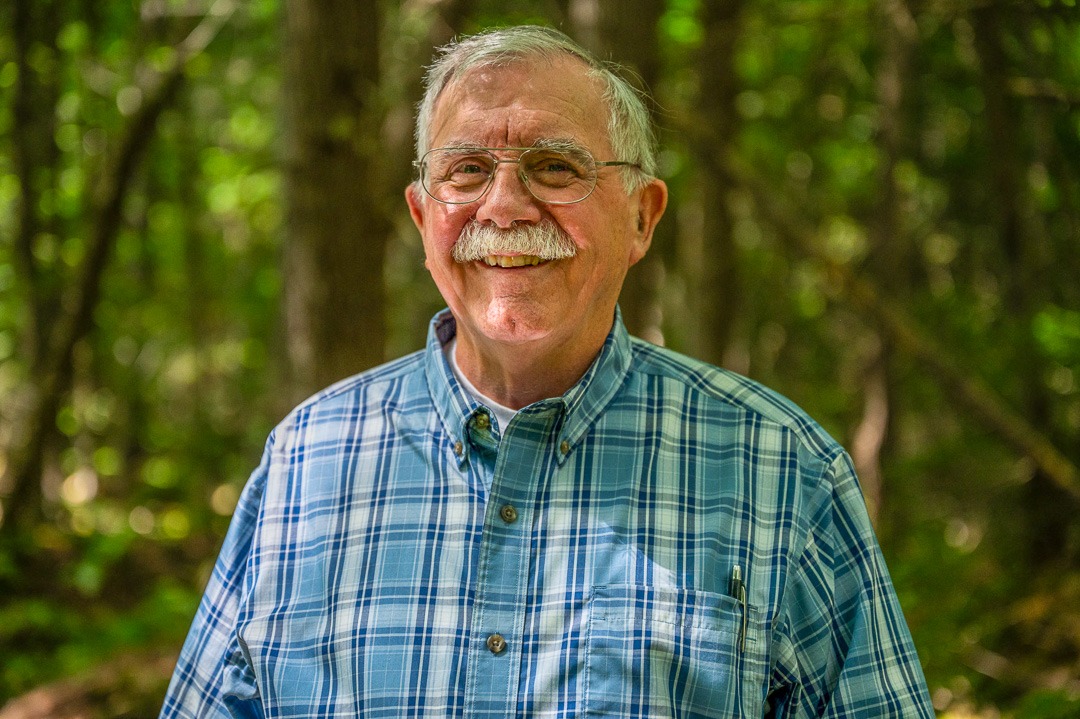
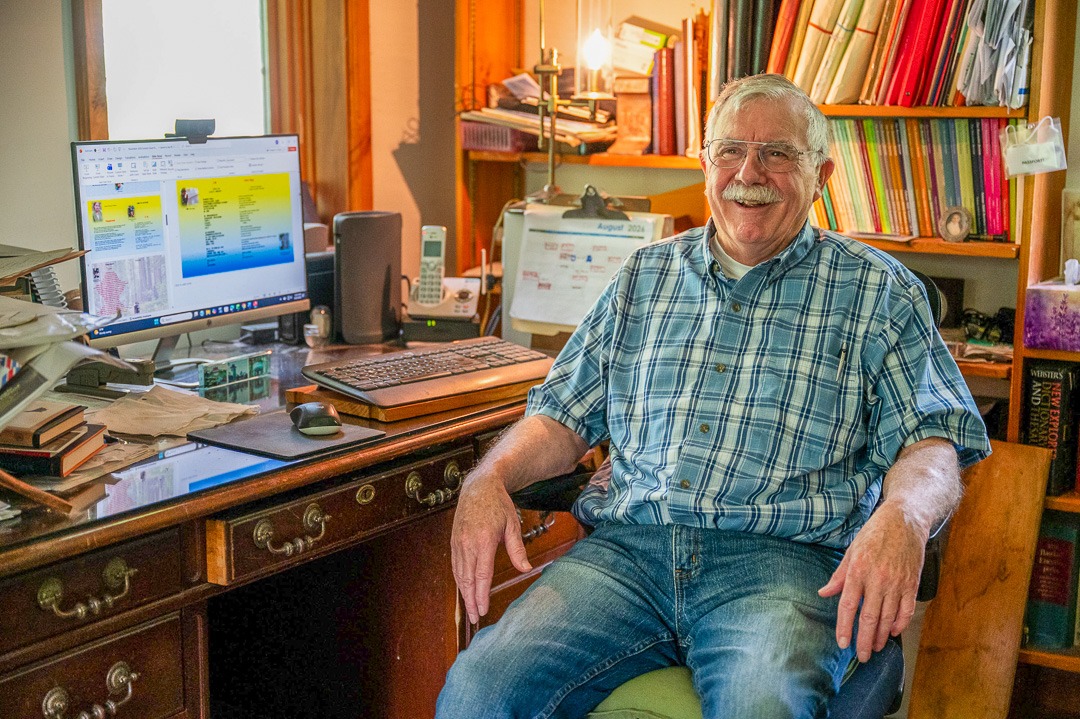


When Rodger Martin returned from Vietnam in 1968, he was driving through New England in the dark on his way to Fort Devens when exhaustion forced him to stop at a roadside rest area. When he awoke at dawn, he found himself looking across the Connecticut River Valley toward a forested and snow-capped Mount Monadnock.
“The moment I opened my eyes and saw that scene, I said, ‘This is where I want to live,’ ” Martin said. After finishing his service, Martin attended Millersville State College (now Millersville University) with a new interest in education. He later described himself as a lost soldier, psychologically and in every other way.
Martin’s first class was English literature, and walking into the classroom with the teacher sitting on his desk was like nothing he’d experienced before.
“He’s wearing sandals. His hair is in a ponytail, and he didn’t say a word,” Martin said. “The class were all sitting there, silence. He [Bruce Kellner] opens a book of poetry, and he read a poem by Wilfred Owen, who was a famous World War I poet. It was at that moment when he read that I knew I wasn’t alone; that I wasn’t the only one who had gone through this.”
Over the following decades, Martin published five books of poetry, served as a newspaper editor, received fellowships to study at Oxford University and Duquesne University, became a professor at Keene State College and now serves as co-adviser to The Equinox student newspaper. His work also took him well beyond New Hampshire through literary exchanges, teaching and poetry programs in China and, most recently, Ireland.
Now the poet, educator and literary advocate is being honored with the Ewing Arts Award for Literary Arts.
“[It is] unexpected, but a privilege, especially when I know it isn’t always given every year,” he said. “That made it really special that they felt enough of the work that I did that it was worth giving an award in the literary arts. That was really nice to hear.”
The nomination, by Rodney Obien, cited not only Martin’s lifetime commitment to poetry, but also decades of service as an educator, editor and organizer who helped connect local writers with literary communities across New England and internationally.
Obien, who is a college archivist and associate professor at Keene State College, said he nominated Martin for “sharing his gifts of literature and writing with the Monadnock Region and beyond.”
Martin sees each part of his work as serving a different purpose. Teaching keeps him young and learning; journalism keeps people informed and holds people in power accountable; and writing offers a space for personal stories. He wants to show people they can develop their language skills to make something beautiful, whether spoken or written.
He gives the example of Pliny the Younger who documented the fall of Pompeii and how Pliny’s grandfather sailed ships across the Bay of Naples to rescue people from the city, ultimately sacrificing himself and his crew to get a final boatload of people off the island. Martin found that story on the anniversary of his mother’s death, a few weeks before 9/11. When the tragedy hit, he watched first responders heading into the towers while workers made their way down, and it reminded him of Pliny’s story.
“I thought had Pliny the Younger not written that down, and had I not read it, I would have never clearly understood that this is a timeless thing, not something special just to Americans. It’s special to human beings,” he said. “That’s what I mean by your job is to get on the record and then let the future take care of itself.”
Everything else helps inspire his poetry, which makes it sacred. Martin subscribes to the philosophy that a poem takes seven years to move through his body before turning into words. He heard the advice before to write every day; now he says that isn’t how it works.
“It has to go through all parts of it, all the senses, all the organ stuff. When it comes out, it’s organic to the person that created it, and only that person could have created that poem because it’s so much a part of that body that produced it,” he said. “It takes me a long time, years sometimes. I used to write every day. Now, I can feel it moving around. I may know what, I may not know what it is. There’ll be a moment when it’s ready.”
Nearly six decades after a chance sunrise view of Mount Monadnock convinced him to put down roots in southwestern New Hampshire, Martin remains committed to the region that shaped him. The mountain that first drew him to the Monadnock Region has remained a recurring presence in his work, just as the community that embraced him after Vietnam can be found throughout his life’s service.
As a teacher and alumnus of Keene State College, Martin said he has long embraced the school’s motto: “Enter to learn, go forth to serve.”
“Your job is service along with bringing home a paycheck,” he said. “It’s more than that, and you have an obligation to make it more than that.”
Rodger Martin serves as a faculty advisor to the Equinox. No members of the Equinox, including Martin, were involved in the writing or editing of this article.
Michael Shine can be contacted at
mshine@keenesentinel.com