
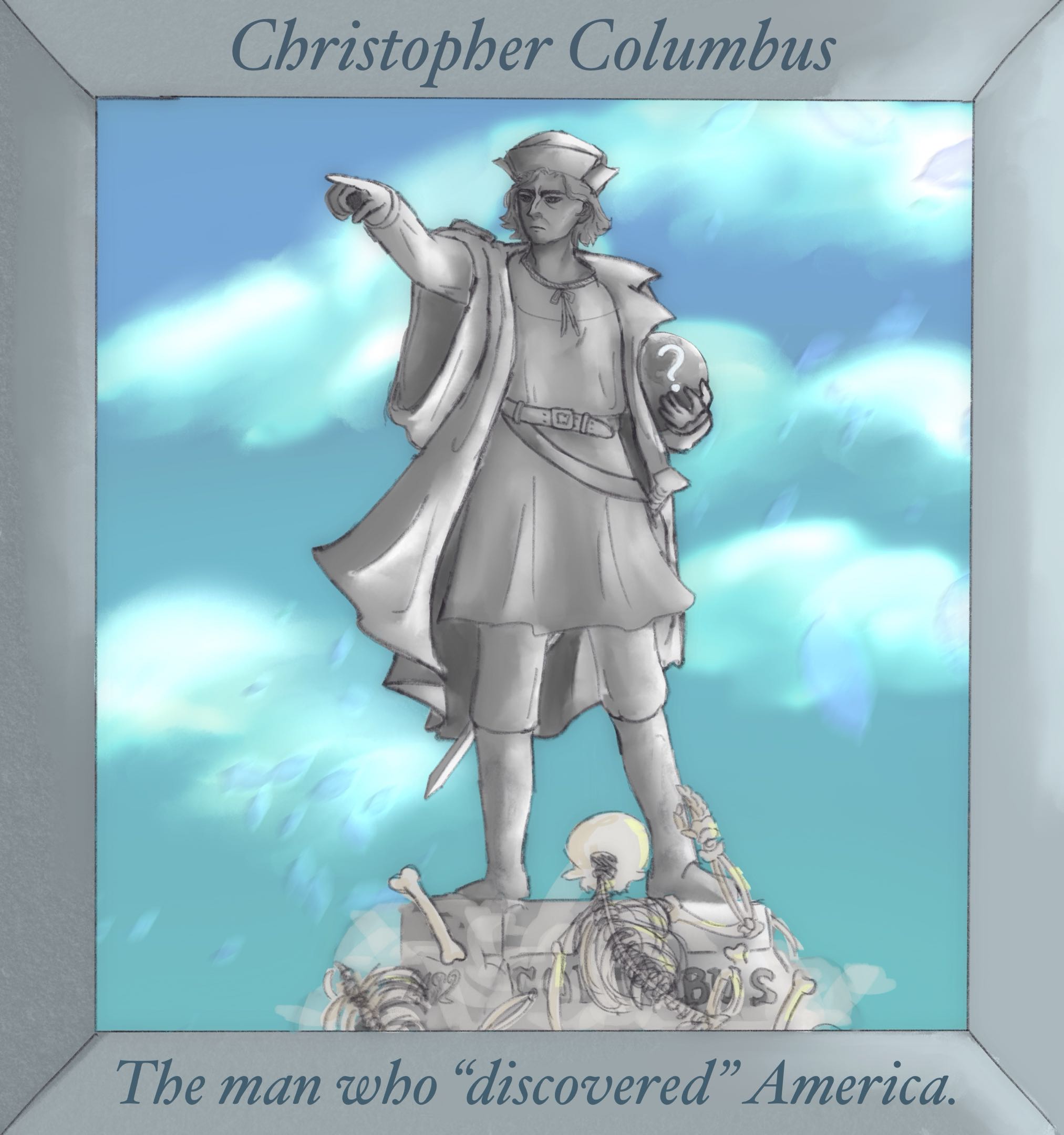
While Christopher Columbus is labeled as the “discoverer of America” on the statue that was recently placed at the Eisenhower Executive Office building, it is a fact that he was not the first person to discover America and we should not be memorializing him.
Many students learn about Columbus in a K-12 history class but what they may have learned is far from the truth.
The Smithsonian Institution, National Museum of the American Indian, stated, “Indigenous Peoples have populated the Western Hemisphere for tens of thousands of years,” long before Columbus’ arrival.
Columbus originally started his journey across the Atlantic in hopes of finding a direct water route west from Europe to Asia. However, to his surprise, he stumbled upon what is now known as the Caribbean.
After he struggled to find a sympathetic audience, he presented his plan to Spanish monarchs Ferdinand of Aragon and Isabella of Castile in 1492.
Columbus, Ferdinand and Isabella shared their want for fame and fortune along with shared catholic ideals. The monarchs saw the opportunity to ‘export Catholicism to lands across the globe’ and ‘Columbus, a devout catholic, was equally enthusiastic’ according to HISTORY.com.
Throughout Columbus’ voyage he kept a detailed journal of the different wildlife he came across, but he also wrote his impressions of the people he came across who already lived on the islands.
“They willingly traded everything they owned… They were well-built, with good bodies and handsome features… They do not bear arms, and do not know them, for I showed them a sword, they took it by the edge and cut themselves out of ignorance. They have no iron… They would make fine servants… With fifty men we could subjugate them all and make them do whatever we want.”
Do you still think Columbus deserves a memorial statue? Not to mention he gave his diary as a gift to Isabella when he returned to Spain.
Once Columbus sailed again in 1493, he reunited with his brothers, Bartolomeo and Diego whom he had left behind in the Americas to rebuild. A large number of indigenous people had now joined their group, enslaved. As another “gift,” Columbus sent 500 enslaved people to Queen Isabella. Of course, she was absolutely appalled, especially considering she told him to bring back gold and riches, not living and breathing humans.
His second-to-last voyage was in 1498, and once he returned to the ‘ill-fated Hispaniola settlement’ he found the colonists had staged a ‘bloody revolt’ against the brutal treatment from the Columbus brothers, according to HISTORY.com.
Spanish authorities deemed the circumstances so harsh that they sent over a new governor.
“Meanwhile, the native Taino population, forced to search for gold and to work on plantations, was decimated.”
HISTORY.com reports that in the 60 years after Columbus landed on the island, the approximately 250,000 Taino population had shrunk to a few hundred.
Columbus was then arrested, put in chains and returned to Spain.
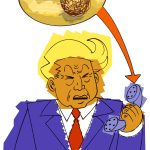
President Donald Trump and Columbus have more in common than I initially thought, and it is no wonder Trump would praise Columbus. One would think that now that 17 states and Washington D.C. recognize Indigenous Peoples’ Day, according to a PEW Research Center report, we would lose the outdated Columbus Day title and stop giving credit to him.
While Columbus may have been a “daring explorer who transformed the New World,” we must not forget his disgusting treatment of native people on every island he stumbled upon. He didn’t discover America, and he wasn’t even the first European explorer to see the “New World.” Leif Erikson, a Viking explorer, sailed to Greenland and Newfoundland hundreds of years ago.
My disdain for Columbus began when I learned about him in elementary school and it has only grown since. My blood boils for the people who came before me. The statue of Columbus is only a seething reminder of the systemic violence that is rooted in America.
Madelyn Marabella can be contacted at