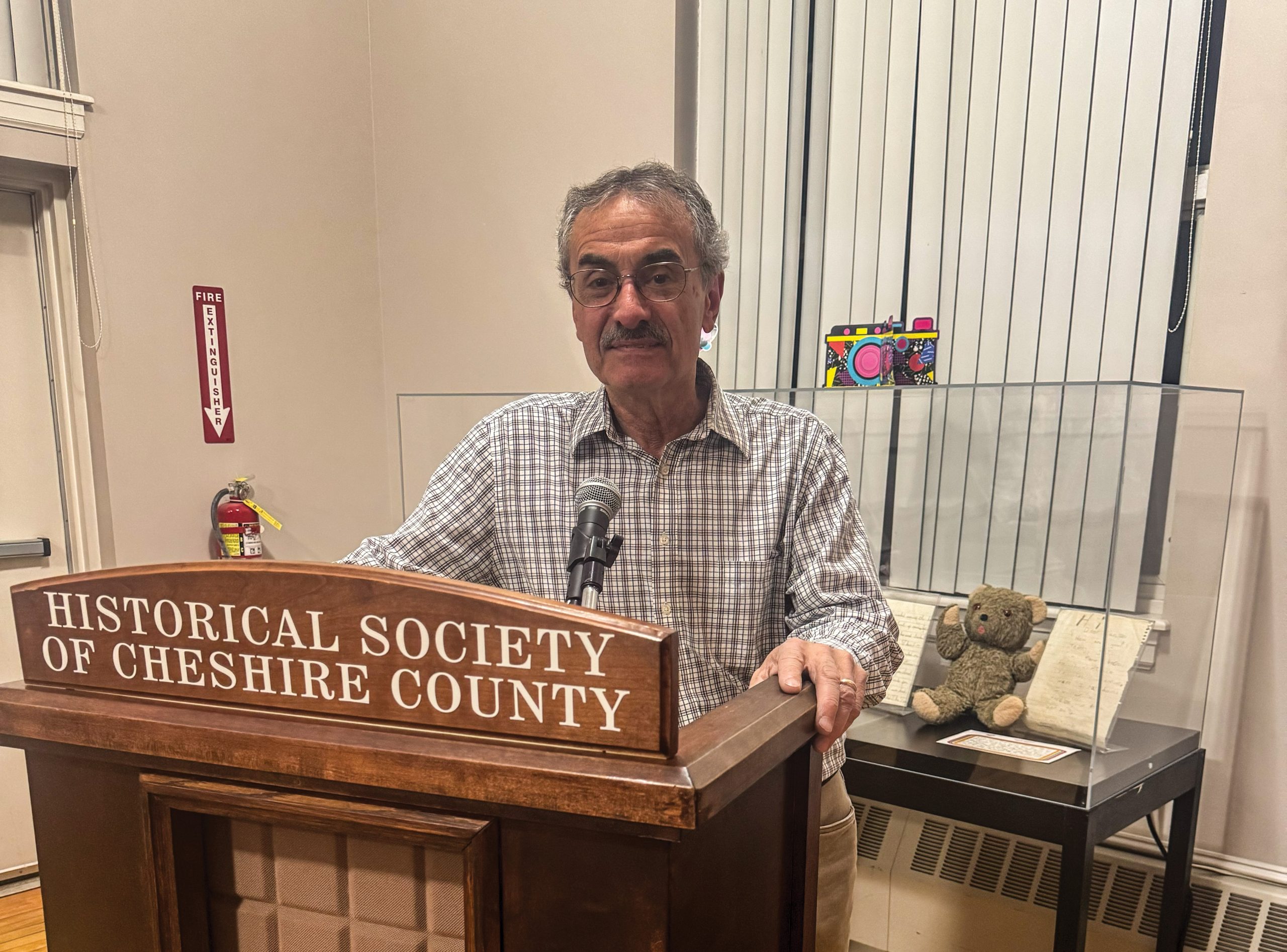


On Wednesday, Oct. 29, the Historical Society of Cheshire County hosted a Railroad History talk alongside the Colonial Theater. The in-person seats were sold out, and around ninety people attended on Zoom as well.
Director of Education for the historical society, Michelle Walker spoke first for the night, mentioning “Revolution, Reaction, and Reform”– a school program for history initiatives.
Keith Marks, executive director of the Colonial, was present at the event and spoke briefly prior to the presentation about the upcoming co-sponsored performance at the Colonial on November 13.
“The colonial is really looking to the future,” Marks said, mentioning how the American Railroad Silk Road ensemble at the Colonial will host a variety of music from around the globe and different communities.
Alan Rumrill, senior historian for the historical society, was the presenter for the night. Rumrill started off with an introduction of the first locomotives ever built, such as Tom Thumb, which holds the title of the first steam locomotive to be made in America.
“By 1840, major cities on the east coast were being connected by railroad lines,” Rumrill said.
Cheshire Railroad, one of the three primary railroad trails discussed during the presentation, was the first to be built in Cheshire County.
“Once the railroad craze started it spread rapidly,” Rumrill said, elaborating that local businessmen used the railroads to boost the economy and invest in convenient and comfortable transportation for passengers.
1846, 1847 and 1848 saw the plans for the Cheshire Railroad come to fruition as construction began, with May 16, 1848 being the date of the first train arriving in Keene on the tracks.
$2,290,000 were invested into the Cheshire Railroad, which was primarily built by Irish construction workers.
“It was considered a great engineering feat of New England,” Rumrill said. “The railroad was an important segment of the Industrial Revolution in the United States.”
Rumrill drew attention to porch rocking chairs and hats, which he said were important products exported from Keene to other places.
Rumrill would go on to say that “the Cheshire railroad was quickly followed by the Ashuelot River [Railroad].”
Three Railroad lines made up the bulk of the discussion: the Cheshire Railroad, Ashuelot Railroad, and the Manchester and Keene Railroad.
The Manchester and Keene Railroad was the last one built of the three, and there was a conflict with the farmers initially over the gratuities that the railroad company wanted to be paid for its construction.
The freight service in Keene would end in 1982, with the last train coming into Keene in 1984.
“The railroads made Keene what it is today,” Rumrill said as the presentation came to a close.
Chris Thompson, an out-of-state member of the audience for the night, provided his reasons for attending the presentation.
“It helps to know and understand the layout of the land and the history,” Thompson said. “Especially as a real estate agent. And the rail trails are a large part of it.”
The co-sponsored performance with the Colonial Theater will be held on November 13 at 7 p.m.
Chloe Erno can be contacted at