

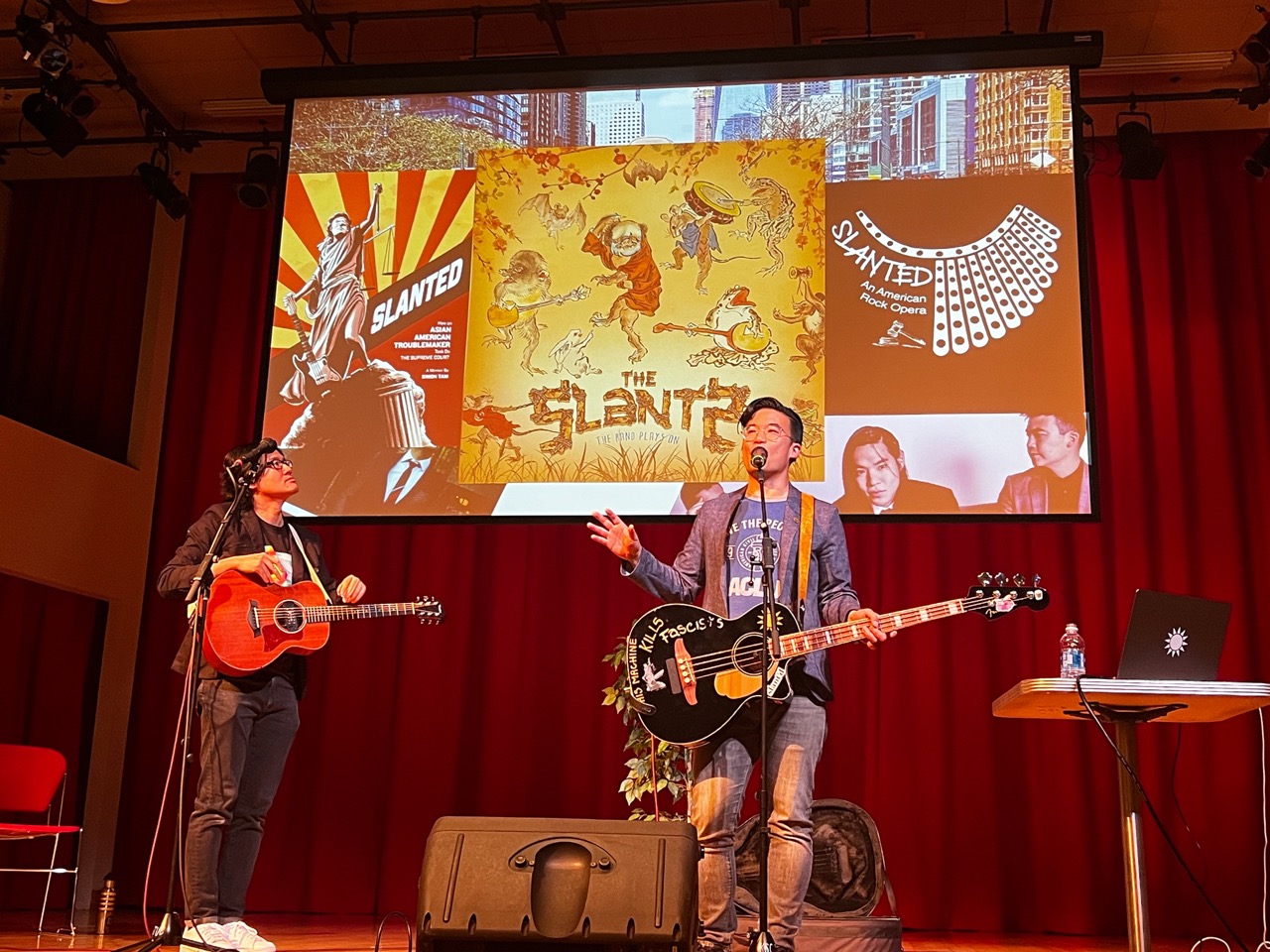
Simon Tam said when he formed the Asian American band The Slants back in 2006, he never imagined having to advocate for the band beyond the stages they performed at, and certainly not at the Supreme Court.
“We applied to register our band name as a trademark … The Trademark Office rejected it, saying that our name was disparaging or offensive to Asian Americans,” Tam explained. “We fought and challenged for about seven and a half years, ended up at the Supreme Court, where we won unanimously.”
Tam and his fellow bandmate Joe X. Jiang spoke about their battle with the Supreme Court through an interactive musical rendition at the Keene State College Mabel Brown Room on Wednesday, Oct. 16 as part of the college’s Sidore Lecture Series. Additionally, Tam and Jiang joined students for a luncheon earlier that afternoon which was hosted by the KSC Office of Diversity, Equity, and Belonging.
During the performance, Tam sang and discussed his struggles with his Asian American identity such as instances of bullying he experienced growing up.
Tam said during the event, “I think there’s power in claiming an identity, there’s power in saying you don’t get to define who I am, only I get to do that.”
The same idea goes for the band name The Slants, which Tam said is a way of reclaiming cultural identity for himself and his bandmates.
“When I had the idea for the band I started asking friends, ‘What’s something you think all Asian people have in common?’ And they would say slanted eyes,” Tam told The Equinox. “I always associated it with shame but I thought, what if we could flip it upside down and change it into The Slants?”
At the Supreme Court, the band argued that copyright denial infringed upon the First Amendment.
“What ultimately won it was, the Supreme Court [was] looking at the law that was used to deny me the registration and said, ‘Does this actually conflict the First Amendment?’” Tam explained to The Equinox. “We think it’s an abridgment of freedom of expression … Language is this really messy thing because it has to do with intention, it has to do with impact, it has to do with interpretation and so to legislate on it is a very difficult task.”
Tam added, “You can’t just have these blanket rules because you’re really impacting how people can express themselves.”
Sophomore Cameron Rockwell said the event was “a really important story about how one person can create a snowball effect that makes something bigger.”
In late 2016, Tam was inspired to write his memoir, titled “How an Asian American Troublemaker Took on the Supreme Court,” which described his journey with his identity and the band’s fight for justice.
“I have these ‘what I was feeling in the moment’ kind of entries and a whole bunch of emails between me and bandmates and lawyers,” Tam said. “I thought, ‘What are experiences that I could reflect on and draw upon that informed why I did the things I did, why I chose to fight?’”
American Democracy Project Coordinator Kim Schmidl-Gagne said Tam and Jiang’s story inspired her.
“I thought it was just an amazing story of [a group] that cares so passionately and were trying to make a difference,” Schmidl-Gagne said. “And the persistence it took to actually bend that arc, like to actually jump onto the moral arc and all of [Tam’s] weight and all the other people he pulled around him, to bend it towards what was the right outcome for them.”
Nicole Dumont can be contacted at
ndumont@kscequinox.com