

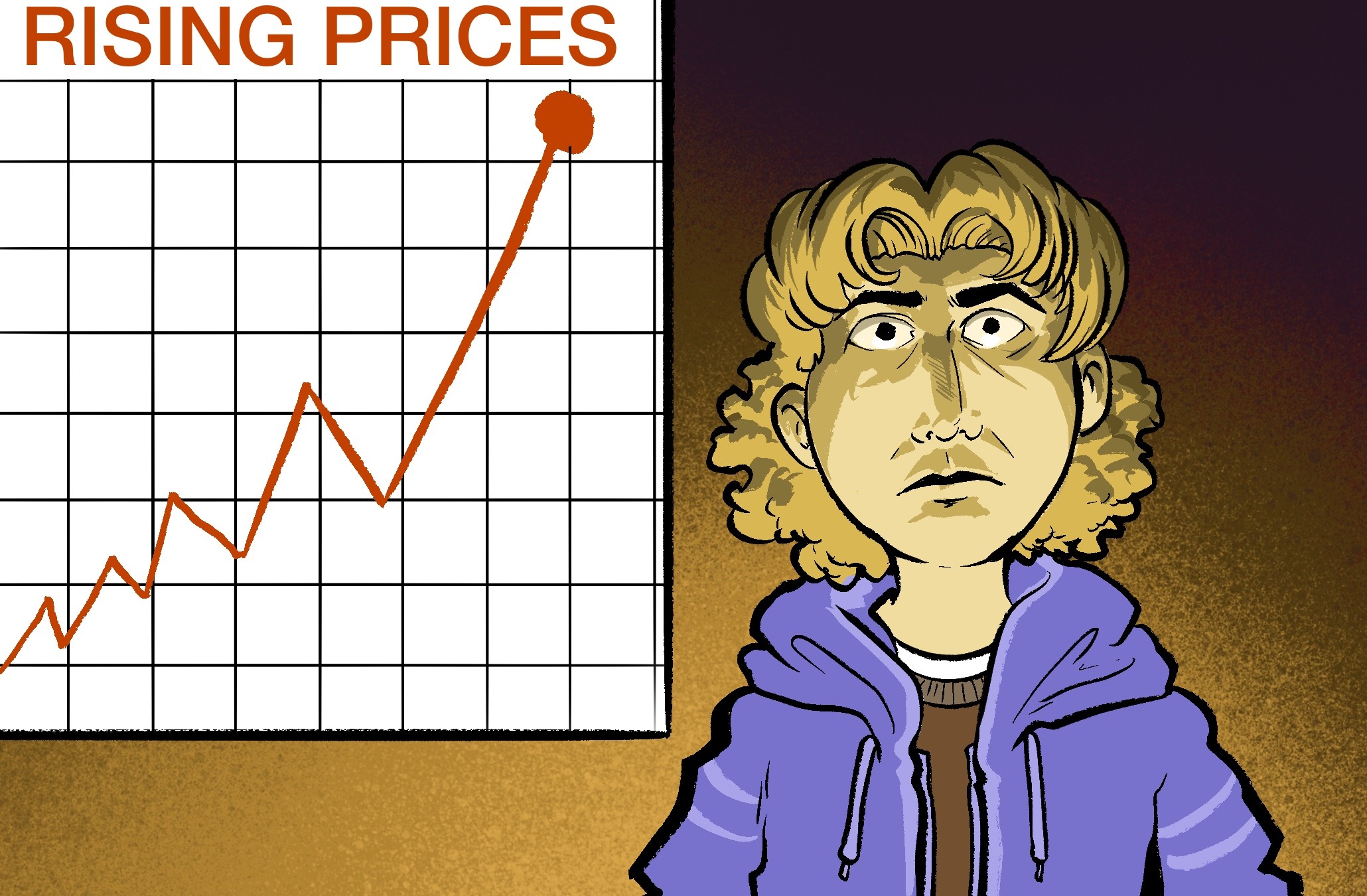
After a day of worrying about the future in a rapidly changing world that seems to be making young people’s efforts obsolete, many full-time college students go back to their dorms to decompress with something like a YouTube video. Immediately, they are met with back-to-back unskippable advertisements.
The first is an artificial intelligence (AI)-generated ‘charming salesman’ type, whose face moves a little too fluidly while the fibers in his suit are shifting around, trying to buy your trust in the cheapest way: Void of humanity. The second is also AI-generated, this one showing a giant hand picking up a shrunken-down senatorial candidate by the shirt collar like a kitten by the scruff.
When I see these types of ads, I am reminded of the degrading quality in not only the media we are supposed to enjoy, but also in housing affordability, the climate and the cognition of our oldest legislators. In a recent survey published by GALLUP, young people’s ratings of life quality have been shown to have gone down by 20 points since 2010. What used to be 64% is now 44%. Rising rates of loneliness and feelings of isolation in American youth are undoubtedly linked to social media usage, but disillusionment with the state of our reality is often ignored as an influence for negative outlooks plaguing young people.
Prices for necessities such as food, water and shelter rise while portions of food and quality of housing shrink. It was just a couple of years ago when Kellogg’s CEO Gary Pilnik said that struggling families “should eat cereal for dinner.” The federal government is now preoccupied with promoting ‘pro-birthing’ policies in response to a declining national population replacement rate.
Politicians never seem to ask themselves “Why?” The answer is: we cannot afford to feed another mouth when we struggle to feed our own; we cannot spend time on raising a child when our time is spent working and sleeping; we cannot pay the medical bills of a brand new baby when our own have put us in hefty debt and we cannot afford to send a child to school when we are paying our own student loans far long after we graduate.
Young people are staying stagnant because our future does not look sustainable. The feelings of isolation young people experience as a byproduct of our times can be used as a prompt for civic action and community building. “Community building” may be a popular buzzword, but helping out others who live around you can create a strong network of support through persistent action. Many voices are louder than just one, and one voice is better than a silent mental frustration shared across a group who face the same obstacles.
Ivan Byrde can be contacted at
ivanushka.byrde@keene.edu