

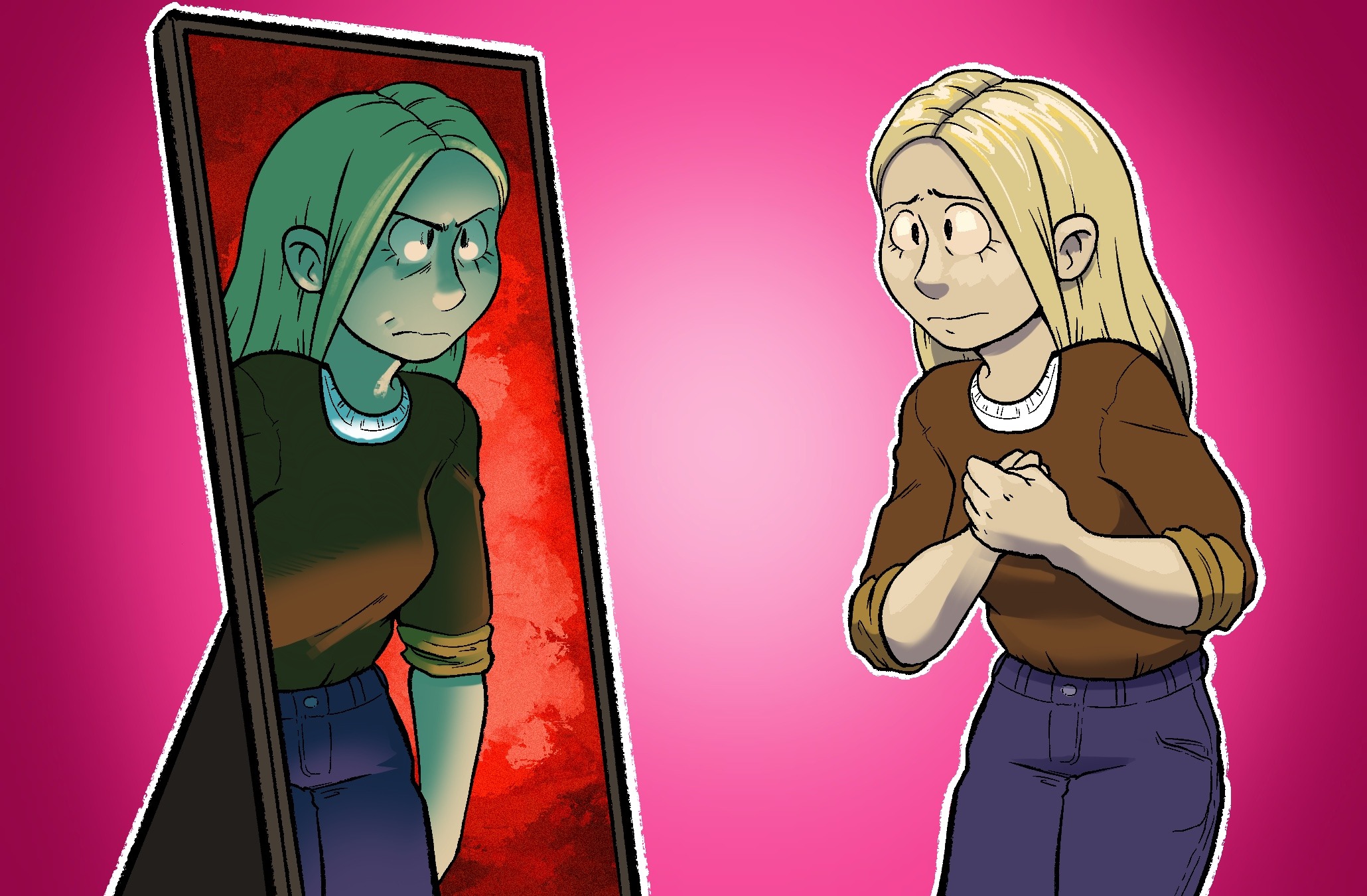
I have noticed something about the way women talk about other women. People are quick to say that we support women; we repost Instagram graphics about girl power, we tell our friends that they are beautiful, smart and deserving of everything they want and we say that women should lift each other up. But sometimes, we get together with our friends and completely tear another woman apart.
That one girl in class “thinks she’s better than everyone,” another girl is annoying because she is loud, the girl who wears a lot of makeup is “trying too hard,” while the girl who does not wear makeup is “not trying enough.” A woman who sleeps with a lot of people is promiscuous, while a woman who does not date anyone is boring. Most times, none of this is even recognized as misogyny.
There is a temptation to distance oneself from other women, and saying “I’m not like that” is an incredibly common way to do it. The phrase “I’m not like other girls” has become a joke, but there is something serious beneath it. Why is being different from other women supposed to make someone more interesting? Why is being called a “girl” so derogatory?
Growing up, “girl” was often used as an insult long before there was language to understand why. Being associated with femininity could feel embarrassing, and liking things considered “girly” could make someone an easy target. Somewhere along the way, we learn that being different from other girls is a compliment. Being “one of the guys” can seem cooler than being a girl, while traditionally feminine interests are treated as shallow, dramatic or less important.
That attitude does not necessarily disappear in college. College is one of the first environments where young women are surrounded by hundreds of other women making completely different choices than their own. There are women who dress differently, date differently, party differently, study differently and present themselves differently. Instead of simply thinking, “That is not for me,” there can be a need to judge.
The girl who goes out every weekend is “a mess” and the girl who never does is “boring.” The girl with a boyfriend is “obsessed with men,” the single girl is “lonely” and the girl who talks to a lot of guys is “promiscuous.” The girl who does not talk to any is “weird,” the confident girl is “full of herself” and the insecure girl is “attention seeking.”
There is seemingly always a reason to criticize another woman, but there is something even more revealing about these conversations: When women dislike each other, appearance is often one of the first things attacked. It is almost automatic.
“She’s not even pretty,” “Her makeup always looks terrible,” “Why does she dress like that?” or “She’s fat.” It often does not matter what the original disagreement was; somehow, appearance becomes relevant. A woman can be rude, and suddenly her body is being discussed. She can be annoying in class, and suddenly her clothes become the punchline. She does anything, and suddenly her face, hair or weight become fair game. Why? Because women are taught that appearance is a measure of value.
From an early age, women learn which bodies are desirable, which clothes are flattering, what makeup is acceptable and what makes someone “put together.” Women are constantly encouraged to evaluate themselves against one another, so when one woman becomes the target of criticism, appearance becomes an easy weapon.
The irony is that the standards used to insult another woman are often the same standards that make women feel inadequate to themselves. Unrealistic beauty standards are criticized online for being such, and then those same standards are used to insult another woman. Women are criticized for being reduced to their appearance, and then another woman’s appearance becomes the first thing attacked when she is disliked. That is internalized misogyny.
From a feminist perspective, this is not simply about women being mean to each other—it is about the way women have been taught to understand female worth. A culture that constantly evaluates women based on appearance, sexuality, relationships, likability and proximity to men eventually produces people who enforce those standards themselves.
Women become the ones policing each other.
Social media makes the comparisons even harder to escape. TikTok and Instagram provide an endless stream of women who appear prettier, thinner, happier, more successful, more fashionable or more desirable. It becomes incredibly easy to turn insecurity outward. Instead of questioning why women are expected to look a certain way, the comparison becomes, “At least I don’t look like her.” Instead of questioning why women are constantly compared to one another, the comparison continues.
Women might make fun of another woman for being “too much.” Maybe she talks loudly, dresses boldly, has strong opinions or is not afraid to take up space. She might be called annoying, dramatic, attention-seeking or full of herself. But why are women so often expected to make themselves smaller to be considered likable? Why does confidence in a woman so quickly become arrogance, while the same confidence in a man can be seen as leadership?
This does not mean every woman has to like every other one. It does not mean every decision a woman makes is automatically feminist, and it certainly does not mean women can never criticize other women. The important question is why the criticism exists. Is the behavior genuinely harmful, or has society simply taught us that certain kinds of women deserve to be disliked? That distinction matters.
Feminism also does not require constant compliments or pretend friendships. “Support women” can become another social expectation that feels performative. Not every woman needs to be admired, defended or considered a friend, but disagreement should not require reducing another woman to a stereotype.
It is easy to recognize misogyny when it comes from a man. It is much harder to recognize it when it comes out of a friend’s mouth, appears in a group chat or sounds like an ordinary joke. It is harder when everyone around the table agrees and when criticizing another woman temporarily makes someone feel better about herself, but that is exactly why it deserves attention, because if something feels completely normal, it is easy to forget that it was learned. It could have been taught by our mothers, television, men, other women or by the thousands of small messages absorbed since childhood about what makes a woman “good” or “bad.”
Probably all of the above.
Women do not need to become nicer to each other simply for the sake of being nice, the more important task is becoming conscious of the standards used to judge women in the first place. A woman should be able to walk into a room without immediately becoming someone else’s comparison point. Not competition, not a threat and not a stereotype. Just a person.
Dismantling misogyny is not only about challenging the men who perpetuate it, it also means recognizing the ways misogynistic standards have been taught, normalized and passed between women. And sometimes, the most important feminist question is not “Why don’t I like her?” It is “Why was I taught to dislike women like her?”
Charlotte McDaniel can be contacted at
cm1621@usnh.edu