
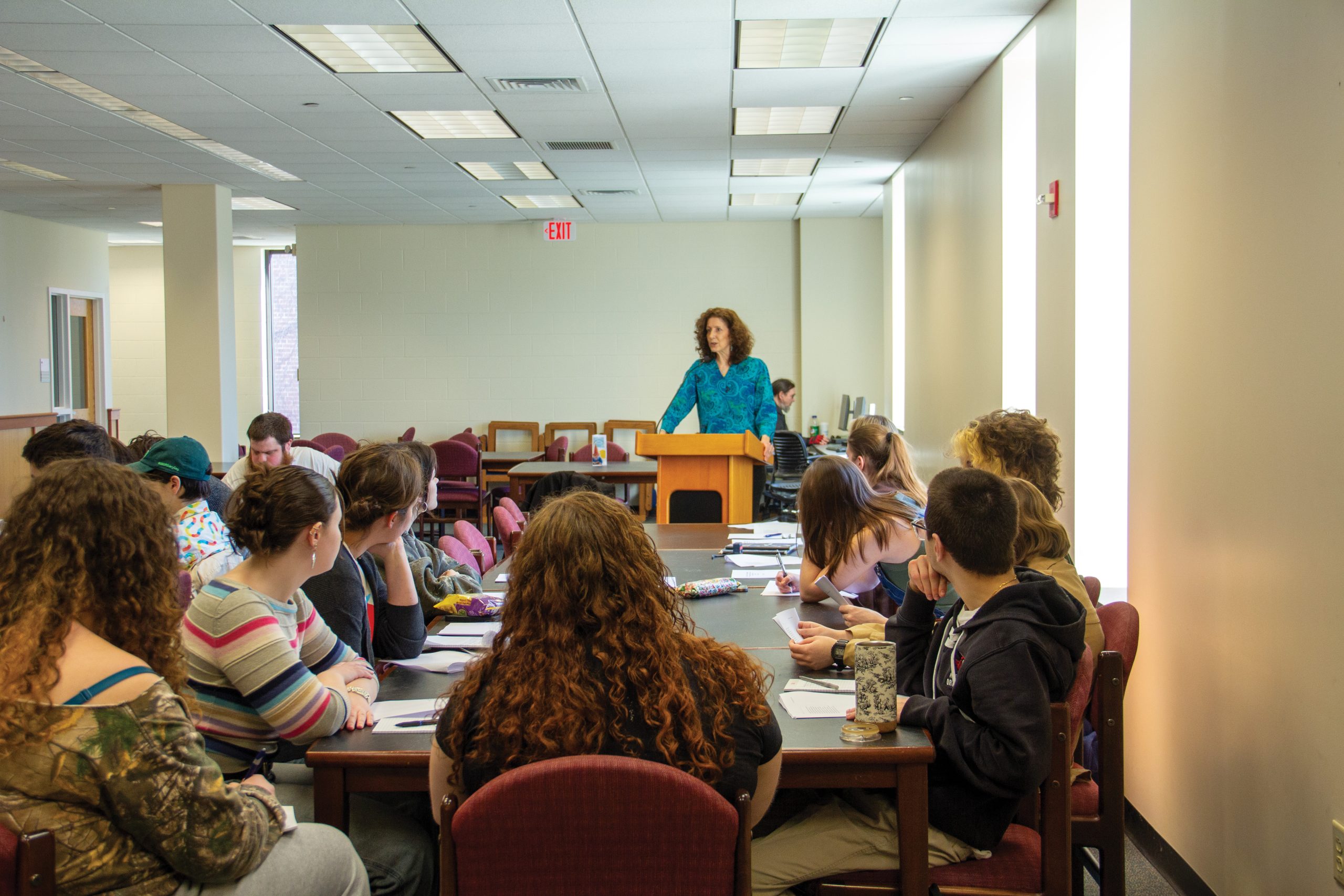
Ink and graphite flowed onto pages in the Mason Library’s West Wing as over 25 students got the chance to exercise their poetry skills during a workshop with award-winning New Hampshire-based poet Meg Kearney entitled “Working in Words.”
Keene State’s Archives and Special Collections hosted Kearney on April 9 as part of a program to celebrate Poetry Month, made possible by funding from a PepsiCo Partnership Grant.
Kearney reflected on the importance of poetry as a medium, referring to the late poet Stanley Kunitz’s quote, “Poetry is ultimately mythology, the telling of stories of the soul.”
The programming saw students, primarily from Adjunct Faculty Rodger Martin and English Professor Brinda Charry’s creative writing courses, create works from two distinct types of poetry: “Tell it Slant” poems and “Creed” poems, splitting the event into two halves, each based on the respective form.
Referring to “Tell it Slant” poems, Kearney said the category manifests as “telling all the truth, but telling it slanted,” as evidenced by the 19th-century poet Emily Dickinson’s work, according to Kearney.
“Find a different way in, other than hitting something head-on,” Kearney advised students. “We’re going to try to write what’s called an extended metaphor that comes at the truth sideways and also gets away from abstract language into more concrete language, words [and] phrases that make you see, feel, hear, touch, taste [and] smell.”
Kearney also explained her motives behind writing poetry to the students.
“A lot of times I write poems because there’s just no other way to express what I’m thinking, what I’m feeling. If I could’ve said it any other way, I wouldn’t have had to write a poem about it,” Kearney said.
After students read aloud examples of selected “Tell it Slant” works, they were off to the races, armed with writing utensils, papers and 30 minutes to jot down rough drafts of their work.
“Tell it Slant” poems from students covered a wide range of topics, ranging from stories of coming out to those of impending graduation and life changes.
Kearney led the discussion after each poem was read, asking students what stood out in each work and what words caught their attention.
Participants reflected on the joyous feelings reflected in the poem and the use of rhymes.
One student, junior T. Jasper Keyes, read his work, entitled “Gender Euphoria.”
Gender Euphoria, by junior T. Jasper Keyes
Bring your acrylics, your brushes, your knives, your modeling paste and blank canvas
Throw down the dropcloth, strip naked in solitude, queue up a dancing tune
Sing loud together, rebel yell soaking the walls long past dormhall noise curfew
Buzz down your hair in the bathroom, shaggy wolf dog muzzled in the groomer’s stall
Nuzzle the nascent sideburns, the chin scruff
Knock back a burning whiskey shot
Crack your knuckles ‘til the marrow pops
Get high together, relearn how to fly together
Scalpel to marble, needle to paper, skin to familiar skin
A student, junior Lyle Lynde, read their work, entitled “Coming Out to You.”
Coming Out to You, by junior Lyle Lynde
It’s like a centipede, really
With his rising carapis, quick, skittering feet on the linoleum
He came from the garden when the screen door was cracked open so you could chainsmoke in peace
Doling away white puffs from your American Spirits caught by the breeze
He came from the garden where he felt the warm sun on his exoskeleton
Nestled in the soil in the dry grass forest
Now he evades you, clicking his mandibles in tongues you do not speak
How I wish I could swallow him back up, thorny legs scratching my throat
But you’ve seen him, and you are poised with a newspaper
Oh, if only he had stayed in the garden, perhaps he could drink from a drop of dew glistening like a marble
Now, whenever I step on dead leaves, I remember the crunch of his little body smeared across the floor
One student attendee reflected on how the poem made them feel bad for the centipede as depicted in the work, despite their usual adverse feelings toward the invertebrate.
“The more you use all this concrete, sensual language, more people are going to remember what you wrote and feel what you feel,” Kearney said.
Senior Lauren Dombrowski’s poem, entitled “The Inbetween,” reflected on her impending graduation from KSC.
The Inbetween, by senior Lauren Dombrowski
The day has finally come
My peers next to me are anxiously awaiting
Some are overfilled with joy, and others may tremble with tears
All the memories from the past four years have crawled upon us
I said to myself, “This is it,” then I hear, “You may all turn your tassels to the left.”
This really is it
Junior Parker Bartlett shared his poem, entitled “Birthdays,” as well.
Birthdays, by junior Parker Bartlett
Today, I feel old
Older than yesterday, younger than tomorrow
My bones creak when I stand, like the floorboards of an old barn, a barn far older than I
I waited through poor friends and the comfort they keep, keeping an eye out for the poor choices they accompany them, blind to it all just the same
There is plenty to resent, plenty more to love, yet no time to ponder it all
Oh, death, I’d love to have this dance
To forget it all, if but for a single waltz
But in your embrace, I can no longer see the sunset, nor hear the birds sing
Oh, death, tonight I’d rather just be
Participants reflected on the somber nature of the poem and the imagery of a dance with death and that of an old barn.
The second half of the workshop saw a smaller, more tight-knit group comprised of around half of the original group, and this portion of the event focused on “Creed” poems. “Creed” poems focus on statements of personal belief, such as those where each line begins with “I believe,” in repetition, or just a simple, consistent expression of belief throughout a piece, according to Kearney.
Students once again read off examples of “Creed” poems and ultimately composed their own within a 25-minute timeframe.
Poems ranged from statements about belief or disbelief in religion, as well as social, political, cultural and personal beliefs.
Kearney praised the work of the student participants.
“Write some more,” Kearney advised.
Nathan Hope can be contacted at