
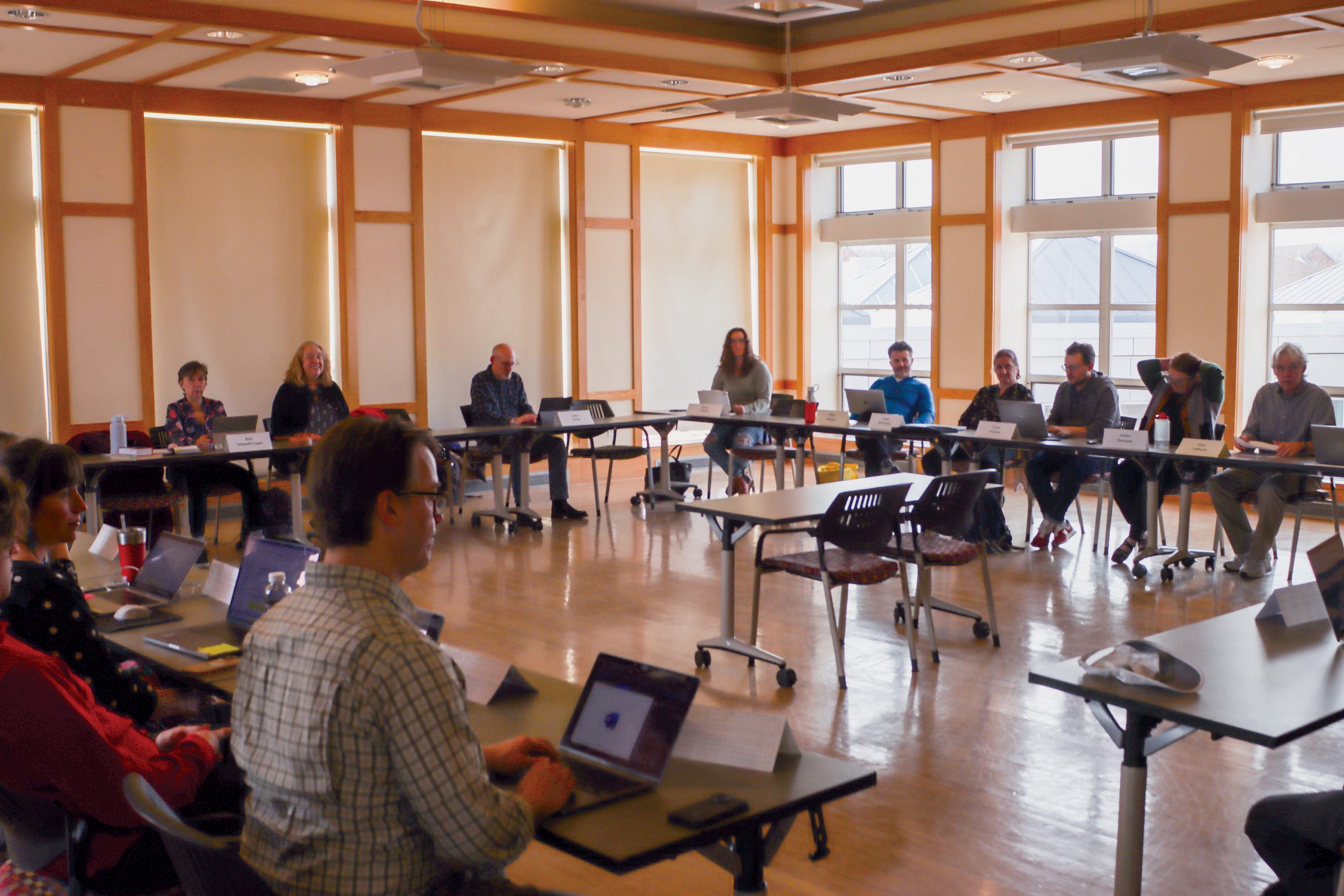
Most undergraduate internships will now be designated by a 97 at the end of the course number after the most recent meeting of the KSC Senate on April 8.
Greg Knouff, current chair of the Academic Standards and Policy Committee (APS), emphasized the role that internships play on campus and said the committee looked at the course numbering policy.
“We took up a discussion as of number of internships that currently end in a ‘97,’” Knouff said. “So we discussed this and you will see that we have a proposal to change the college-wide numbering policy. The two changes are to add the following term of courses ending in ‘97’ will be internships and we also obstructed some of the language. Doing this on a piece-by-piece basis, taking away some of the ISP language with the gen ed switch.”
Senator and Associate Professor Kim Lauffer added an amendment to the proposal.
“I ask that we make a friendly amendment to include the words ‘at the undergraduate level’ after the proposed addition,” Lauffer said.
The amended version of the proposal passed, establishing that all undergraduate courses ending in “97” will be internships.
Senator and Professor of Communication and Philosophy, Amber Davisson, raised concerns over whether the change would affect the computer science program. Kim Schmidl-Gagne, the Senate parliamentarian and college’s assessment officer, responded, clarifying that “it was clear that there were some [internships] that have ‘200s’, ‘73s,’ and I now have a list of everything that people call internships. There are numerous programs that use numbers other than ‘97.’ I think what this is saying is that ‘97’ should only be used for internships.”
The amended proposal passed unanimously after the senators’ questions were answered regarding the change.
“APS did meet as per our charge to discuss the transfer recommendations that were passed under the new general education proposal,” Knouff went on. “APS took a look at a lot of our previous recommendations and we were able to get SASS’s [Student Academic Support Services] perspective on this. A lot of those recommendations are recommendations that SASS currently operates with.”
Knouff emphasized that a point of concern during the discussions was whether the recommendations are already the current practices for multiple offices and what should be implemented going forward.
“One proposal is making language consistent with the second degree policy for people who are coming here to transfer in,” Knouff said. “So we’re working on a draft of that alongside a draft of general education transfer credit. That is designed to make it easier for students to transfer in with an associate’s degree and be pretty clear about what they need to finish out the general education program.”
Knouff said that for the upcoming Senate meeting, the proposal would be brought forth by both the College-Wide Academic Program Committee (CAP)and APS.
Mike Cullinane, chair of CAP and professor, spoke on what his committee is doing to clarify the changes to general education.
“We have met twice since the last senate meeting,” Cullinane said. “The first of those meetings, on March 25, we were continuing our discussions of the questions that we had been charged with by the senate executive committee. We’ve opened to votes and then we’ll report to the senate on what we’re recommending for the clarifications on the general education explorations program.”
Nick Germana, chair of the Senate Curriculum Committee and professor of history, was re-elected for his position, along with Greg Knouff for the Academic Standards and Policy Committee.
Chloe Erno can be contacted at