

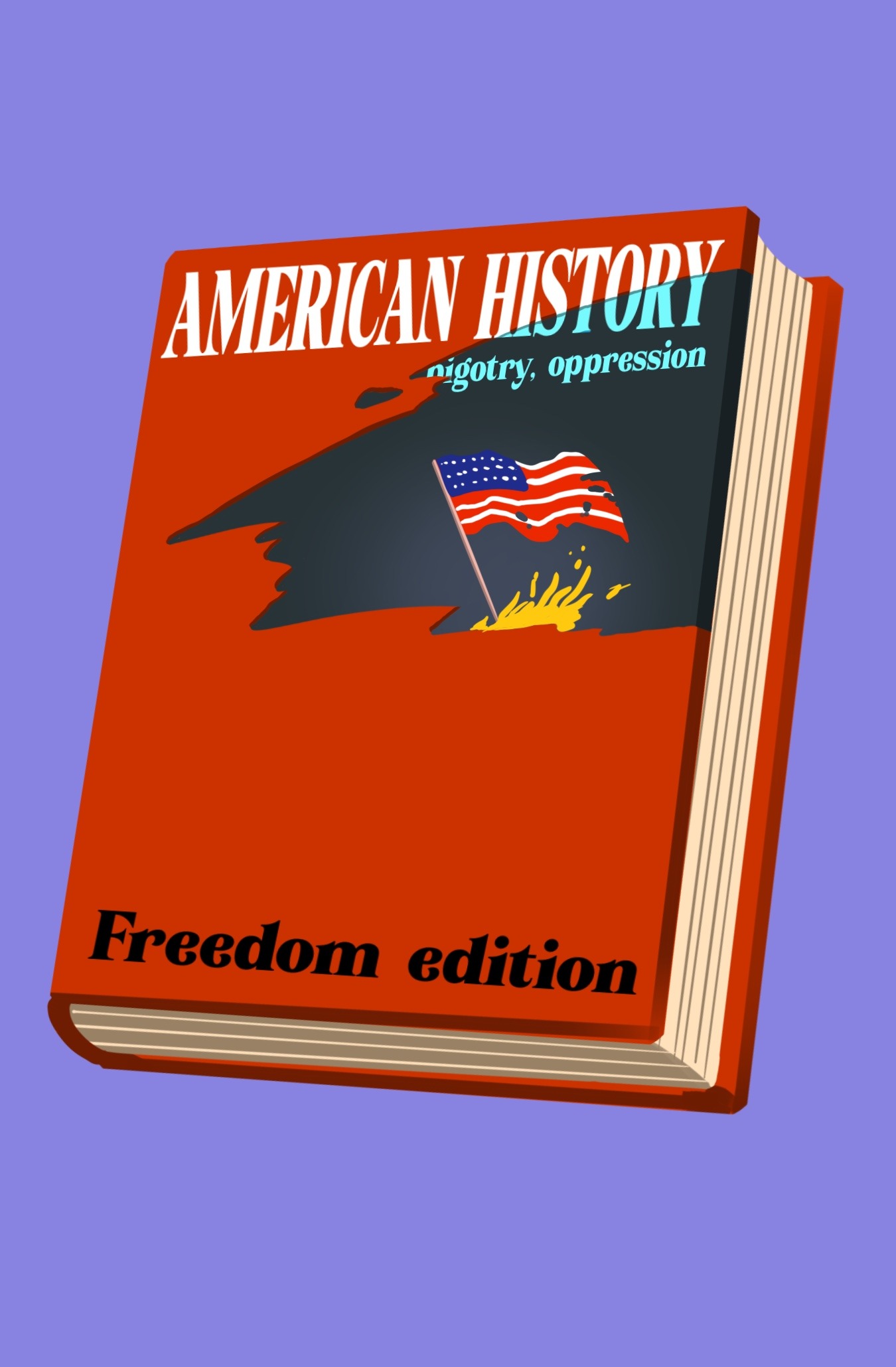
As a young child, I always accepted what I learned in school to be fact. My parents solidified this every time I asked them, “Why do I need to go to school?” They would say, “You go to school to learn,” and that was that. I never took a second to ponder how my parents would feel about what it was that I was learning, or whether what I was learning was legitimate or not. What child has time for that? There were more important things in my world, like chasing butterflies, melting play-doh and watching Ninjago.
It was only when I came close to young adult-status that I began to think a little differently about some of the things I had been taught. Things like how I learned so extensively about Martin Luther King Jr. during the Civil Rights Movement but hardly anything about Malcom X, or how up until eighth grade or so my teachers frequently referred to our nation’s original human inhabitants as though they hailed from India rather than American land.
I thought that perhaps this should have been corrected. I didn’t blame anyone or think my teachers were evil for teaching what they did, and I most certainly didn’t think my country was evil for it. I just figured history should be taught to me like it truly was, that’s all.
How grateful am I that in the year of 2026 I’m a first-year in college pursuing a Journalism degree rather than one in Education, because lawmakers are now rallying to make it so that if I had wanted to become a teacher, I could be criminally prosecuted for thinking twice about teaching my curriculum to students if it contained anything pertaining to the topics I’ve reflected on. This revelation finds itself in the CHARLIE Act.
According to Valley News, “named after the conservative activist Charlie Kirk, House Bill 1792 would prohibit schools from engaging in “indoctrination” of “critical theories or related practices that promote division, dialectical world-views, critical consciousness or anti-constitutional indoctrination.” The bill’s title, the Countering Hate And Revolutionary Leftist Indoctrination in Education Act,” forms the acronym “CHARLIE.’”
This bill was passed by the New Hampshire House Republicans chamber on Thursday, Feb. 19. “The bill passed nearly along party lines, 184-164, with four Republicans joining all Democrats to oppose it. It heads next to the Senate, after Rep. Ken Weyler, R-Kingston, the chairman of the House Finance Committee, waived the option for his committee to review the bill,” according to Valley News.
The purpose behind passing this bill is rooted in opposing something that the now deceased political activist Charlie Kirk advocated heavily against, a concept known as critical race theory. Critical race theory is “a set of ideas holding that racial bias is inherent in many parts of Western society, especially in its legal and social institutions, on the basis of their having been primarily designed for and implemented by white people.”
The reasoning behind why this theory must be abolished in schools is rooted in the idea that by implementing this theory within teaching, students will be indoctrinated into developing hatred towards white people and, by extension, the founding of the United States and the ideals for which our country stands. In response to this idea, I ask a simple question: Should we not be taught our history?
Here are some concrete facts of American history. Our country is over 248 years old, officially created in 1776. Slavery was abolished over 170 years ago, officially de-institutionalized in the year 1865. That means that slavery was a legalized institution in our country for roughly 78 years, 22 years short of a century.
Despite full-on slavery being abolished before the 20th century, legalized segregation persisted in public schools until the year 1954, roughly 89 years later. While segregation was declared unconstitutional in 1954, the last segregated American public school was not desegregated until the year 2016, which was 10 years ago now. So, for 78 out of the 248 years of American history, the complete enslavement of human beings based on race persisted legally, and for 240 years, so did segregation in state institutions.
On the topic of segregation specifically, a commonly posed question is “how was segregation allowed to continue for so long even after it was declared unconstitutional?” I answer this with another question: When a baby is first born out of a mother’s womb, does it immediately know how to walk? The answer is no.
See, a baby has only known its womb, where its legs are bunched up and it merely floats in fluid, until it takes its first breath. When creatures only know one thing for so long, it takes a while for them to adjust to doing things differently. The same can, unfortunately, be said regarding segregation in the United States. That same principle applies entirely to why teaching critical race theory is not a form of evil indoctrination, but rather a necessary part of allowing the American people to process our history.
Believing racism perished immediately when slavery and segregation were made illegal is an extremely negligent worldview to have. The literal constitution that our nation is founded on–the piece of writing that defines each branch of our government–was crafted at a time when slavery was legal and widespread. The first police force established within our country was created for the sole purpose of hunting down enslaved people who managed to escape their horrific circumstances. Many American family trees still growing today accumulated generational wealth by profiting off of enslaving human beings simply because their skin was darker, and that meant they legally could.
All of these things and more created a culture beyond laws and legalities. Our country’s history is bathed in systemic racism, and attempting to outlaw the teaching of that reality is as detrimental as attempting to outlaw the teaching of our constitution would be. Censoring history is wrong. Period. The people putting the CHARLIE act forward who are of the belief that learning anti-racism is learning anti-whiteness need to take a good, long look at themselves in the mirror and think about why it is that in their minds, those two things are not mutually exclusive.
It is high time for our culture to stop pandering to the egos and negligence of the people who put forward laws like this. Oppose the CHARLIE act. Oppose censorship in schools. Educate yourselves on what the term “systemic” means. Then start speaking up.
Serena Taylor can be contacted at
staylor@kscequinox.com