
Whatever the world has come to, it has been bad enough to spawn superheroes in major and minor cities. Yes, real superheroes; not yet at the level of Captain America or Superman, but they’re making more of a difference than anyone could have ever imagined from people running around in homemade costumes at night. Well, some of them, at least.
Funnily enough, superheroes have been around for a much longer time than the mainstream says. I just do not think we noticed them as much until now, when we have content-making ones. It is a subculture that I never even knew existed, so huge that I do not even have enough page space to cover all of them. They had to be somewhat recognized at some point, though, considering a documentary was made about the rising number of superheroes back in 2011 titled “Superheroes,” which can be found streaming on Tubi.
On the RLSH Wiki (Real Life Super Heroes), there is a whole directory and map to locate superheroes that are recognized by RLSH, with hundreds of names and groups in cities across the nation and even around the world. Every hero’s page lists information about them, such as their abilities, affiliations/affiliates, foes and outfit details.
One that recently came to my attention was the D3V1L, who began a group of superheroes called the New York Initiative back in 2009. According to the New York Initiative website, there are ten heroes in the group, each with their own specific roles with the goal of “stopping violent/sex crimes through the use of direct action, including ethical investigations, community networking, and physical intervention (de-escalation-based and adhering to proper levels of force).” For more detailed information on what they have handled in the past, there’s a timeline on their website as well.
What I found there is that they really did a number on helping people back in the early to mid 2010s. They were– and still are– real heroes in my eyes, considering the number of charity events and help they have provided in the core of the Big Apple. But is that the same for those assuming similar roles today? Or are they here for the name and spandex?
There are some more major names in this recent escalation of superheroes. The biggest name I know of is Skyline, the first one I came across online. For anyone curious, most– if not all– of these superheroes can be found on social media. In Skyline’s case, he has an Instagram account and a YouTube profile. As an Albequercue protector, he goes on night patrols and gives out food, water and hygiene products such as deodorant and shampoo to the homeless, plus cleans up a lot of trash on his way around whatever area he’s patrolling.
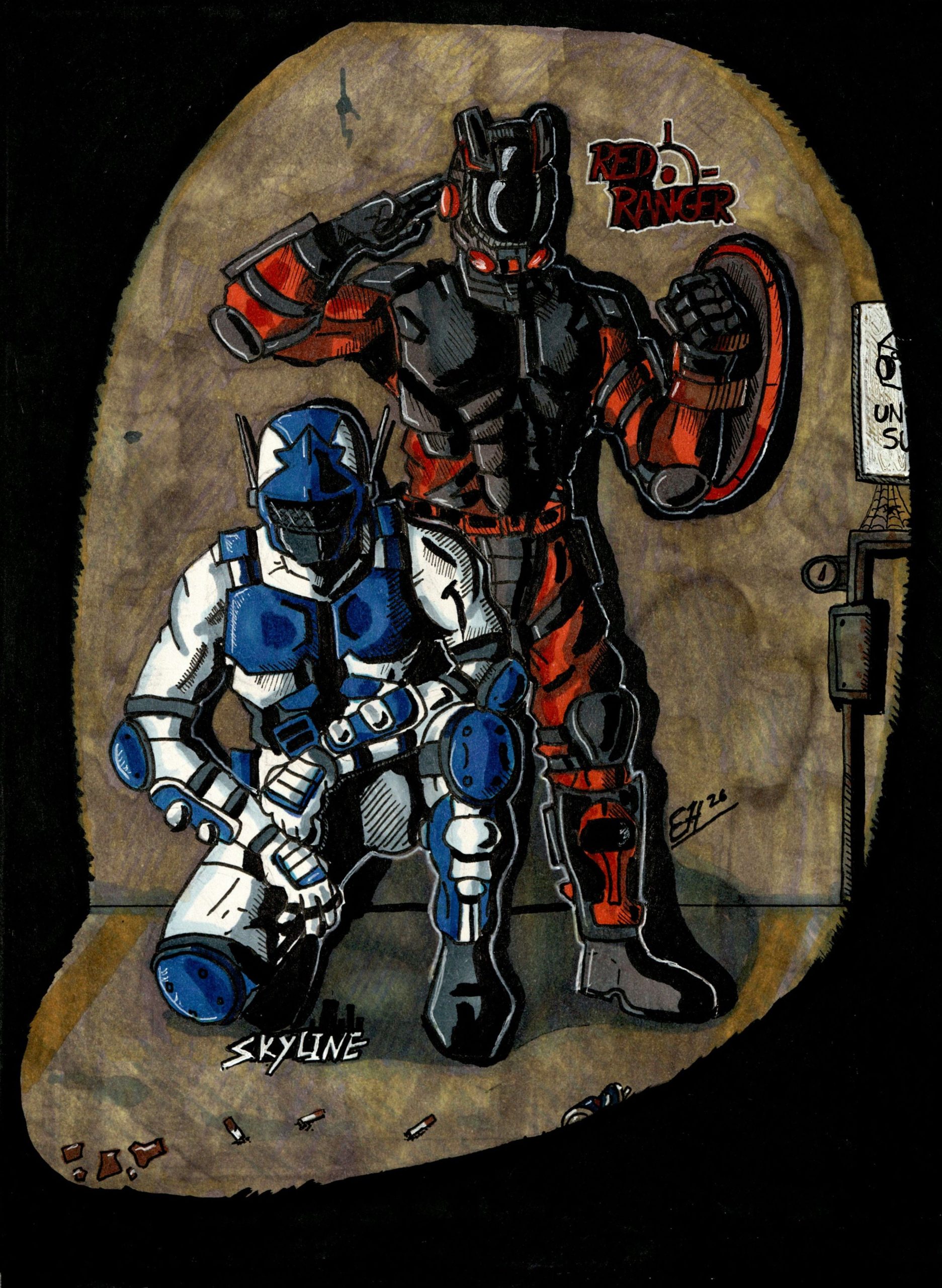
His bulletproof outfit is pretty interesting, with a mix of white, black and light blue to be bright and approachable, according to a reel he posted on Instagram, similar-looking enough for him to often be called a Power Ranger. For a homemade suit, I think it’s well-detailed.
According to his “Real-Life Superheroes Start Somewhere…” video on his YouTube channel (what I’d call a channel full of humorous content both about superheroes and hero-based video games), he explains what he’s done and his various training in fighting techniques, such as boxing and Shaolin. He also talks about how he has had a lot of jobs– 28, to be exact– mentioning his military experience to a vague detail. There’s more information on his Instagram profile about his backstory, but in one reel I found, his military service ended after about a year and a half due to some mental health issues regarding the passing of three loved ones from Covid.
Prior to taking on the Skyline name, he became a rapper (a superhero called Mystery Figure) in an attempt to raise money to become a full-time superhero. He also became part of many activist groups, but ditched them after he realized how many others were already on the streets. The backstory reel he posted on Instagram goes more in depth of his life leading up to being Skyline.
Another I found was the Red Ranger, a Seattle superhero and leader of the team known as ECHO, or the Emerald City Heroes Organization. It was established back in 2013 with a goal to “raise public safety awareness, conduct public safety patrols, participate in community service projects, and lend a hand when other RLSH groups might need more bodies in the Greater Puget Sound Area.” The Red Ranger patrolled on his own until he encountered the organization in 2014, according to the RLSH Wiki.
His outfit is similar to that of Skylines, apparently an attempt to impersonate the Red Power Ranger, but primarily Red and Black. While his identity remains anonymous, he works as a medic by day, according to a video made by king5evening in 2025. Being a medic is heroic enough, but doing even more at night afterwards? I can’t even describe how admirable that is.
But let’s talk about the cons. Not to be a negative Neil, but there are some obvious problems with this. Whenever there’s good, there’s always going to be some form of evil to take advantage of it. Are we to assume anyone running around in a costume is to be trusted with our lives? What if they aren’t trained? What if they can’t protect themselves, never mind us? What if they are out there for the sake of wearing a costume and pretending to be someone greater than themselves?
An example of this is Phoenix Jones, another vigilante in Seattle, where he was based in the early 2010s. He was arrested after being found to be a drug dealer after disappearing from crime-fighting for a while, according to the Seattle Times. I guess his greatness didn’t last long, considering he was the leader of the Rain City Superhero Movement sometime around 2012, according to Slate. It did not seem like they were doing much of anything back then, but making things worse.
And you want to know what came of it? A villain emerged, calling out the group as fake and delusional – Rex Velvet, who turned out to be more right about them than we could have ever hoped or feared. He has a video on YouTube from back when the movement was growing, calling himself “the people’s villain,” considering that a lot of people were really on Velvet’s side, given that the heroes were nothing more than people stampeding around the streets. The madness the movement created, instead of heroism, was only proven later when Phoenix Jones was arrested.
Am I saying it is wrong for people to go out and be a superhero? Am I saying it’s bad to fight for what you love? Not in any way possible. Heck, if I lived in a city with skyscrapers and alleyways filled with trouble and had the time to be fighting crime and helping the homeless, I’d be out there, no capes and all. I would even improve past my yellow belt in karate to help out with these things, but I can’t. Most people cannot– commitments, classes, bedtimes, they really get a hold on us, but some people have the time, some people make the time. They use what time they have and give it to helping others. That is commendable in itself.
Does putting on a costume make you a hero any more than holding a baseball bat makes you a major league champion? No. Being a superhero means so much more than that. It’s not about wearing a fancy costume and posing for pictures. It’s about making a name with that persona, of knowing what it means to wear that outfit, to be more than someone to take pictures of or to gain popularity online. It is to live with tough choices, to persevere through evil and to put actions to your name to prove you are a true hero (cliché, I know). Some heroes, such as Red Ranger and Skyline, understand that. Others do not. That’s the way the world works.
For those who are truly making a difference in the world, it is an amazing and noble thing to be doing, especially in the times we are surviving. I thank those who remember what it is like to care for others, and I thank the heroes who are doing this to make a difference, not an influence. I hope everyone can follow their example, with or without the sparkling tights.
Hayley Doda can be contacted at