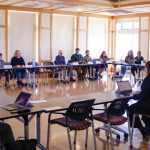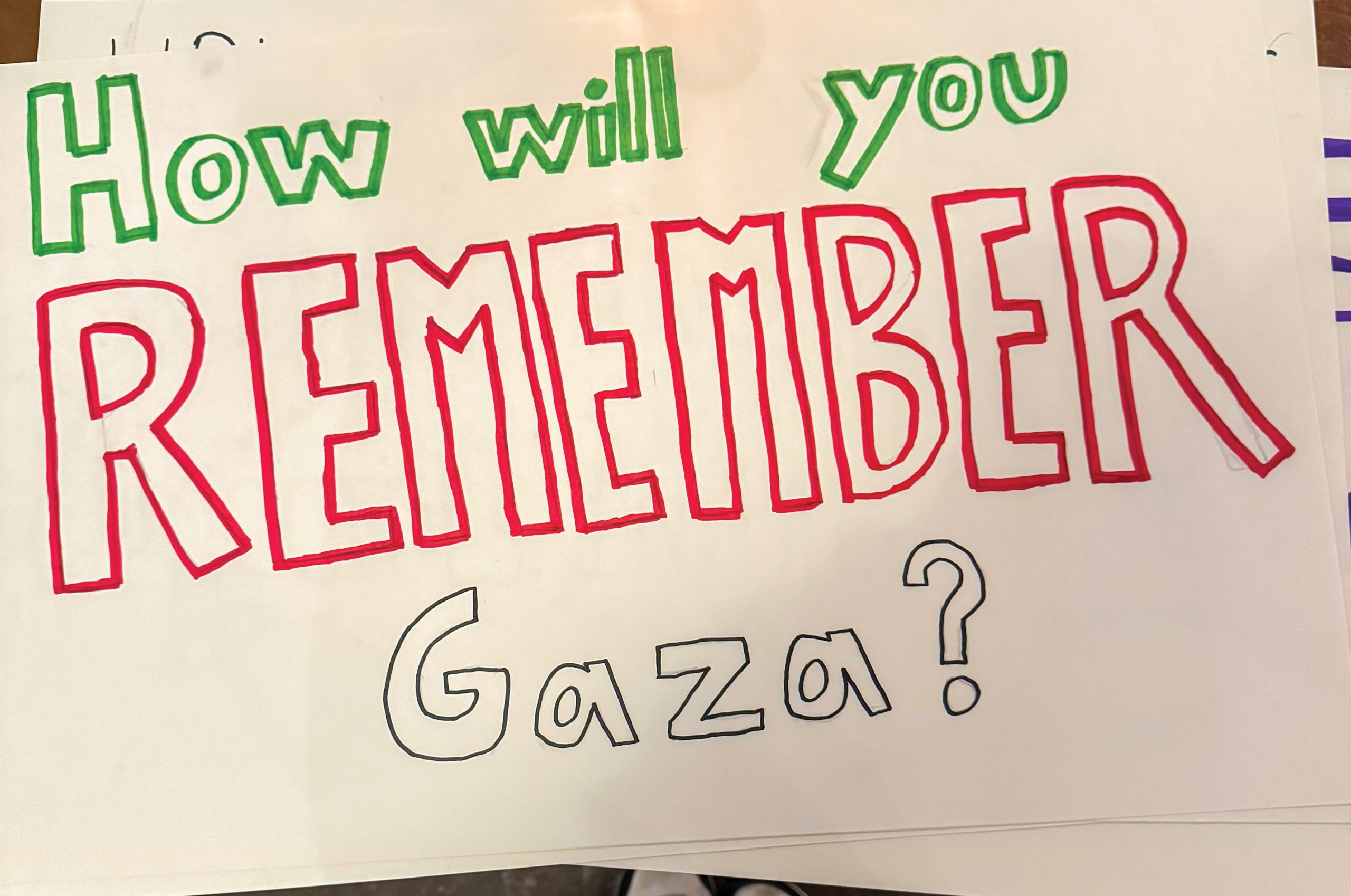
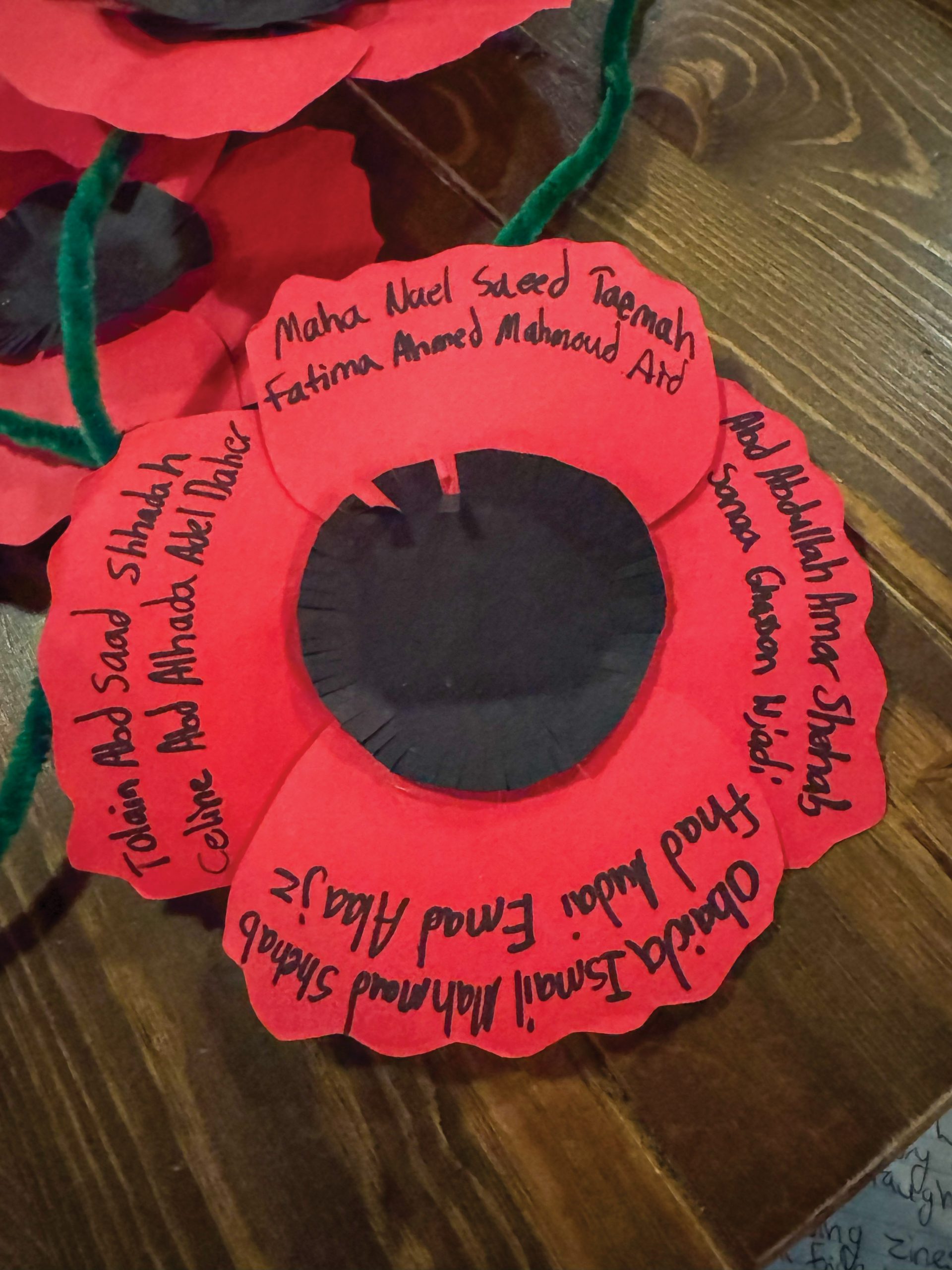


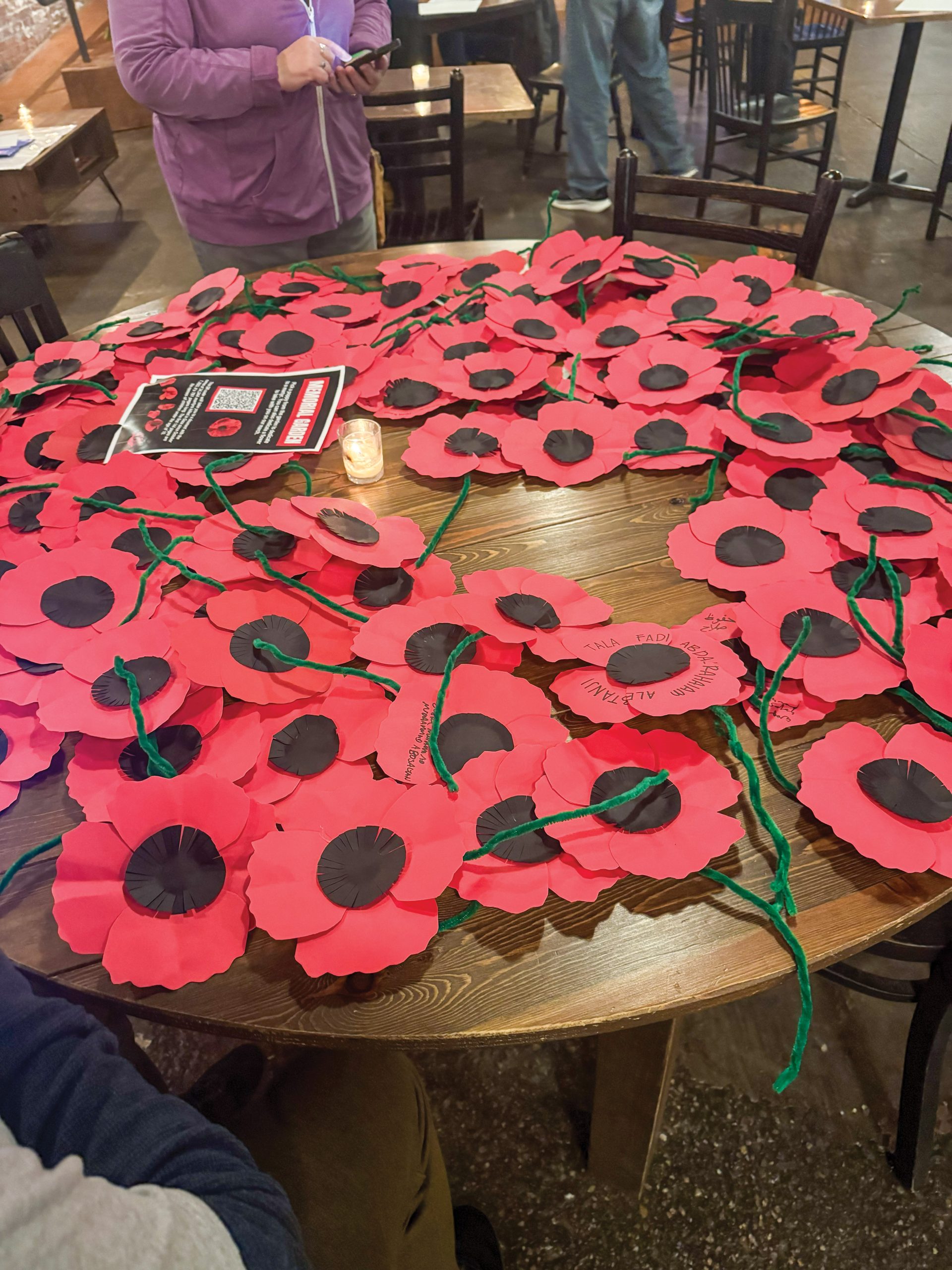


On October 15, Keene For Palestine hosted an art build downtown at Brewbakers. The event included folding zines, painting a banner, decorating mirrors and writing the names of the dead on poppy flowers. According to the Papa Art Foundation, “The red anemone, also called the Palestinian poppy, is known as the ‘Flower of Martyrs.’”
The poppies were included so attendees could write the names of those killed in the war in Gaza on their paper petals, with a list of those killed—many of which were children—provided for those who participated in the activity. According to Middle East Eye news, “Featuring all four colours that make up the Palestinian flag, the poppy has come to symbolise resistance and indigenous Palestinian heritage; the rich red also represents the blood shed by those who have fought for the Palestinian nation.”
Katie Carbonara, a member of Keene For Palestine and one of the hosts for the event spoke on the issue in a short speech before the activities began.
“I want to take a moment to ground us in the moment,” Carbonara said. “For the two-year mark of the genocide.”
Carbonara reflected on the fact that taxpayer money from the U.S is used to continue the initiative in Gaza, and that it isn’t clear how long the current ceasefire between Israel and Hamas will last, given there has been ceasefires in the past.
According to AP News, “Hamas released all 20 of the last living hostages on Monday [October 13], the Israeli military said, as part of a breakthrough ceasefire after two years of war between Israel and Hamas in the devastated Gaza Strip.”
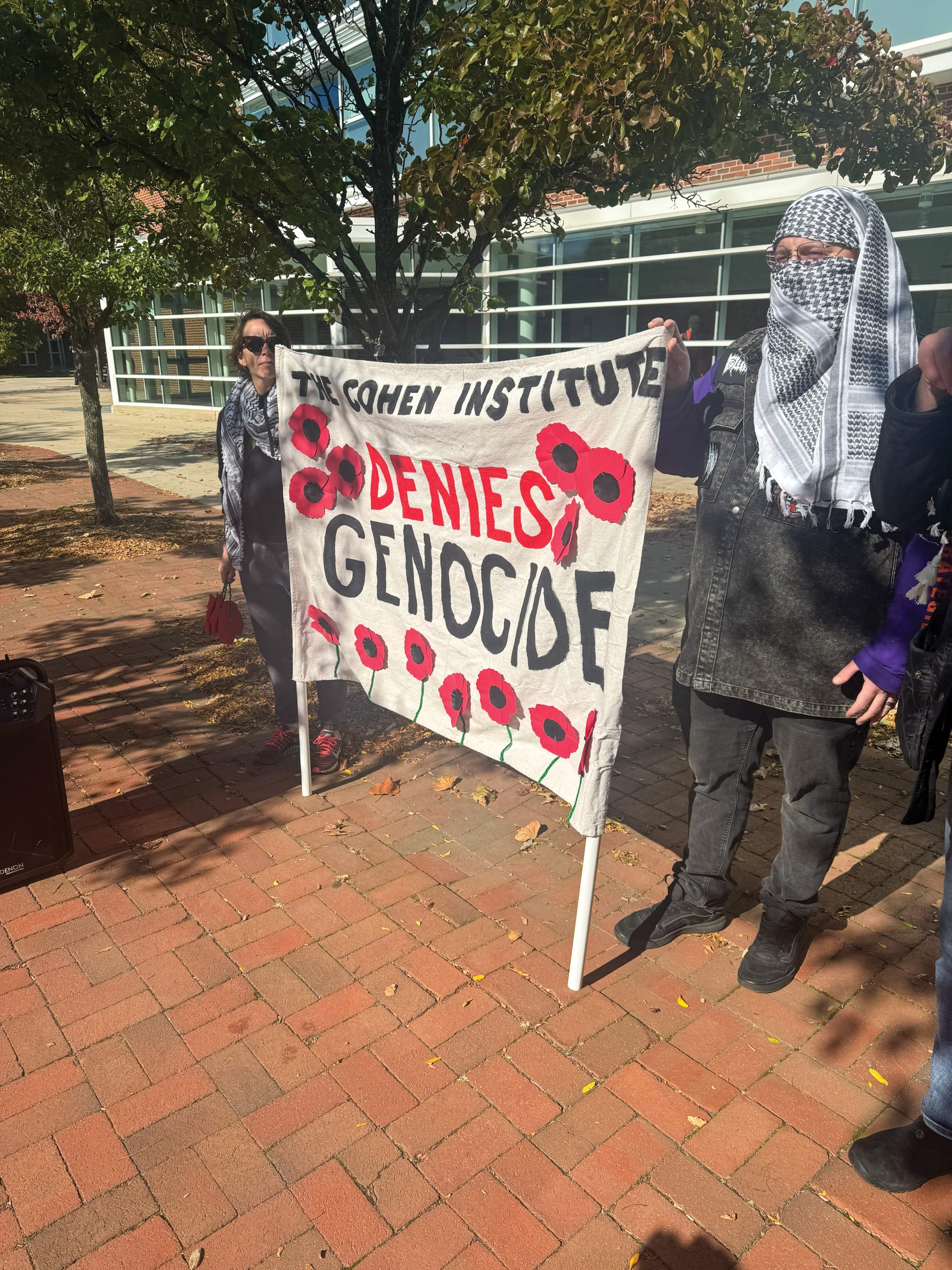
Carbonara also mentioned how “the lessons we should learn about genocide and history are important,” and that Keene For Palestine believes they are not being taught properly by the Cohen Institute.
Alli Holte, another one of the hosts and members of Keene For Palestine, expressed excitement at seeing so many people attend.
“I think the turnout is great,” Holte said. “I’m excited to see some new faces. I think it’s important that we’re showing up where we should.”
The event was hosted alongside Nova Arts, an arts initiative and non-profit organization that supports marginalized voices and aspiring artists.
Eliza Murphy, a member of Nova Arts who attended the event, provided the reasoning for the non-profit organization co-hosting the art build.
“We support art-based initiatives that are for social impact and inquiry,” Murphy said. “We felt like it was a good chance to partner with another organization that had a social impact.”
Murphy added that Nova Arts often partners with schools or nonprofits.
Carbonara said that Nova Arts has “always been really supportive.”
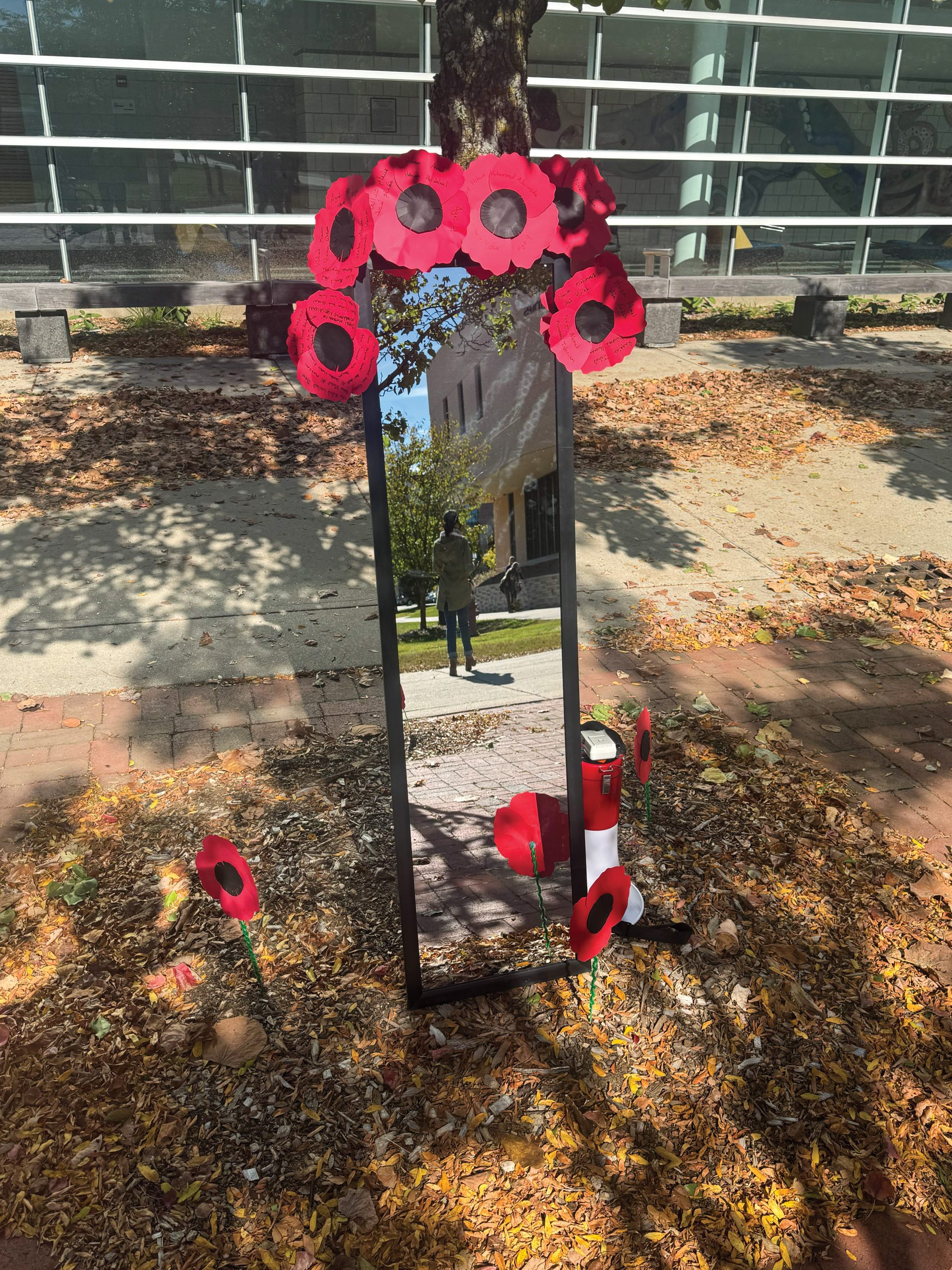
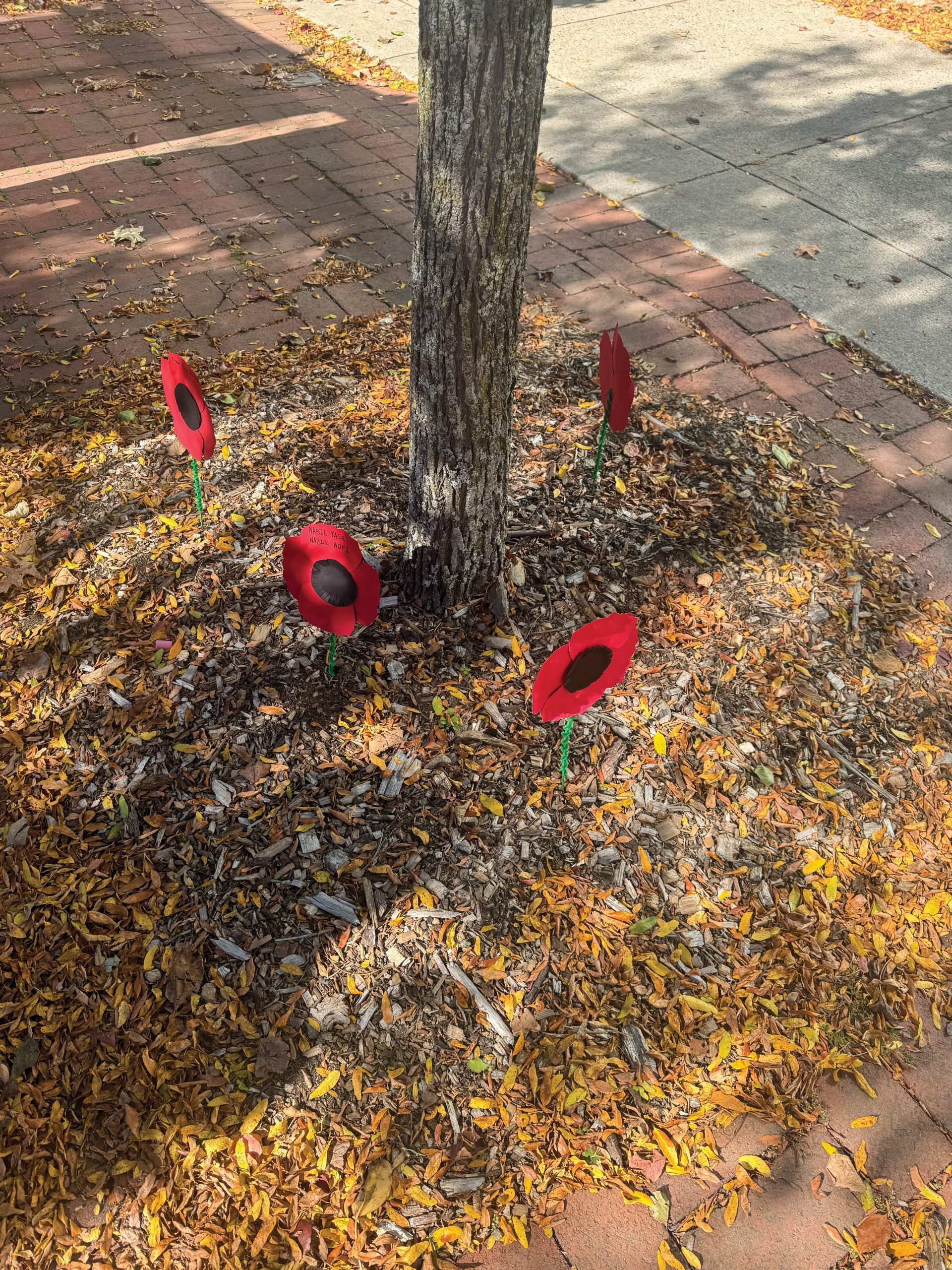
Keene For Palestine hosted a follow-up event on October 17 on Keene State’s campus. The poppies made at the event on October 15 were utilized as they were taped onto mirrors and planted in the ground.
Carbonara drew attention to the Friday event during the speech on October 15 prior to the activities, providing a poster which included the times and why making the banners and poppies was so important.
On October 17, Keene For Palestine and event attendees gathered at the arch on Appian Way leading to Keene State’s campus. The event was open-mic, and attendees were encouraged to speak out and to bring signs and keffiyehs, which “is a traditional Arab headdress. Historically, it was worn by nomadic communities — or Bedouins — in historic Palestine,” according to NPR.
During the event, a police liaison stood alongside the protesters as a precaution for police interference. The event attendees, led by Carbonara, marched down Appian Way holding signs, mirrors and poppy flowers chanting “Free, free, Palestine” among other phrases.
Carbonara spoke first at the event, gathering the attendees together in the middle of Appian Way, as another member of Keene For Palestine passed out zines.
“We were told time and time again that the institute cannot comment on current events,” Carbonara said. “This raised questions, since they’ve done events on Myanmar and Sudan.”
“How are you resisting the narrative of Palestinian dehumanization?” Carbonara asked the institute.
The members of Keene For Palestine also criticized the screening of “Combatants for Peace” by the institute, which they found to have a positive view of the occupation and not properly portray the conflict.
Rosemarie Bernardi, professor emeritus of arts at KSC, took the mic at one point, criticizing the sending of funds to Israel.
“Everything I thought about Israel was wrong,” Bernardi said, reflecting on what she was taught when she was younger.
Prior to the event, KSC President Melinda Treadwell spoke on the events Keene For Palestine was planning on holding.
“I am happy that the Keene For Palestine group wants and finds the way to express their voice and their mind and to use our campus facilities. They’re welcome to do that. Just as other groups are welcome,” said Treadwell. “It’s scary. To take a polarizing issue where there are no easy answers and where the institution is not gonna make a statement or pick a side. Because we shouldn’t. We can’t have a public point of view as an institution.”
“What we can do is say ‘Let’s bring the points of view to the table. Let’s try to get a deeper understanding. Let’s try to hold our humanity for one another,’’’ added Treadwell.
Chloe Erno can be contacted at