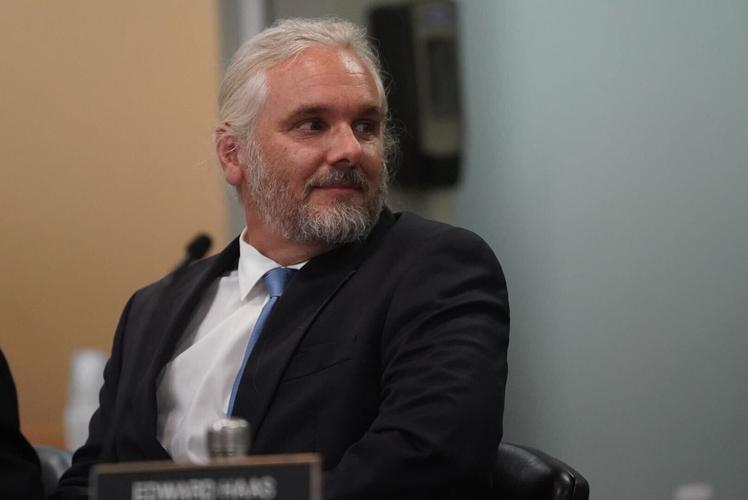
Amid a wave of firings and other disciplinary action nationally against people who’ve made comments about conservative influencer Charlie Kirk’s killing, Keene city councilors Thursday decided not to discipline one of their own after his Facebook comments drew significant backlash.
After a half hour in front of a large crowd, councilors voted 11-4 not to proceed with disciplinary action against Councilor Bobby Williams. His term ends in 2027.
A primary argument during the to-the-point discussion was that Williams’ speech is protected by the First Amendment. But many people who wanted him removed from the council have argued public officials should be held to higher standards.
Williams, who was first elected to represent Ward 2 in 2019,has made no indication of plans to resign, and joined 10 other councilors in voting “no” on Thursday’s motion. The city council’s rules of order on conflict of interest permit this kind of vote.
The vote came less than a week after Williams sparked outrage over his social media comments, which included posting on his personal Facebook page that Kirk — who was fatally shot while speaking at Utah Valley University on Sept. 10 — “was a piece of [expletive] who promoted gun violence and died by gun violence.” In response to a Facebook user asking if he would say these words to Kirk’s wife and children, Williams wrote, “His wife made her choice. Her kids need to know.”
The backlash to these and other comments included an online petition demanding Williams’ removal that, by Thursday, had garnered more than 1,000 names. Though Tom Burton started the petition and said he lives in Williams’ ward, it’s unclear how many of the signatories live in Keene. City Clerk Terri Hood said Friday the office had received seven emails regarding Williams’ comments, with one calling specifically for his removal. Mayor Jay Kahn said that he received several messages through a city portal and phone calls from people outside of Keene.
After issuing a statement on the city’s Facebook page on Friday, Sept. 12, saying Williams’ remarks do not represent the opinions of the City Council, Kahn initiated the process to consider disciplining Williams.
In a Sept. 16 letter to the council, Kahn said, “Williams’ rhetoric on social media provoked the public into polarizing perspectives and was insensitive to the loss being felt by some in our community.
“… While I respect the constitutional right of freedom of speech, public officials are looked upon as respected voices and as leaders in our community,” Kahn’s letter continues. “Mr. Williams’ comments were divisive at a moment when unity is needed in our community and country.”
Keene’s disciplinary process for councilors and the mayor can be initiated only by a city councilor or the mayor. Once an official complaint, like Kahn’s, is received, councilors vote on whether to move forward with the process. There is no opportunity for public comment during the meetings. The city charter, per the provision that addresses this subject “provides for the possibility of removal of the Mayor or Councilors on specific charges and after due notice and hearing for prolonged absence from or other inattention to duty, mental or physical incapacity, incompetency, crime, immorality, or misconduct in office.”
By the time Thursday’s meeting started, all seats in the City Council chambers were taken and some people were standing. Mayor Kahn banged his gavel to request an attendee put down their sign, and when Williams read a statement that drew applause, Kahn asked the audience to settle down.
Police escorted one attendee from the room.
After Williams began reading the statement of apology he’d previously issued, Bradford Hutchinson lifted his arms in Williams’ direction, according to Deputy City Clerk Kathleen Richards, in a way Kahn said appeared to be imitating holding a weapon like a rifle. Hutchinson, who will challenge Kahn for mayor in the upcoming municipal election, responded to Kahn’s request that he stop by saying he’d been having a seizure. This prompted anger from Councilor Kris Roberts, who said he has suffered seizures for most of his life.
After Hutchinson said he didn’t think Kahn had the authority to ask him to sit, Kahn had police to remove him from the room.
A speedy discussion
Councilor Roberts was the first to speak at the meeting on whether councilors should discipline Williams. He kept his comments brief.
“I spent 21 years in the Marine Corps. I went to a number of places that have left me beaten up and everything,” Roberts said. “But we have a saying. ‘I may not agree with what someone says, but I will always defend with my life their ability to say that.’”
Councilor Randy Filiault also recalled his past in the military. “Others that we disagree with can speak. That’s the whole purpose.”
His argument became more technical from there. After a thorough review of city documents, including the city charter, Filiault concluded there was no legal justification to move forward with the process.
“To be clear, I did not agree with Councilor Williams’ comments at all, not in the slightest,” Filiault said. “And he will tell you, I said in no uncertain terms how ticked off I was about those comments and how we’re dragged into it now.”
Councilor Ed Haas made similar remarks to Roberts’ and Filiault’s. “Our right to speech, wherever it is, is the most sacred right. It is the most absolute one. Barring direct threats … we should be able to say whatever we want without fear of persecution.”
He said councilors can get criticized in several forums, whether that be in letters, via social media or by friends and neighbors. “But we should still not suffer professionally or especially as elected officials from what we’ve said.”
Councilor Catt Workman recalled community members calling for Troy Police Chief David Ellis’ removal after he attended the 2021 protest in Washington, D.C., that preceded the Jan. 6 riot at the U.S. Capitol. Ellis told reporters he left before the insurrection. Workman said that like Ellis, who participated in the protest outside of his capacity as a public official, Williams has the same right.
“Words do matter,” she noted.
“Especially for those of us in public office, the way we communicate can either build trust or deepen divides, and it’s our responsibility to choose language that reflects respect and fosters constructive dialog,” she said.
“At the same time, nobody is perfect … nor should anyone … be expected to be, public figure or not.”
Councilors Kate Bosley, Jacob Favolise, Thomas Powers and Michael Remy all voted to move forward with the disciplinary process. Of the four, Favolise was the only one to contribute to Thursday’s discussion.
“A statement made by a political leader in the wake of an act of political violence that belittles, dismisses, even excuses or justifies that act represents, at its most generous, a lapse in judgment,” he said.
At one point he noted, “We are talking about the standards we should hold ourselves and each other to as stewards of the public trust, stewards of the public interest.
“We each have a responsibility around this table, collectively and individually, to represent this city with integrity, and the allegations in your letter, Mr. Mayor, if founded, would represent, to some extent, a failure to meet that responsibility.”
In the hours after the meeting, Williams posted about the outcome. “Thanks to those who have supported me in this tough time. I apologize to those who I have made trouble for or have disappointed.
“I’ll do better.”
Prior to Thursday’s meeting, Williams apologized for his comments in the statement he issued Wednesday, while making a broader statement about the state of democracy in the United States. “I believe that the death of Charlie Kirk is being used as a pretext for the undermining of the American people’s right to free expression. If I was just one guy who screwed up and was facing consequences, that would be one thing,” he wrote.
“But across the country, there are hundreds of cases like mine, in which people who have expressed negative sentiments about Charlie Kirk are being subjected to organized harassment campaigns, of the kind that Kirk himself pioneered.”
Burton, who started the petition calling for Williams’ removal, didn’t see this as censorship.
Williams’ comments were dehumanizing and were “rationalizing a political assassination, and making callous statements about a murdered man’s wife and children,” he said in a Facebook message to a reporter. Burton said this, and not politics, drove him to start the petition.
“What residents are asking for is basic accountability, which is not censorship—it is a foundational part of public service,” he said.
“ … It’s about whether someone who shows such poor judgment in a moment of national tragedy should continue to represent this community.”
Sophia Keshmiri can be reached at 603-283-0725 or skeshmiri@keenesentinel.com.
These articles are being shared by partners in the Granite State News Collaborative.Don’t just read this. Share it with one person who doesn’t usually follow local news — that’s how we make an impact. For more information, visit collaborativenh.org.