
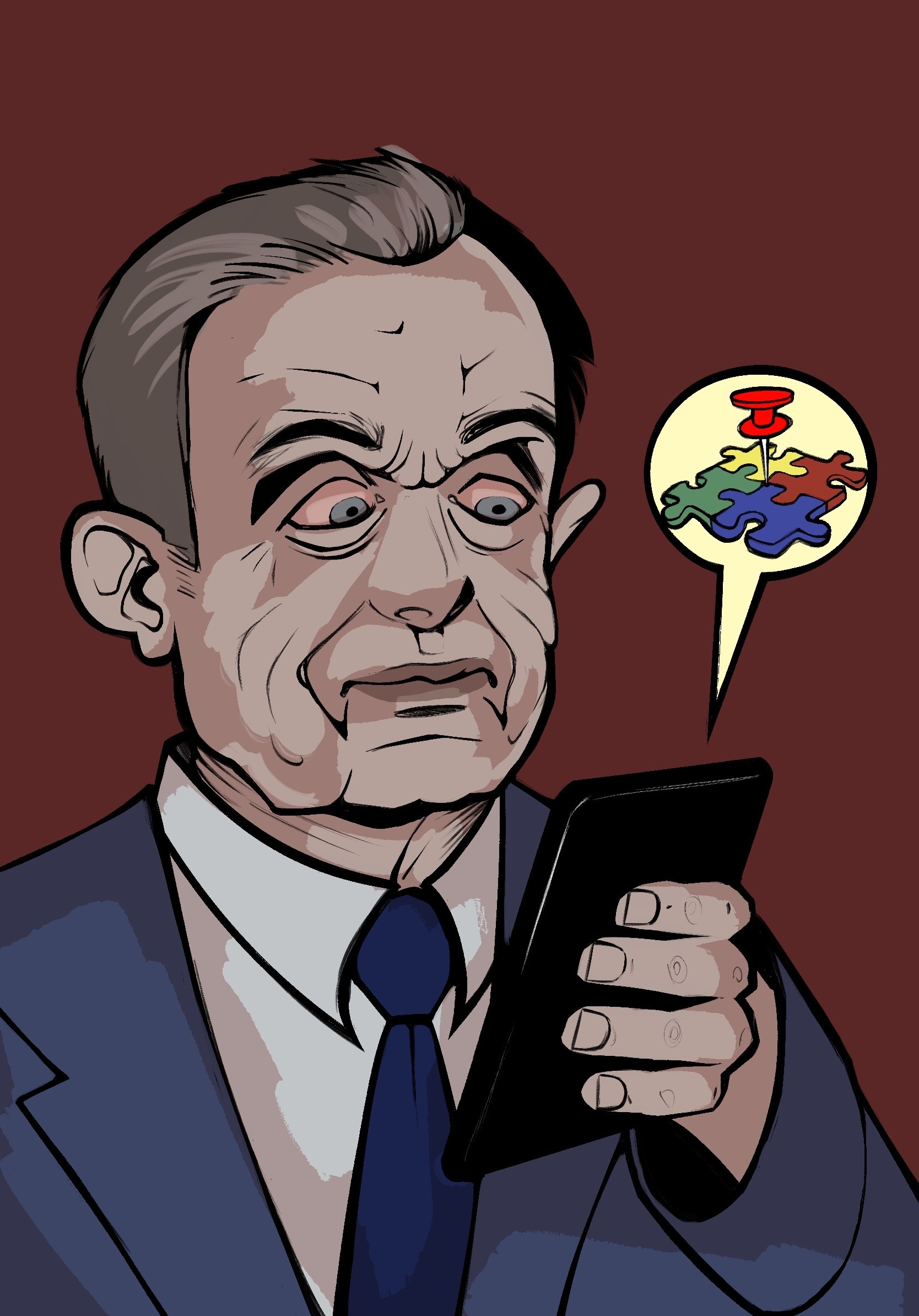
When I saw Robert F. Kennedy Jr. (RFK Jr.), the current secretary of health and human services, wanted to create a database to track people who have been diagnosed with autism. I felt many things; surprise was not one of them. Autism has long been associated with vaccines in populist science; this assertion was initially made by Andrew Wakefield in a 1998 pilot study, which claimed to find a link between the measles, mumps and rubella (MMR) vaccine and autism. The study was later retracted by the publisher and Andrew Wakefield himself was struck off the medical register for “serious professional misconduct.” According to Scientific American, RFK Jr. has been a vaccine skeptic since 2005, when he published a story in Rolling Stone linking vaccines with thimerosal to autism. Doctors have published mountains of evidence disproving any link between vaccination and autism, but that’s not the point. The question was never what they’re doing or how they’re doing it; it’s why. Why are they doing it? To what end? What are they hoping to accomplish?
I’m a systemic worrier; this is my bias. I worry about the systems that rule over us, and I fear how they plan on encroaching on our freedoms. I could call specific examples to mind, but that would only undermine my point: The foundational idea of government is to relinquish some personal freedoms for security. But what does pulling records from pharmacy chains, lab testing and genomics data from people treated by federal agencies like the Department of Veterans Affairs or the Indian Health Service, claims from private insurers and data from smartwatches and fitness trackers do for us? What purpose could gathering information on autistic people serve to protect us?
This could be nothing; I admit that. I may be blowing this way out of proportion. When I posted this on my Instagram story, a friend with diagnosed autism reached out to me. I asked them about their opinion on this, and they told me that they weren’t worried. Their autism diagnosis is a large part of their identity. If they needed accommodations, they could get them with their autism diagnosis, and that’s comforting to them. Also, they feel that they are the counterexample to how RFK Jr. sees an autistic person: They pay taxes, they have a job at their college, they could play baseball if they wanted, they’re a songwriter and have a beautiful girlfriend.
But like I said, I’m a worrier. I’m worried about what the Department of Health and Human Services will do once they have their database of all people diagnosed with autism in the U.S.
The Ten Stages of Genocide is an interactive report published originally in 1996 by Gregory Stanton, an expert on genocide and leader of Genocide Watch, a non-profit dedicated to fighting genocide internationally. This document details a formula for how a state can facilitate genocide—and it is necessarily a state; according to this, to be deemed a genocide, it must take place with a state’s legitimate use of force backing it. A good analogy for thinking about this is a Russian nesting doll. The first step is classification, and as a given society gets more genocidal, the more likely it is to align with the ten stages of genocide. In the document, Stanton only uses examples from ethnicities, races and religions. But the idea behind classification is to create an “us” and a “them.” It tends to work most efficiently when there is no overlap between the two.
Genocide Watch recommends that steps be taken in times of peace, including the outlawing of genocidal militia groups and the U.N. imposing arms embargoes on nations that are committing or complicit in genocide.
In times where the idea of fascism seems more and more appealing to the powers that be, the U.N. will not step in to save us. They have an established history of not doing that. Since they were founded as a peace-keeping organization after World War II, genocides continue to be committed: see also, the Bosnian and Rwandan genocides. The so-called U.N. has a council of five world superpowers who can veto anything other than a “procedural” decision, which includes, of course, the United States.
So what can we do for ourselves and our communities? For people formally diagnosed with autism, the Health Insurance Portability and Accountability Act (HIPAA) ensures that all Americans’ medical records are private, despite what the executive branch says. It also allows Americans the ability to request amendments to your medical record; hypothetically, you should be able to call your doctor’s medical records office and request that your autism diagnosis be voided from your medical record.
However, the downside to not being formally diagnosed is that you are no longer labelled as autistic in the eyes of the law, so please, talk to your doctors and do your research, and write to me at dexterekeegan@gmail.com if you get a diagnosis expunged from your medical record.
When virtually everything is getting worse, and the systems of governance we once relied on are collapsing in on themselves, it is natural to feel fear. It’s a scary time to be alive. But in such unstable times, a unique opportunity presents itself: we can create our own systems that help our communities, without government as a middleman. Studies in developmental and comparative psychology show that humankind is inherently prosocial, which means that we are hardwired to care about the feelings of others from as early as 14 months. It’s the reason that you hold the door open when you see another person coming. When the government codifies that prosociality into law, and then dispenses punitive measures for antisocial behaviors, it takes the power of reconciliation away from the communities affected by the antisocial behavior. The government has the power to decide what “antisocial behavior” is, too. Governments with fascist leanings tend to be more liberal with their labelling of antisociality; as activist Angela Davis wrote to author James Baldwin in 1970, “if they take you in the morning, they will be coming for us that night.” If they take the political dissenters in the morning, they organize lists of autistic people in the afternoon, they will come for us all at night.
Dexter Keegan can be contacted at
dexterekeegan@gmail.com