

Stories of resistance, adoption and identity took center stage at Keene State on Tuesday, April 23, as the college honored the research of Modern Languages and Cultures Department Chair Lisa DiGiovanni and Film Studies Department Chair Jo Dery during a faculty presentation event in Rhodes Hall.
Organized by Professor of Education Darrell Hucks, the faculty research presentation aimed to create a space for professors across disciplines to share their scholarly work and build connections beyond the classroom, according to Hucks. The event is part of an ongoing effort to foster community, collaboration and mutual understanding among faculty—and ideally, to engage more students in the future.
“The goal is to create a community of scholars,” said Hucks. “It’s about sharing, connecting and supporting each other’s work.”
The first presentation came from DiGiovanni, who serves as both the chair of the modern languages and cultures department and as a faculty member in the Holocaust and genocide studies department. Her research spans trauma, memory studies and gender, with a particular focus on how societies process violent histories after military dictatorships in Chile, Argentina and Spain. Her work is centered on the concept of “militarized masculinity,” a term coined by American political theorist and professor Cynthia Enloe. This concept focuses on the construction of male identities around aggression, combat, nationalism and dominance, where “masculinity is defined through the capacity for violence.”
DiGiovanni’s deep interest in the traumatic histories of Latin America and Spain, particularly under dictatorial regimes, eventually led her to explore videographic scholarship.
“My long-standing interest since 2005 has been in how film and literature depict traumatic dictatorial histories,” said DiGiovanni. This passion naturally expanded into filmmaking.
In her video essay “Militarized Masculinity,” DiGiovanni explored the long shadow cast by the military regimes of Francisco Franco in Spain and Augusto Pinochet in Chile. Using archival footage, the video analyzes how these governments used violence to indoctrinate young men into a militarized sense of identity—an identity rooted in aggression, nationalism and dominance.
DiGiovanni explained that her approach to crafting video essays centers around three key components: “Sound, visuals, and, most importantly, the argument,” which she conveyed through on-screen text instead of voiceover narration.
“Crafting video essays demands extensive research and the cultivation of both critical thinking and viewing abilities,” said DiGiovanni.
The creative process, especially layering audio and visuals, was a highlight for DiGiovanni.
“What we see is shaped by what we hear,” she said, emphasizing how music and sound design guide viewers’ understanding of images.
Yet mastering the editing software Adobe Premiere Pro proved a steep learning curve, according to DiGiovanni. “The time commitment is significant,” she said, but she noted the rewards were “manifold,” opening up new forms of creative scholarship valuable for teaching and presenting at conferences.
The final portion of her video essay shifts toward hope, showcasing examples of modern resistance movements in Chile and around the world. Through these acts of cultural defiance, DiGiovanni said she aims to highlight how communities are continuing to challenge militarized forms of masculinity and create new narratives of identity and justice.
These themes are further explored in her new book, “Militarized Masculinity,” published by the University of Toronto Press, which offers a deeper analysis of how cultural resistance has fought back against hyper-masculine violence in Spain and Chile.
Narrative themes of trauma and perseverance through scholarly creativity continued in the second presentation.
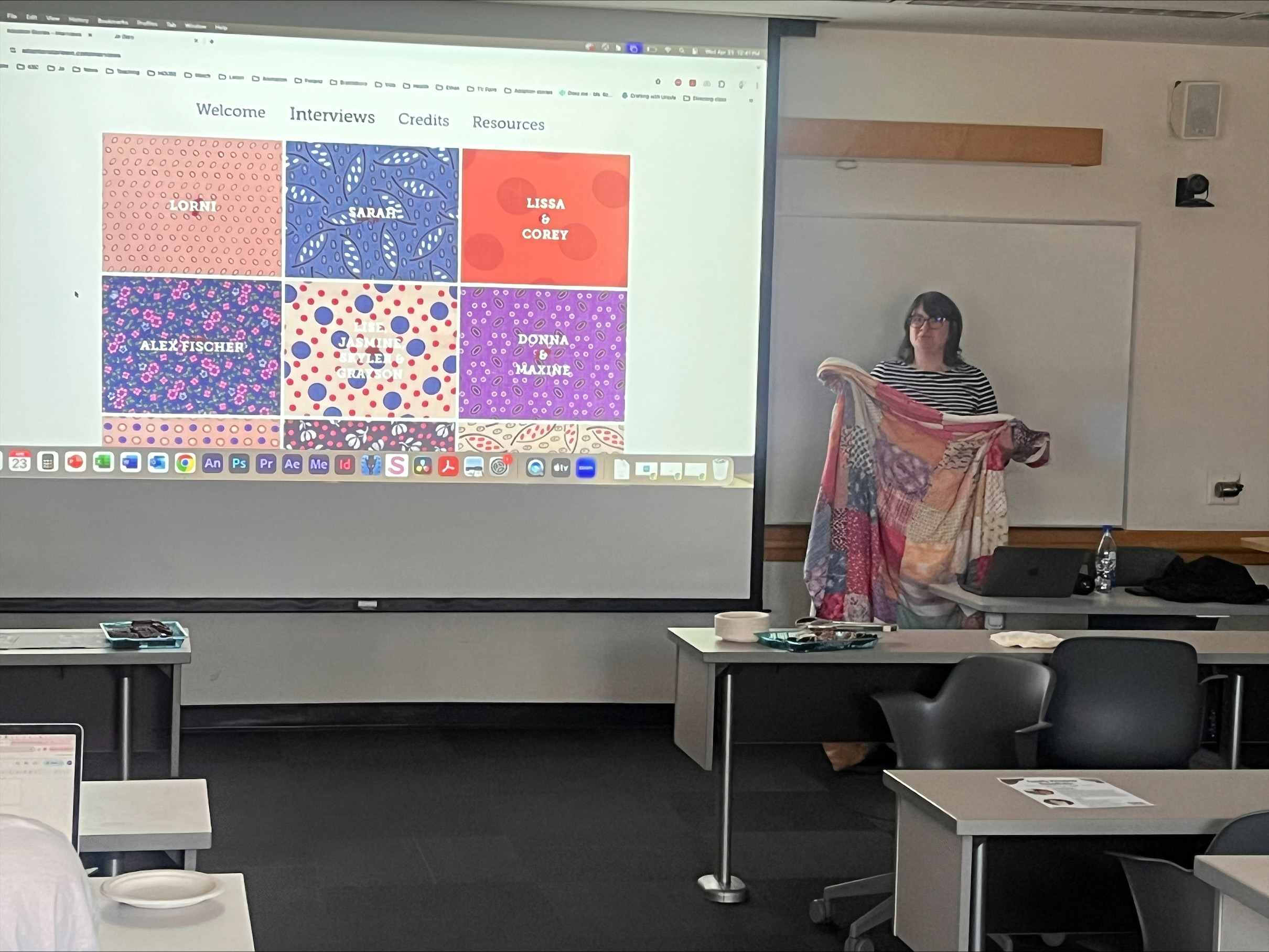
The second presentation came from Film Studies Department Chair Jo Dery, who showcased her podcast project “Adoption Stories.” Funded through a faculty development grant from KSC and a community grant from the town of Brattleboro, Vt., the podcast features personal narratives from adoptive families, adopted individuals and adoption professionals in Windham County.
Originally conceived as an animated short film created by children adopted through the foster care system, the project was reimagined due to the onset of the COVID-19 pandemic. Dery and her collaborators, Tamara Evanson and Lissa Schneckenburger, shifted the focus to audio storytelling in order to prioritize safety.
“We realized that if we changed this to be audio interviews, we could maintain social distance and keep everyone healthy,” she said.
Dery said the result is a deeply personal and varied series of accounts that reflect the emotional complexities of adoption.
“There’s a diversity of perspectives in the podcast,” Dery explained. “There’s a grandmother who adopted her granddaughter, a queer person who adopted a queer and trans teen and a couple who became adoptive parents after struggling to have biological children.”
Dery said these stories show “the breadth of ways that families are made through adoption.”
While the podcast does not seek to critique the foster care system directly, it does aim to illustrate the impact adoption has on a person’s narrative identity, according to Dery.
“Going into foster care is a huge disruption to a person’s life story,” she said. “Adopted children often piece their story together in a nonlinear way.”
By collecting and sharing these stories, the podcast explores how families construct and support a sense of identity for children who have experienced trauma.
The production of “Adoption Stories” took about four years from start to finish, including interviews, editing and the creation of an original musical underscore. Dery emphasized the importance of showcasing creative faculty work to students and the community.
“I think it’s really important for students to see what a creative adult looks like in the world,” she said. “Especially in the arts, it’s kind of a magic trick to balance being an artist with the realities of living in this country.”
With May recognized as National Foster Care Month, Dery also pointed to the local relevance of the project.
“There are children all over the world in need, but there are also children right in your community who need support. It’s important to remember that,” she said.
The event was attended by several faculty members spanning across a multitude of disciplines, including Professor of Physics Sarah McGregor. She spoke to the impact both presenters’ projects had.
“I think both of them did an amazing job being able to talk to a diverse audience,” said McGregor. “At the same time, they were really honest and vulnerable and therefore really impactful, showing how what they’re doing is really important to the broader community.”
Hucks highlighted the importance of coming together to form an academic community.
“I think there is a need to be together in community and share ideas and raise questions and constructively challenge each other sometimes and support each others’ work and raise those questions that allow people to think differently about their scholarship and how to communicate about their work,” said Hucks.
Although Wednesday’s faculty research presentations were the last two of the semester, Hucks said he plans on continuing the series in the fall with one request.
“The only thing I ask is that you try to keep it to 20 minutes,” said Hucks. “The richness is in the conversation that happens often after.”
Elías Stowell Alemán can be contacted at
estowellaleman@kscequinox.com