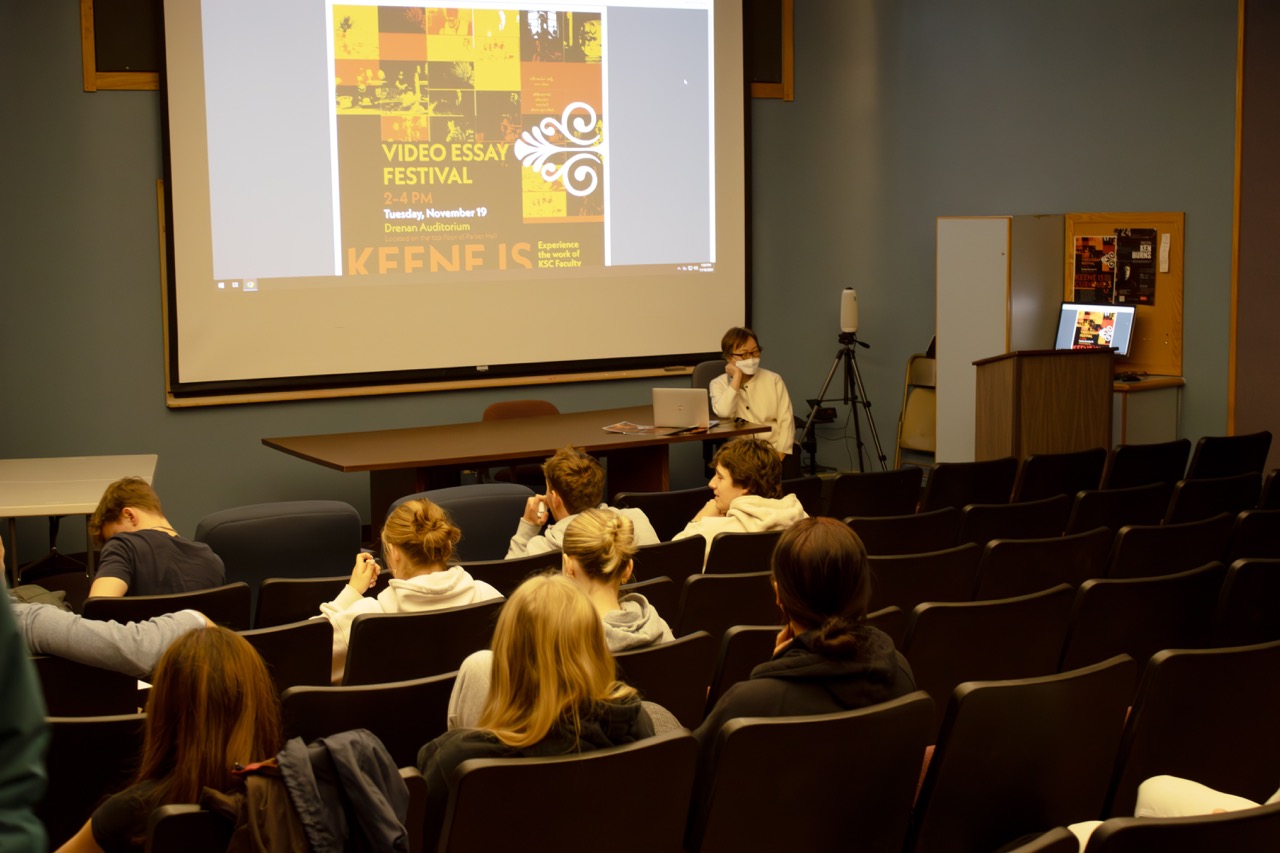
A Film Essay Festival was held for the first time on Tuesday, Nov. 19 in the Drennan Auditorium, hosted and organized by Associate Professor of Film Dr. Jiwon Ahn.
This event showcased three film essays made by Dr. Lisa DiGiovanni, a cultures/holocaust and genocide studies and a modern languages professor at Keene State College, and allowed students to submit their own works to show.
Film essays are “a self-reflective and self-referential documentary cinema that blurs the lines between fiction and nonfiction,” according to Oxford Bibliographies. They use existing visual media to prove a thesis statement made by the author of the essay.
“So in a lot of ways, it’s a bridge between creative audio, visual production and traditional academic scholarship,” DiGiovanni said.
DiGiovanni earned a PhD in Romantic Languages, a Graduate Certificate in Women’s and Gender Studies, as well as a Bachelor’s and a Master of Arts in Spanish. She has published three video essays.
“I think that one distinction from video art, even though these lines are often a little bit blurry, is that a video essay has an argument and that argument can be open-ended,” DiGiovanni said, “but there is kind of a thesis statement there, like an actual written essay.”
The first half of this event consisted of DiGiovanni’s work, which was the three essays she made herself. After each of her essays, the room was encouraged to discuss their feelings about the topic presented and ask any questions they might have had about the essay.
“I’ve already presented my video essays at various conferences, like the Latin American Studies Association Conference, the Association for International Genocide Scholars Conference; a whole number of conferences, and it’s a lot, in my experience, more engaging than the traditional form.”
One essay she presented was “Guillermo del Toro’s Multiple Masculinities,” published in June 2024, which uses four of del Toro’s (a Mexican filmmaker and author) films, such as “Pinocchio” (2022) and “Pan’s Labyrinth” (2006) to show her critique of the relationship between masculinity, violence and militarism over a 20-year period.
DiGiovanni also talked about the importance of the film medium itself and how written essays “don’t need to be replaced by the video essay.”
“I think that we hope those of us who are doing this kind of unusual work, we hope that it will continue to grow and also gain respect,” DiGiovanni stated. “I don’t propose to have all of the solutions, but I think that this is a really great form, a really great way to provoke discussion about it, and to understand violence in clear ways.”
The second half of the festival allowed students’ work to be presented that covered topics of their choice. A couple of these were “Anyone Can Wear the Mask” by Nolan Ryan, which talked about the Spider-Man movies and how they have become more inclusive, and an essay about the evolution of better representation of autism in movies and TV made by junior Tyler Robinson. No students were available for an interview before the publication of this paper.
Because of the new popularity of the film medium, this was the first time this event was hosted. It is “hopefully not the last time,” according to DiGiovanni.
Hayley Doda can be contacted at
hayley@kscequinox.com