

Many of us use social media frequently, but how much do we know about the effects it can have on our mental health?
This question was the subject of Philip Wyzik’s talk, titled “Social Media, Smartphones, and Emotions.” The talk was held Monday, Oct. 7 at 6:30 p.m. in the Mabel Brown Room.
Wyzik, who is the chief executive officer (CEO) at Monadnock Family Services, spoke about his own observations on the effects of social media.
“Our clinicians will tell you, especially [those] who work with teenagers, that this is a growing phenomenon,” said Wyzik. “People come in for treatment around their addiction to technology.”
Wyzik stated that he sourced most of the information for the talk from two books: “The Anxious Generation” written by Jonathan Haidt and “Permission to Feel” by Marc Brackett. The talk combined themes and ideas written about by both researchers. He also stated that the talk and his research would focus primarily on the effects seen in children and teenagers.
Emily Alexander, senior coordinator of student involvement and well-being, spoke about the importance of the subject matter.
“We know how prevalent social media and smartphones are,” said Alexander. “I mean, it’s something that impacts everyone if they have social media … or smartphones that they use.”
“Knowing how those impact our brains and emotions can help us better set limits around using [smartphones],” continued Alexander. “Also just monitoring how it’s impacting us so that we can make better or more informed decisions.”
Some students said they had seen these mental and emotional effects in their own lives.
“I know many kids who go to the daycares that I work at have struggled with [smartphone use],” said junior Erin Ciempa. “So they’ve come out with a lot of toys that represent smartphones and kids automatically go to those toys when we’re at free time.”
“It still has affected our [generation] because we have now passed it down onto the children,” continued Ciempa. “But I think [the younger generations] have more of an effect.”
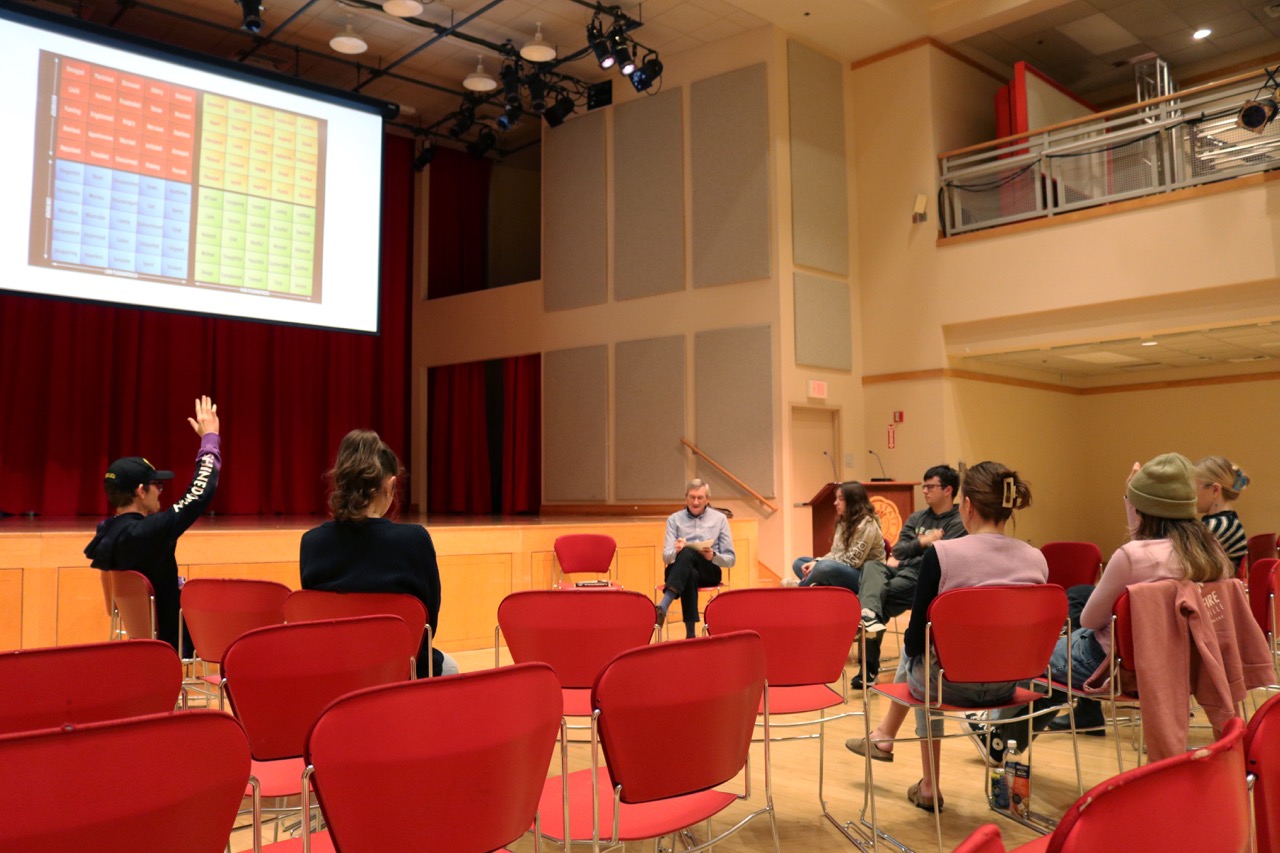
The talk drew in an audience of less than 10 attendees. Wyzik had attendees arrange their seats in a circle, encouraging everyone to talk with each other and ask questions.
Wyzik started his discussion with a presentation showing charts and statistics about mental health in recent years. They were sourced from “The Anxious Generation” and created by the U.S. National Survey on Drug Use and Health, U.S. Center for Disease Control and Prevention and the National Center for Injury Prevention and Control. They showed that, according to those organizations’ studies, things like emergency room visits for self-harm, depression among teenagers and rates of mental illness among college students were all increasing. Wyzik linked these to not only mental troubles but also emotional troubles.
He continued the talk by discussing Haidt’s idea of “the great rewiring of childhood,” and how young children are observed to be more likely to be tech-oriented instead of play-oriented. Wyzik stated that this “great rewiring” causes children to be sleep-deprived and socially deprived, have fragmented attention spans and be less exposed to nature. The talk concluded with a discussion about emotions and the impact social media use can have on them. Wyzik said that emotions are linked to attention, decision-making and many other aspects of our life. Attendees used an emotional scale on the axis of “pleasantness” and “energy.”They reported that heavy social media use made them feel low energy, with the majority reporting that it also made them feel low-pleasantness.
Students in attendance agreed that discussions like these are very important.
“I think it’s definitely a concern for our generation and the younger generation,” said sophomore Liam Thorne.
“We talked a lot about how social media shapes how we think and what it’s done to this generation,” said recent alum Isabella April. “I’ve been impacted, most of my friends have been impacted. It’s just something that, throughout my high school years….I kind of watched change how we thought.”
Orion Corbin can be contacted at
ocorbin@kscequinox.com