

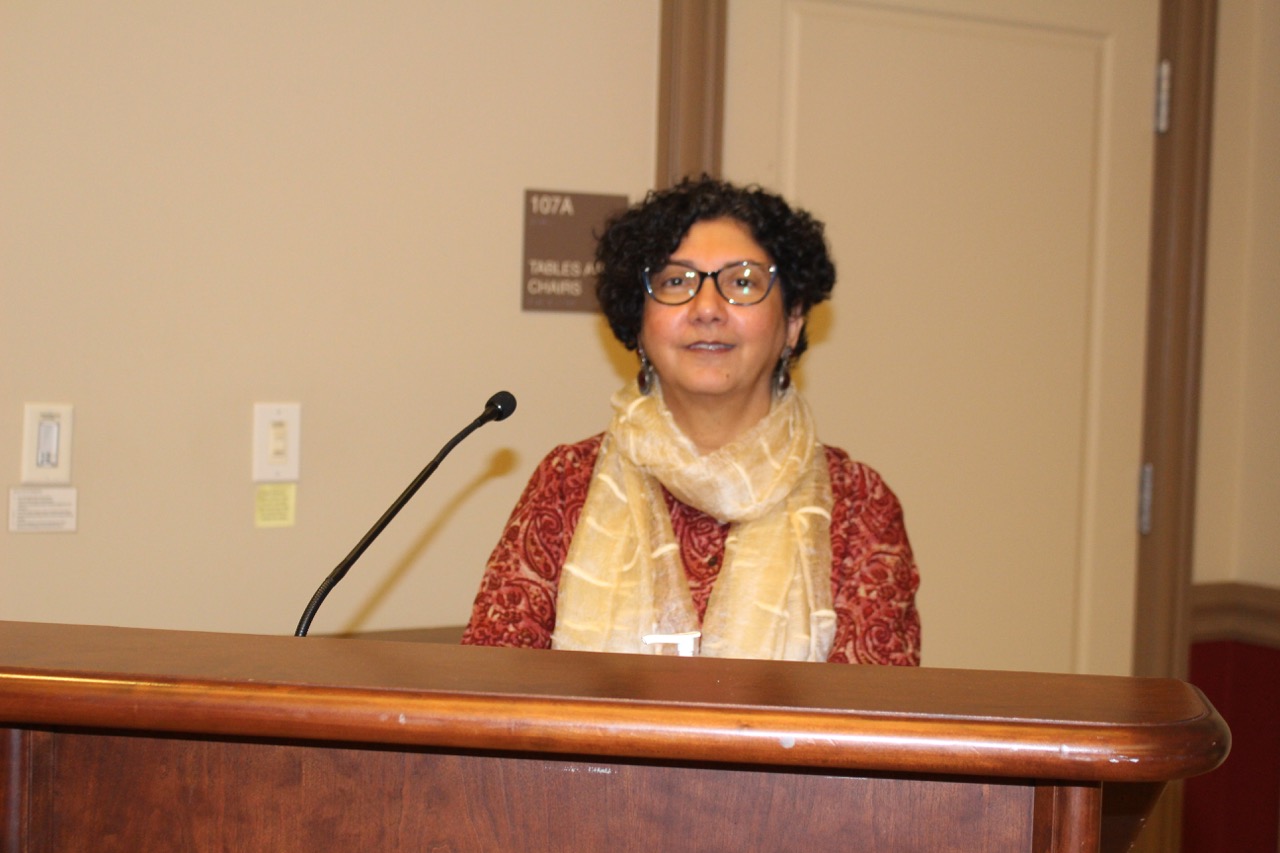
Keene State College hosted a lecture by author Zilka Joseph about her new poetry collection and her Bene Israel heritage.
This was done as part of KSC’s Sidore Lecture Series, a lecture series created by the Saul O. Sidore Memorial Foundation.
“We try to bring in speakers or performers who will be engaging, sometimes a little bit provocative,” said Celia Rabinowitz, the assistant vice president for academic engagement and the director of the Mason Library. “We’ve tried hard not to just do traditional lectures … sometimes Sidore funds are used to fund dance performances…tonight was a talk and a poetry reading. They’re always free and open to the public.”
English Professor Brinda Charry was the one to first reach out to have Joseph give a lecture with the Sidore Series.
“[A] lot of the times, these things kind of happen by accident,” continued Rabinowitz. “In this case … Professor Charry emailed me last spring and said, ‘I met this really wonderful poet and I’d love to bring her to campus.’”
Joseph is a poet and freelance editor. According to her website, many of her published books have been nominated for various awards, such as the Pushcart Prize and the National Book Award, and has won a Best Indie Book Award. Her newest book, “Sweet Malida: Memories of a Bene Israel Woman”, was published in February 2024 and was the main subject of the Sidore Lecture.
The Bene Israel are a Jewish population that have lived in India for over 2,000 years. Joseph spoke about the history of the people and theories as to how they arrived in India. One of the popular stories is that the Bene Israel people were shipwrecked on the coast in 175 BCE, Joseph said, and a big piece of evidence is an ancient cemetery in the area.
“When you read about [King Solomon] they talk about peacocks and ivory and monkeys coming from way east,” said Joseph during the lecture. “There is documentation, though not enough to support that 175 BCE arrival. But because there are so many of these stories about this particular village in which the cemetery exists, most Bene Israel believe in that theory, but most likely, I think, would be fifth or sixth century.”
Joseph said that although a great number of the Bene Israel people do still live in India, there are also Bene Israel populations worldwide.
After the talk, she read several poems from her newest book “Sweet Malida.” The poetry focused on her culture and history with an emphasis on the food.
“I’ve always loved food, I’ve always written about food in some form or the other,” said Joseph. “But food writing is not just food writing because it includes the angle with which you’re using food. It can be to convey memory, it can be a way to convey emotion, it can be a way to convey politics. It could be several things all at once.”
Joseph also spoke on her experience of becoming a writer and her love of reading.
“I never grew up thinking I would be a writer or a poet,” continued Joseph. “I was always a voracious reader, very curious, loved listening to stories. And I’m guessing all of us who are read to as children or love reading, there’s always that interest in expressing yourself.”
Keene State students who attended the lecture expressed an appreciation for both the poetry and for learning about Bene Israel history.
“I thought this [lecture] was really great, it was such an enriching experience,” said senior Emily Fowler. “I learned so much about a part of the world and a community that is so diverse, I really had no idea.”
Orion Corbin can be contacted at
ocorbin@kscequinox.com