
While most students at Keene State spend their academic career within the bounds of campus, others go global.
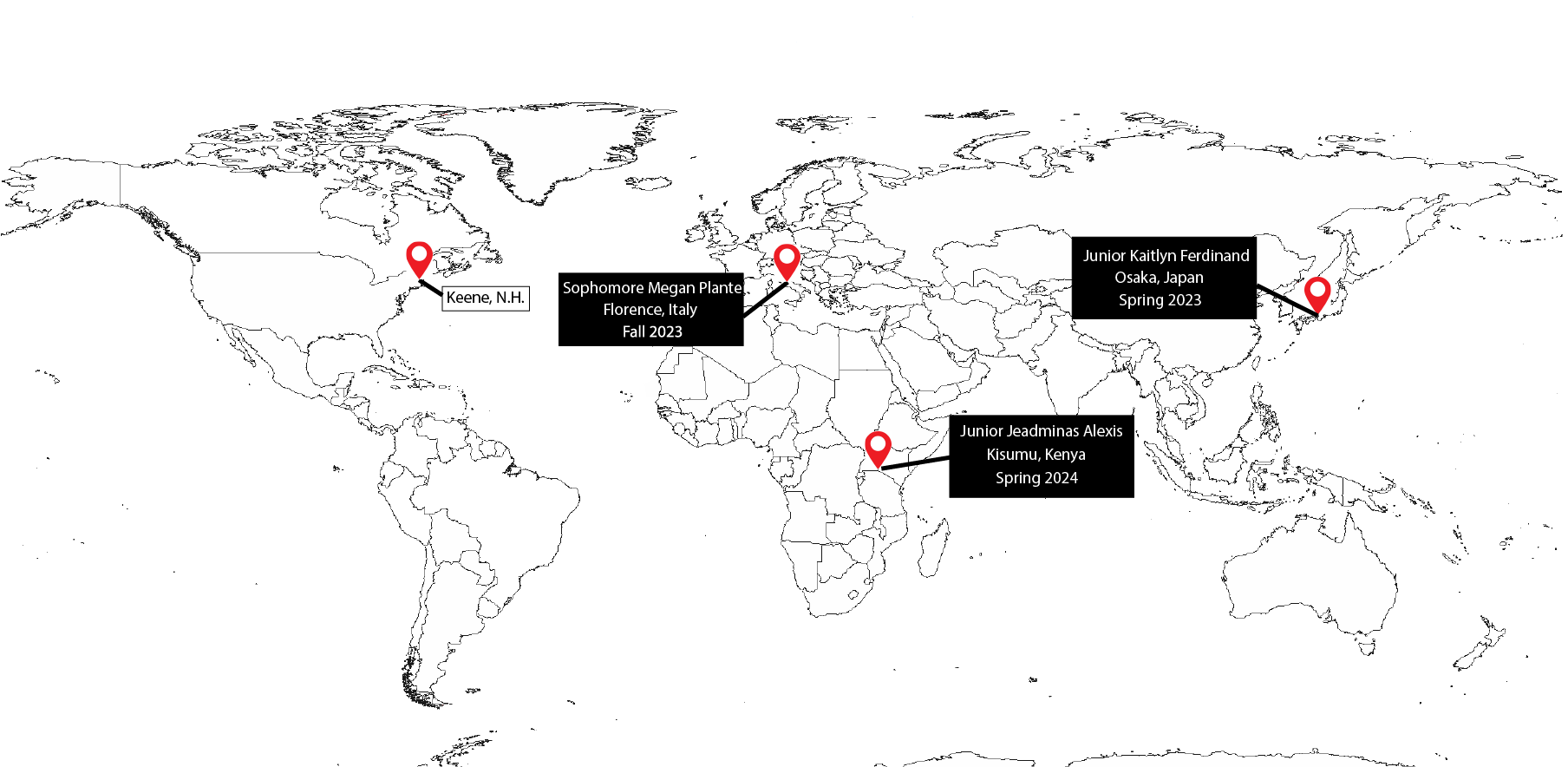
Sophomore Megan Plante, a Health Sciences Nutrition and Dietetics major, spent her fall 2023 semester in Florence, Italy.
Plante said she knew about studying abroad going into KSC and decided to start pursuing it during the spring semester as a first-year. Credit transfers from a vocational school and the encouragement of a friend who was also going aided her to further pursue the trip.
“By taking that step with her it helped me have the courage to go,” she said.
Once Plante got to Italy, cultural and language barriers presented themselves early on.
“We felt like we had to figure out what they’re saying right when we’re getting in the taxi and some things we just didn’t understand … it hit us the second we got there,” Plante said.
KSC does require students studying abroad to take a course in the local language, but Plante noted the classes themselves were all in English.
“You see that similarity between Spanish and Italian that really helped me taking Spanish in high school, it translated a bit,” Plante said.
In terms of course structure, Plante said hands-on work was beneficial to her.
“I had a cooking class and that’s all we did was cook and get to know the culture there and it really helped with my major now,” Plante said.
Another class, Palaces of Florence, involved sightseeing through the region’s local attractions.
Before the trip, filling out paperwork and getting a visa was intimidating to her, but Plante said Skye Stephenson, the director of KSC’s Global Education Office, helped her through it all.
Stephenson said she aims to offer as many opportunities as possible.
“We call ourselves the Study Away office, not the study abroad office … We have opportunities in the United States and outside the U.S.,” Stephenson said.
First and foremost, Stephenson said she wants to ensure different programs have strong support for students.
“We try to have a good collection both by location and by type of program among other factors,” Stephenson said.
Typically, Stephenson said courses taken in the program are general education requirements or electives for a student’s major.
“Anything you take when you study away you will automatically get credit for as long as you get a D or better, the courses come back as pass/fail on the transcript so they don’t impact your GPA,” she said.
Stephenson said some majors like safety and education programs make studying away a little more difficult, but they are still able to if they plan accordingly.
Financially, Stephenson said students often get support from financial aid to ensure they can make the trip.
“One of the great things about Keene State College is that our financial aid office is really supportive and works with people,” she said.
During her tenure of over 15 years at the office, Stephenson said there have been some changes, notably to programs in England. She said there used to be more exchanges to large universities in England, but KSC students found it difficult because of the lack of on-the-ground support for them.
“Students weren’t enjoying it so I stopped that and I do feel like it’s always been true but students at Keene need more or expect more,” Stephenson said.
Additionally, when Stephenson joined the program, there were no programs in Asia or Africa.
“That’s ridiculous, sorry, you have to have something in every continent not just be all-Europe focused,” she said, noting the program in Osaka, Japan has become one of the more popular ones in recent years.
Junior Kaitlyn Ferdinand, a Psychology major, spent her spring 2023 semester in Osaka, Japan.
“I’d always grown up in the same area in small rural New Hampshire where everyone looks the same, everyone has the same customs as you, it’s all the same and so I was looking to broaden my horizons,” Ferdinand said.
Ferdinand said her courses were general education requirements, as her major did not have specific courses offered.
Initially, she said she was looking at Costa Rica as a potential option, but did not pursue it because the living situation would be a homestay as opposed to a dorm-like environment in Japan.
“The dorm building that I was in was about a 15-minute walk, so I feel like going to classes was very similar to Keene State College, it was very scheduled,” she said.
Ferdinand said public transit infrastructure in Japan made travel and free time more enjoyable for her as compared to the U.S.
Despite Ferdinand not having prior knowledge of Japanese, she said Google Translate proved mostly helpful in daily life.
“I specifically remember a time because I had forgotten to take deodorant and so I used Google Translate to ask where the deodorant was and the worker, he took me to an area that was actually more odor things like a smelling salt,” Ferdinand recounted.
However, she said there were a lot of accommodations for English speakers in most situations.
Ferdinand said her most impactful experience on the trip was visiting the Hiroshoma Peace Memorial Museum.
“In Japan, the atomic bombings are seen very different … When you’re going to a country where there’s been war and especially your country has contributed to large devastation in that area however justified or not justified it was … knowing that your country did that you can still recognize that and be human,” she said.
Ferdinand said the trip was important for her because it showed her life in a different part of the world.
“There tends to be a lot of people who are willing to help you and are definitely excited that you’re trying out their culture and customs,” she said.
Crossing continents into Africa, junior Jeadminas Alexis is currently studying abroad in Kisumu, Kenya.
Alexis, who was born and raised in Haiti, said she initially looked to study in France due to her knowing the language.
“Study abroad in Africa is not really advertised as much and I was really given the option in Europe and then toward the end of my sophomore year I was like ‘I actually want to look at other places because Europe is not the only place,’ ” Alexis said.
Alexis said the cultural barriers have not been as stark, as the Kenyan and Haitian cultures are similar to each other.
Alexis, a Criminal Justice Studies major on a pre-law track, said her courses are in the areas of public health and human rights, which align with both her major, as well as her minor in Biology.
“It’s totally different, we get to be in the field a lot and actually work in the field which is really great,” Alexis said.
In terms of free time, Alexis frequents Java House, a coffee shop in Kisumu, as well as Dunga Hill Camp which overlooks Lake Victoria, one of the largest lakes in the country.
“Usually there’s this nice spot it’s like a restaurant with some music, some weekends we’ll go there and have fun,” Alexis said.
Alexis said it’s important to have study abroad opportunities in Africa.
“Experiencing the culture, appreciating the culture, especially with all the stereotypes that have been going on in the U.S. about Africa … When you come here it’s totally different,” Alexis said.
Nathan Hope can be contacted at
nhope@kscequinox.com