

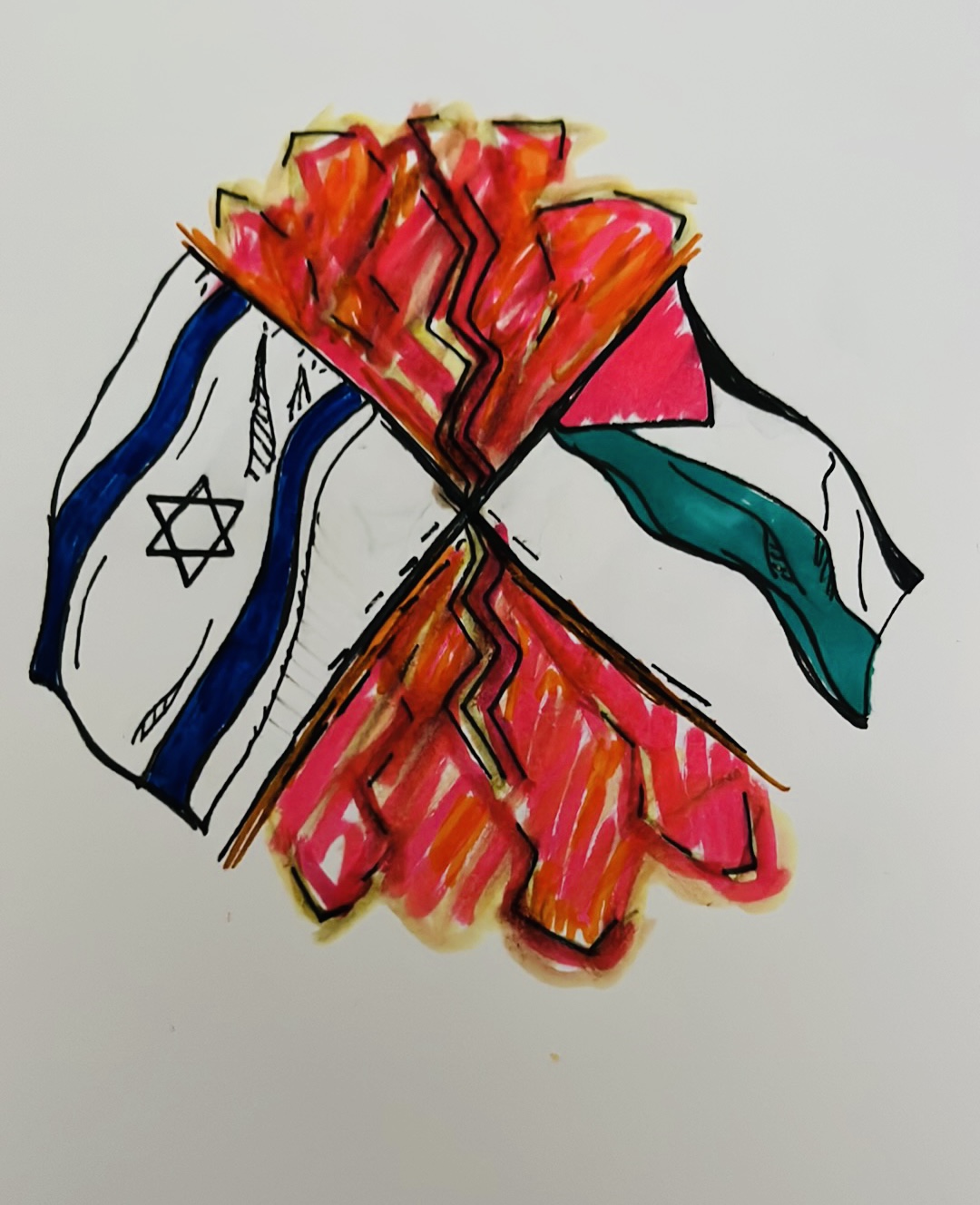
Keene residents had the opportunity to learn about the roots of the Israel-Palestine conflict, led by Tyler Schuenemann, assistant professor of environmental and sustainability studies at Keene State.
Understanding the War In Gaza took place on Thursday, Feb. 1, in the Alumni Center’s Norma Walker Hall from 12 p.m. to 1 p.m. and was sponsored by the KSC’s Diversity, Equity and Inclusion (DEI) Office.
The discussion’s purpose was to teach about “the context for the current conflict in Israel and Gaza,” according to the event’s promotional poster.
On Oct. 7, Hamas launched an attack on Israel, firing thousands of missiles into Israel, killing at least 1,400 people and kidnapping civilians, said Schuenemann.
“There were reports of torture and sexual assault, which is just to say that it wasn’t merely a military strike, it seems to have a lot of emotional force behind this,” he said. “It’s often been compared to our 9/11 in terms of its impacts on Israeli society.”
Hamas claimed it attacked Israel because of their blockade on Gaza and military occupation of the West Bank.
“Just about everybody in the Gaza Strip has been forced to flee their homes out of fear of attacks. Just about every standing structure in Gaza has been destroyed or damaged,” said Schuenemann.
Israel’s attacks have led to shortages of clean water, electricity and medical supplies, he said. With mass disruptions to electricity and telecommunication systems, it is difficult to report when bombs hit or signal for emergency response. Surgeries and births are being conducted without anesthesia.
Over 27,000 people in Gaza have been killed so far, Schunemann said, and according to CNN, over 66,000 have been wounded since the Oct. 7 attacks.
Schuenemann said to understand the Oct. 7 attacks and to start unpacking the complexity of the current situation, it is necessary to understand the conflict’s history with a focus on how the rise of nationalism and Zionism in the 1900s contributed to the conflict’s origin.
He said, for the time, nationalism was, “A pretty new idea about how to make your community and your people safe and free.”
With antisemitism in Europe running rampant in the early 1900s, Nationalism was seen by many Jewish people, mainly secular, as the path to avoid persecution. They believed the only solution to anti semitism was to occupy and control your own country, and this was coined zionism, Schuenemann said.
After the conclusion of World War I, the British Empire was in control of the territory that was the Ottoman Empire. Many of the Zionists viewed the territory as the movement’s destination, Schunenemann said.
“The British took over what is today Israel, Palestine and Jordan and it’s in this time period where you start to see this conflict really start to take shape,” said Schuenemann. “Where you have European Jews, this mass movement, seeing this territory as the ideal home for their people. This is where they’re going to find safety, by establishing a state on that piece of territory.”
As more and more European Jews came into the territory and tried to establish communities, conflict arose with the local populations.
“Not only did these Jewish, migrants want to establish a state here. But the Palestinians and the larger Arab communities also wanted to establish their own state. Because, not only is there Jewish nationalism, but there is Arab nationalism,” said Schuenemann. “And so you have two different groups, both seeking some sort of freedom and security and liberation by establishing a state, planning to establish that state on the same piece of land.”
Following WWII, the UN proposed a solution to the land dispute, which would establish an Israeli state on part of the land, and the other parts would be given to the local populations. The local populations rejected the proposal.
“If you compare the amount of land that is being given to each group, compared to just how few Jewish residents there were at the time, and how little of the land they already had the deeds to, you can understand why the Arab population thought that this was an unfair proposal, right?” Schuenemann said. “It was just disproportionately in favor of the Jewish population.”
In 1948, the British Empire decided being in between both sides of the conflict was not sustainable, so, “Eventually, the British, who were supposed to be the people in charge here, they said, ‘We’re out of here,”’ Schuenemann said. “So the British just walked away and where the borders ended up being drawn isn’t according to any UN Map. The borders just end up being drawn over who takes what by force.”
A war between the Arab and Jewish populations breaks out following the British Empire’s departure, Schuenemann said, and “when there was a ceasefire declared, the parts of the land that the Israeli army occupied became Israel.”
Once the Israelis had an organized military, they started to carry out “acts of ethnic cleansing” against the Arab populations.
“They wanted a state for Jews. They did not want the local population there,” Schuenemann said. “700, 000 Palestinians were forced or, um, or fled for their lives from the, from the land.”
It is here that Schuenemann ends his history lesson and comes back to the present day and with a message.
“I do think Israel could make peace with Hamas if [Israel] wanted to,” Schuenemann said. “It would be hard,” but “Hamas has signaled a willingness for peace.”
A large part in why peace is not being achieved is because of “leadership on the Israeli and United States side,” he said. There needs to be more “pressure on politicians for a ceasefire … American aid for Israel should be contingent on if they commit human rights violations.”
Boxcar, a Keene State student and spectator, said they felt the discussion and event were important because of how many people are unaware of what is happening.
“I’m big in activist circles and last semester I had a 400-level with [Schuenenmann] and he actually derailed class for a whole day to talk about what was happening right after Oct. 7,” they said. “It was good because a lot of the people in the room were very opinionated about it but had no clue about what was happening at all.”
“I have been to Israel twice and Jordan twice and it wasn’t on a vacation, it was on a mission to learn more about life and everybody,” said an audience member. “I’ve met Palestinians and Israelis and they are almost the same people, and yet they are in this conflict that doesn’t seem like it is going to break.”
Harvie Marcotti can be contacted at
hmarcotti@kscequinox.com