

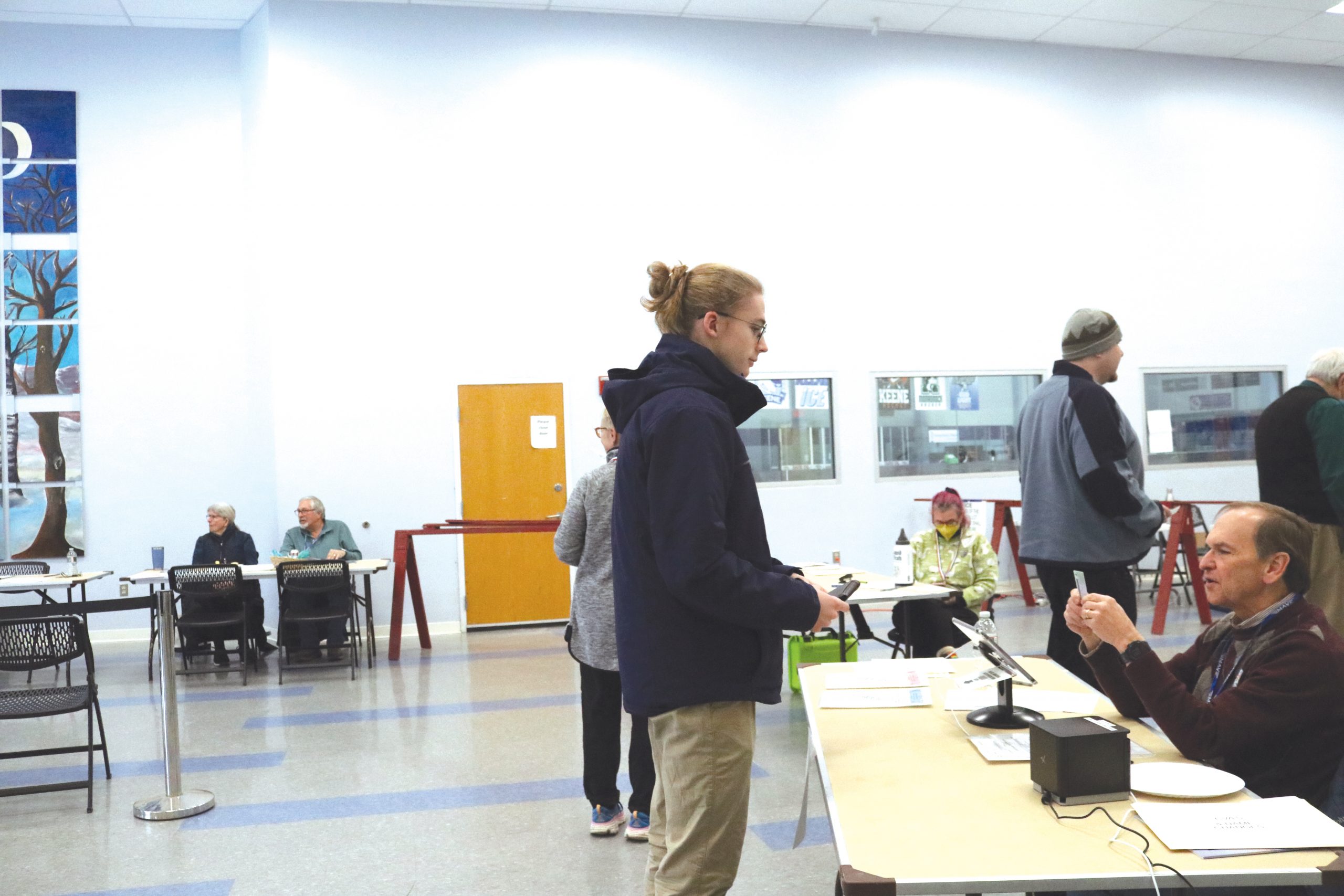
KSC students had an opportunity once again to make their voices heard at the polls on Jan. 23, as the Granite State’s first-in-the-nation primary took place.
Kim Schmidl-Gagne, who serves as a coordinator for the American Democracy Project (ADP) on campus, said that the college being an ADP campus is important for a number of reasons. “Our mission and our values and our college-wide learning outcomes all value civic engagement, and part of what American democracy does is look at one of the ways that people can be civically engaged which is through the political process,” Schmidl-Gagne said.
Schmidl-Gagne said that the ADP also helps to coordinate candidate and issue forums to allow students to get to know their choices on the ballot, rather than zeroing in on party affiliation.
In terms of voting, Schmidl-Gagne noted that many students might feel it is more difficult to do than it is. “We do some things as a college to verify domicile for all the students who live on campus so you don’t have to bring something that verifies domicile … and then there are things like citizenship and age, so if a student brings their driver’s license with them it counts as your ID, and your birth-date is on it so that ticks a box,” she explained. Non-driver IDs and passports also work well to verify identity, Schmidl-Gagne said.
For the bulk of elections, the ADP offers shuttles to transport students to the polls, with a majority of students falling in either Ward 1 or Ward 5 of Keene, with both polling places outside of walking distance.
Tufts University has also collected data on voter turnout of KSC students since 2012 when the college joined the ADP. According to the numbers, in the 2020 elections, KSC students turned out at a rate of 68.7%, a 27% increase from 2012. Among colleges that opt into the National Study of Learning, Voting and Engagement, of which there are around 1,200, KSC was 2.7% above the average turnout rate of 66%. However, data was not collected for primary elections.
This year’s presidential primary will look a little different than previous cycles though, with incumbent President Joe Biden not appearing on New Hampshire’s ballot, as well as continued legal issues and questions revolving around the candidacy of former President Donald Trump.
Professor Margaret Mott, who teaches a class on political participation, said a key issue that she was looking at was the question of whether Trump can be disqualified from the ballot under the Constitution’s 14th Amendment. “I think this is a big game-changer but I may be wrong … the Supreme Court is gonna weight in on it and I’d be so curious to how they make sense of it,” Mott said.
In Dec. 2023, the Colorado State Supreme Court ruled 4-3 that Trump could not appear on Colorado’s primary ballot, disqualifying him under Section III of the 14th Amendment which bars candidates who engaged in insurrection against the U.S. from running, according to a Dec. 19 Associated Press (AP) article. Back in September, 2023, New Hampshire’s Secretary of State David Scanlan declined to remove Trump from the ballot.
Biden, alternatively, will not appear on New Hampshire’s Democratic primary ballot due to the Democratic National Convention (DNC) changing the primary calendar, allowing S.C. to be the first primary contest, while N.H. and Nev. would be held on the same day after the Palmetto State. However, N.H. state law mandates any primary to be held at least seven days before any other state.
With the party and the state in disagreement, Biden did not file to run in the state’s Jan. 23 primary. Despite this, the N.H. state Democratic Party urged voters to write-in the incumbent. Mott said that in the current political era we are in, the party systems are decreasing in power and sway. “I’m not sure the party system is functioning very well, and the Republicans don’t seem to be able to offer anyone who can beat Trump, so is that a party decision or is it that parties are struggling to keep up with the conditions on the ground?,” she said.
Mott said her hope is that a serious third party would emerge in the future. “They’re certainly appealing to the largest voting bloc which is unaffiliated between two parties,” she said.
Political Science Department Chair Mike Welsh said that the lack of competition on the Democratic primary ballot due to Biden running for re-election can show independent voters voting in the Republican primary instead. “You might see, especially Democratic leaning independents won’t feel obliged to vote in the Republican primary, they may go in and put in an endorsement for one of the more moderate or centrist candidates,” Welsh said. In the buildup to the N.H. primary, Gov.
Ron DeSantis of Fla. dropped out of the race, leaving former U.N. Ambassador Nikki Halley and Trump the only two prominent candidates in contention.
“I think it’ll have an impact, and I would say it would not have a difference-making impact but it does look like the race is tightening,” Welsh said.
In terms of out-of-state students voting in N.H., a group that has seen repeated attempts by the state legislature to either restrict or disallow them from voting in the Granite State, Welsh said it is a complicated issue. “There is a logic to it, and it’s a reasonable logic, but I don’t think that it’s a compelling logic. You should encourage registration as much as possible and you should get people voting as much as possible and not worry so much about the consequences of local stake,” he explained. Welsh said there are material impacts when young people vote. “The collective impact of young people voting starts to mandate that politicians pay more attention to young people issues,” he said.
“If candidates in the primary election sense that young people will turn out if I speak to them, then that’s incentive for them to start debating issues that they’d otherwise neglect,” Welsh noted.
Nathan Hope can be contacted at
nhope@kscequinox.com