

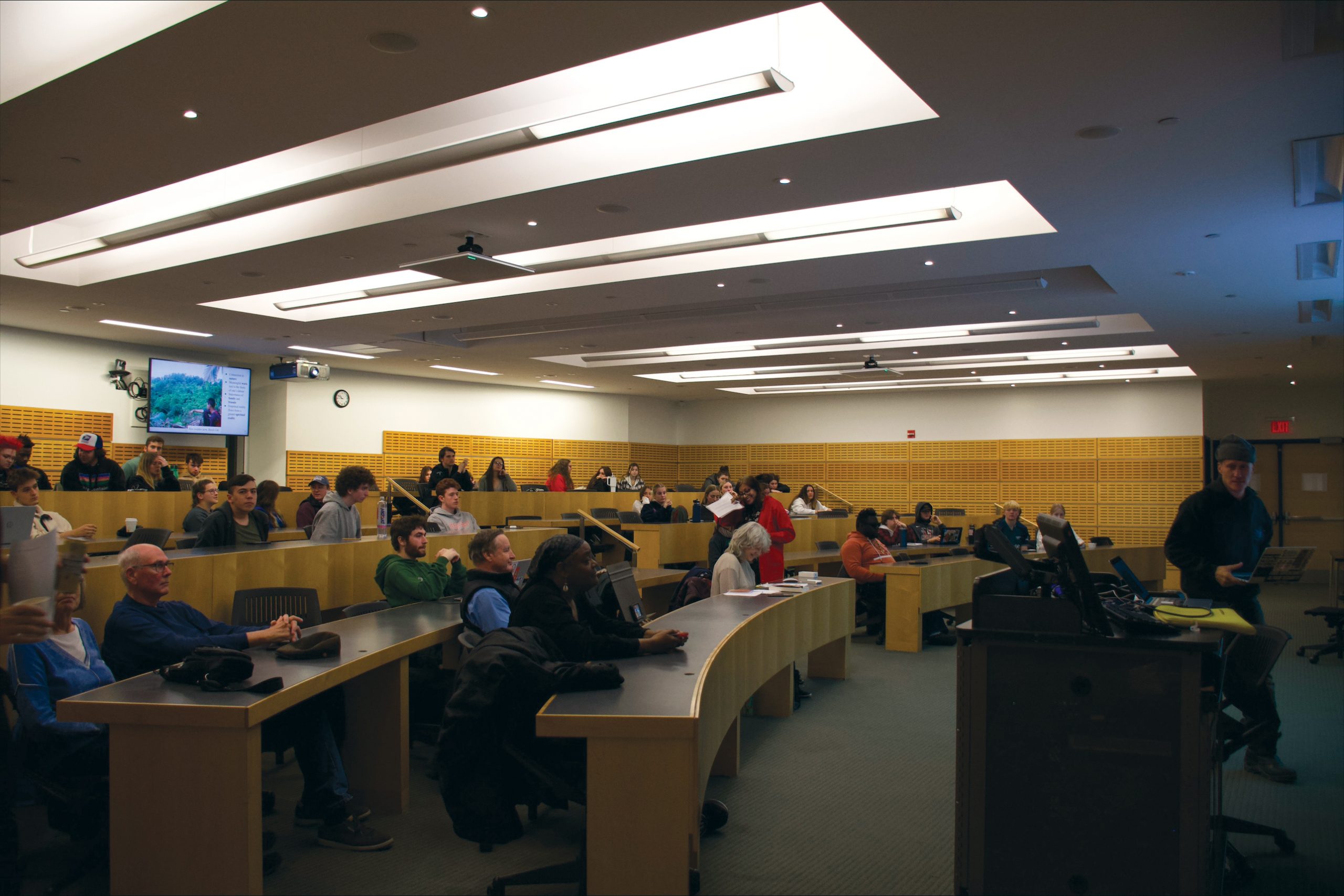
Students of Keene State College gathered together to further their education on indigenous people along with their history.
On Dec. 1 at 6 p.m., students and faculty met in the science center to learn more about the Semai people, solutions at the intersections of the climate crisis, Andean Indigenous Ceremonies and environmental studies.
Guest speakers Karen Heikkila, Henry Harris, Skye Stephenson and Professor Sasha Davis discussed crucial issues and educated others on some of the problems the world is currently facing.
Each individual on the panel, presenting different issues, shared the same theme throughout the discussion: A hope for always. All four guests discussed examples of the post-nuclear restoration of life activism, Indigenous cultural empowerment and food sovereignty movements that are shown in different parts of the world.
Heikkila came to campus to spread awareness regarding the Semai people, who are a sedentary ethnic group that live in the center of the Malay Peninsula in Southeast Asia. The Semai people have faced many challenges, one being no legal protection from the government causing them to lose their land. Another issue they face is “generational trauma,” which explains their shy personalities and avoidance of violent confrontation.
Heikkila said it is important to educate others on the Semai people because, “First and foremost it puts the Semai on the map, showcases their fight better and helps their land rights situation.”
Heikkila further said that it is important to spread awareness about their fight since “an average man on the street would probably not know who the Semai are.”
When asked what her hopes are for Semai people, she said, “For the Semai to get their homeland back and legally recognized.”
Harris talked to students about the intersections of the climate crisis and the importance of a social movement.
During his talk, he provided examples of possible solutions that will reduce greenhouse gas within 30 years. Harris said he first became interested in learning more about the climate crisis the world is currently facing out of fear.
“The idea that we have to unite because we have to was really compelling,” said Harris.
Harris said that while it is important to spread awareness about climate crisis, it is also crucial to come up with ideas on how to resolve the issues. This is because “the bad guys have made it a conversation about whether or not it’s a climate crisis or not … I think it is important to spread awareness about scientific solutions to the climate crisis regular people can get involved in,” said Harris.
Skye Stephenson, director of global education office, provided information regarding indigenous universities worldwide. Stephenson shared her first-hand experience of visiting different universities across the world. Some of these universities included ceremonies, where the individuals made offerings to the earth. Stephenson was able to experience one of these ceremonies. Even though rarely given the name “indigenous universities” and instead referred to as intercultural as it is centered around different viewpoints and different people of all types to come together and embrace one another, Stephenson said, “Besides Indigenous universities, it is also really interesting that in all of the Americas, even while separated, when we can intercept and work together there’s a lot of mutual learning and support.”
Samantha Smalick can be contacted at
ssmalick@kscequinox.com


