
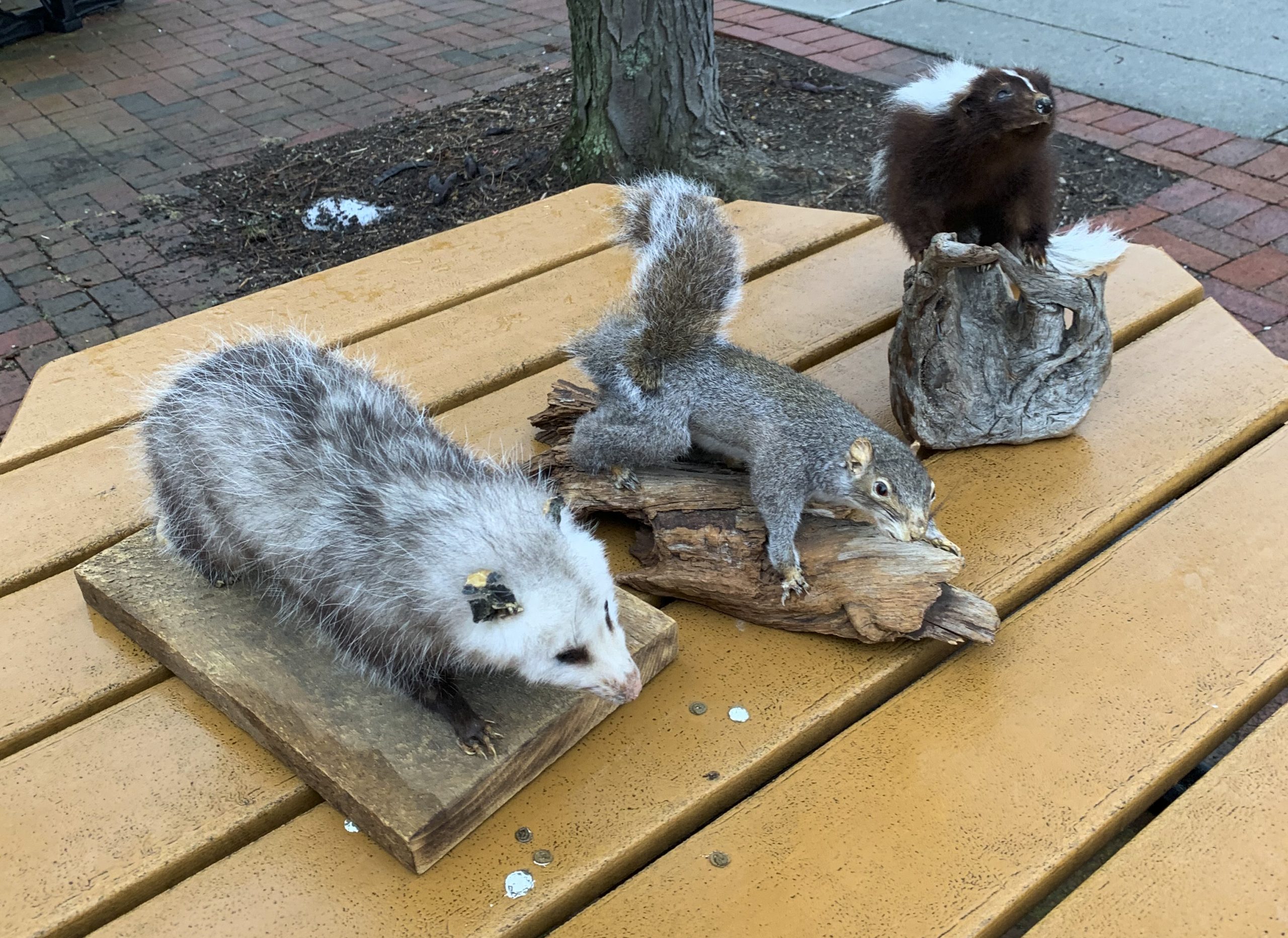
A skunk, a squirrel, and a possum: three taxidermied animals greeted the group of 12 gathered by the tables in front of the Science Center.
On Friday, Feb. 17, The Harris Center hosted a Winter Tracking event on campus. Students met at noon near Huntress Hall. These three specific animals were anticipated that the group would find the most tracks to be related to one of these three species.
The group was led by Susie Spikol, a naturalist from the Harris Center. “I love mammals, I always have. They’ve always been something that sparked my interest,” she mentioned during introductions.
Before the group set out on the trek, Spikol gave some facts about the animals that the group would potentially encounter, such as possums. Spikol noted that possums are the only marsupials (mammals that carry their babies in a pouch) naturally found in North America, and that baby possums are the size of jelly beans at birth.
When asked about the origins of the term “playing possum,” Spikol gave insight to the group. “Possums have a trick up their sleeves. When they are threatened, they give a lot of warnings before playing dead. They foam from their mouth and vomit green goo, which is slimy. The possum is saying, ‘You don’t want to eat me, look how sick I am,’” she said. She mentioned that possums are very convincing while playing dead, which would deter predators from eating them.
The group started by looking at the trees along Appian Way to see whether or not there were any dreys present, a term referring to a squirrel’s tree nest. Participants were able to spot a couple, but Spikol noted that they would be vacated at this time, as squirrels will rest in tree cavities during the winter.
Spikol cautioned that the rainy weather and lack of snow might make it difficult to find tracks, but said that sand, mud and other soft straights may still show signs of animals. The group continued to the Redfern Arts Center, where they found an acorn on the ground. Spikol informed the group that this past year has been a bad year for acorns, not just for Keene, N.H., but for the North East. She detailed how oak trees synchronize with other oak trees, so when one has a bad year for acorns, the surrounding ones do as well. This is bad for small rodents that consume acorns and the predators that hunt these small rodents.
The group finished their walk by Pondside 1. There, they found evidence of a former beaver dam. They noted the bite marks on the wood nearby, which were at the angle typically seen in beaver bites. There was also evidence of debarked trees, which were eaten by beavers.
The group also noticed holes in trees made by woodpeckers. When a student in the group inquired about why woodpeckers peck trees, Spikol informed them that woodpeckers can hear the bugs inside a tree from the outside, and they peck holes in so that they can eat the bugs. Spikol also broke down how woodpeckers are able to peck without hurting themselves. Spikol described how they have really long tongues and a hole in the pallet of their mouths. The woodpecker puts their long tongue into the hole in order to cushion their brain while they peck.
The next Harris Center event on campus will be on March 24 in Science Center room 101, where they will discuss salamanders.
Zach Murphy can be contacted at
zmurphy@kscequinox.com