
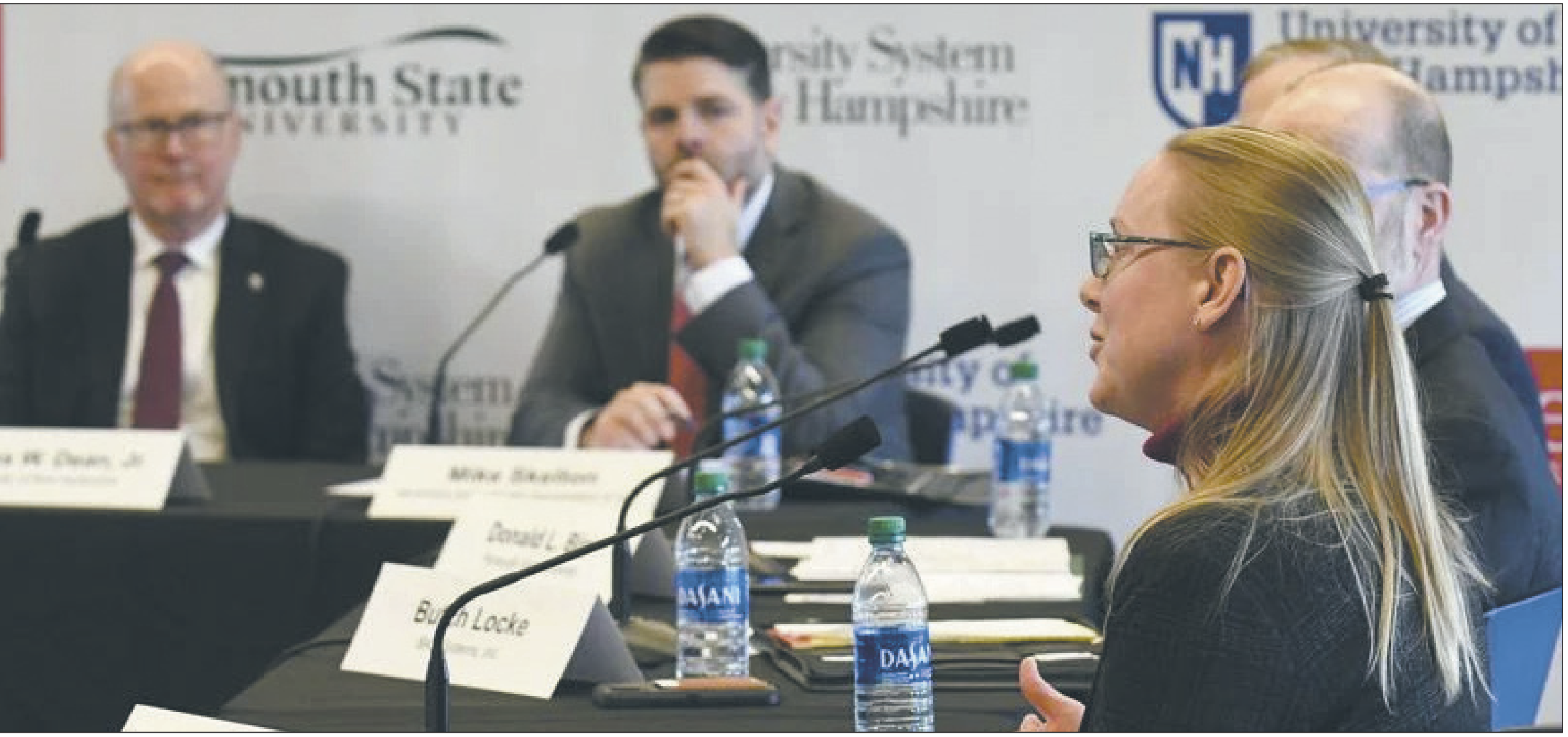
MANCHESTER — Keene State College President Melinda Treadwell and Cheshire Medical Center Chief Nursing Officer Anne Tyrol said Tuesday it is critically important to build and maintain strong ties between academia and the business community. They participated in a University System of New Hampshire roundtable discussion at UNH-Manchester that also highlighted a pending request for more higher-education funding from the state.
Treadwell told fellow participants that half of Keene State’s students participate in internships and that she would like to see even more get such opportunities.
“If we are successful, we will commit to 100 percent of our students being involved in internship experiences,” she said. Those who intern in the area boost the local economy, working in industries such as health care, education and precision manufacturing, she said.
The goal is for them to stay in the state and build New Hampshire’s workforce, said Treadwell, who graduated from Keene State College.
Tyrol, a graduate of the University of New Hampshire, said colleges and universities in the state can provide a key labor pipeline. “In health care we are facing a tremendous workforce challenge, both in clinicians and also people at our hospital who work in other fields,” she said.
Other roundtable participants were James Dean Jr., president of UNH and interim chancellor of the system; Plymouth State University President Donald L. Birx; DEKA Research & Development founder Dean Kamen; Freudenberg Sealing Technologies HR manager Ben Learned; Elizabeth Brindley, group talent acquisition manager, Enterprise Holdings; Joe Murray, vice president of government relations and public affairs, Fidelity Investments; Butch Locke, strategic operations director, BAE Systems, Inc.; and Mike Skelton, president and CEO, Business and Industry Association of New Hampshire.
After the roundtable discussion, Treadwell said New Hampshire’s beauty and quality of life are two big selling points for graduates to remain in the state. Professional relationships built while in college can also provide an incentive to stay.
“My vision is that our students should have compensated internship experiences so they are becoming the best teachers, the best physicians, the best nurses and the best manufacturing engineers they can be,” Treadwell said. “That happens when they are working side by side with mentors and leaders.”
Meanwhile, Dean, the interim chancellor, said there has been a decline in state support for higher education. That annual funding level was $100 million in 2011 and is at $88.5 million now, he said.
Lawmakers this year will put together the next two-year budget. The system has requested $95.2 million next fiscal year and $104.2 million the year after that. Dean said Keene State, UNH and Plymouth State — all part of the public university system — have not raised tuition in five years but have increased student financial aid.
“With all of the great things that all of our colleagues at the universities are able to produce including the students we talked about today, it’s becoming increasingly difficult to do that with the level of funding that we have,” Dean said.
According to a Jan. 9, 2022, report from the nonprofit Education Data Initiative, New Hampshire’s average in-state tuition and fees for public colleges and universities was $16,679, second only to Vermont’s $17,083. Dean provided a fact sheet showing that nearly 60 percent of New Hampshire’s college-bound high-school students leave the state to attend colleges and universities elsewhere.
Rick Green can be reached at
RGreen@KeeneSentinel.com or 603-355-8567
These articles are being shared by partners in The Granite State News Collaborative. For more information, visit collaborativenh.org.