
Rachel Vitello
News Editor
Across the nation, Indigenous Peoples’ Day is being recognized in place of Christopher Columbus Day. According to USA Today, eight states, ten universities and more than 130 cities across 34 states have already made this change.
On Monday, October 14, Keene State College held a discussion around the topic of Indigenous Peoples’ Day. The speakers included Franklin Pierce University adjunct professors Donna Moody and John Moody, Associate Vice President for Institutional Diversity and Equity Dottie Morris, Cohen Professor of Holocaust and Genocide Studies Jim Waller and the KSC students behind this process, Jeniffer Afualo-Robinson and Jedidiah Crook.
Keene mayor Kendall Lane was also in attendance and read an official proclamation of the City of Keene recognizing Indigenous Peoples’ Day.
“This is an important transition we’re making—a transition from being a European-centric community to a people-centric community for all people who have lived here and live here now,” Lane said.
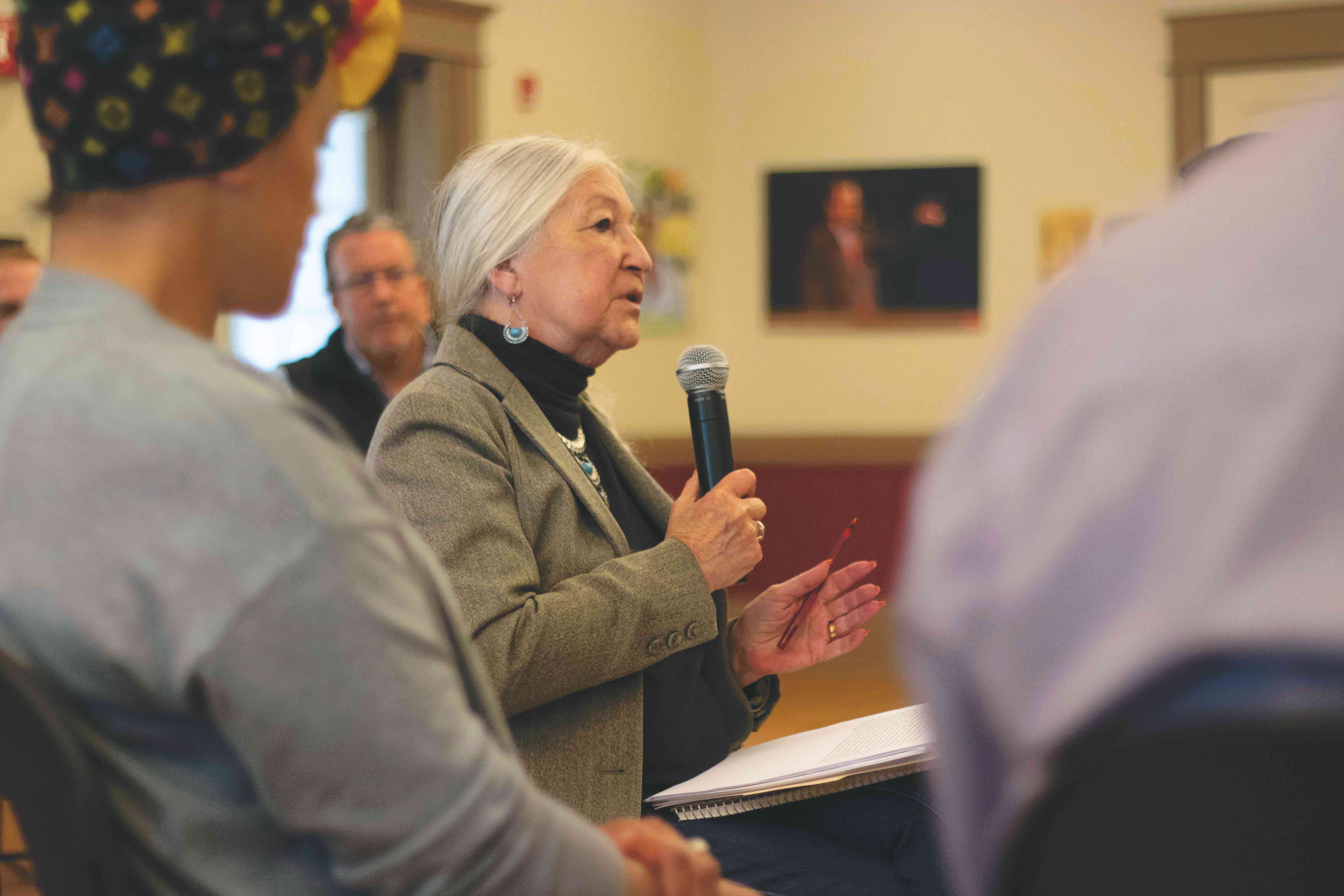
A Native American tribe that is native to the Keene area is the Abenaki. Moody is of the Abenaki tribe and her area of expertise is in cultural anthropology. She discussed the significance of recognizing Native Americans not only nationwide, but right here in the Keene community.
“We’re rooted here, our story is here, our language is here, our ancestors are buried here,” Moody said. “So it’s a very special place to us.”
Moody also conducted a small test. She had all the students in the room stand and told them to remain standing if they knew who Christopher Columbus was, to which all students stayed standing. Then, she told them to remain standing if they knew who the first people were with whom Columbus came in contact with. Only two students of about 20 remained standing. The first people Columbus met in America were the Taíno. The small test was meant to show the disparity in knowledge students have about Columbus as compared to the indigenous people.
KSC senior Jedidiah Crook has been working with the college and with the city to have the recognition of Indigenous Peoples’ Day accomplished. He spoke on the role that candid and open conversations play in battling discrimination and ignorance.
“Education can serve as a really important tool for dismantling the continual colonial violence that goes on today,” Crook said. “When talking about Indigenous Peoples’ Day, we can talk about [how] education has been a tool of genocide in this country specifically for indigenous people, so any sort of conversation about this has to tie into education. Ways in which we can do that are one, representation and second, visibility.”
KSC senior Afualo-Robinson has been working on this effort as well. She presented to the group an interactive example of this education. She created a timeline of issues that impacted the Abenaki tribe of New England, including the Sokoki people. The timeline addresses a variety of problems the tribe faced from 1600-1800. This timeline can be found at http://hidden.coplacdigital.org/keene/timeline/.
Waller discussed how the United Nations Declaration on the Rights of Indigenous People is significant to the acknowledgment of repairing past injustices done to native people, and that there is hope this declaration will eventually become international law.
“The declaration prioritizes the rights of indigenous people to self-definition and self-determination. In this country all the way up to about 1970, the U.S. government never gave native people the right of self-definition. That’s a basic right,” Waller said. “Secondly, that indigenous people have a fundamental right to protect their distinct cultural identities. We’ve gone to great lengths in countries around the world to destroy cultural identity. Thirdly, indigenous people have the right to live free from discrimination and to live free from the threat of genocide.”
Moody discussed the educational imbalances between indigenous people who get their master’s and PhD degrees compared to other ethnicities. She also cited the institutional racism in the U.S. that allows for native people to have a 38 percent higher incarceration rate than any other ethnicity in the country.
“Indigenous people were in the Americas by 1492, we were the first astronomers, geographers, physicists, doctors, botanists, on and on. We were the first on this land. Let’s acknowledge it and let’s teach it,” Moody said. “Let’s address the underlying issues of bias and oppression. When these issues are being addressed and progress made, then we really have begun to address the issues of the genocide of the land, the disappearance of language, the disappearance and erasure of our histories.”
Rachel Vitello can be contacted at
rvitello@kscequinox.com.