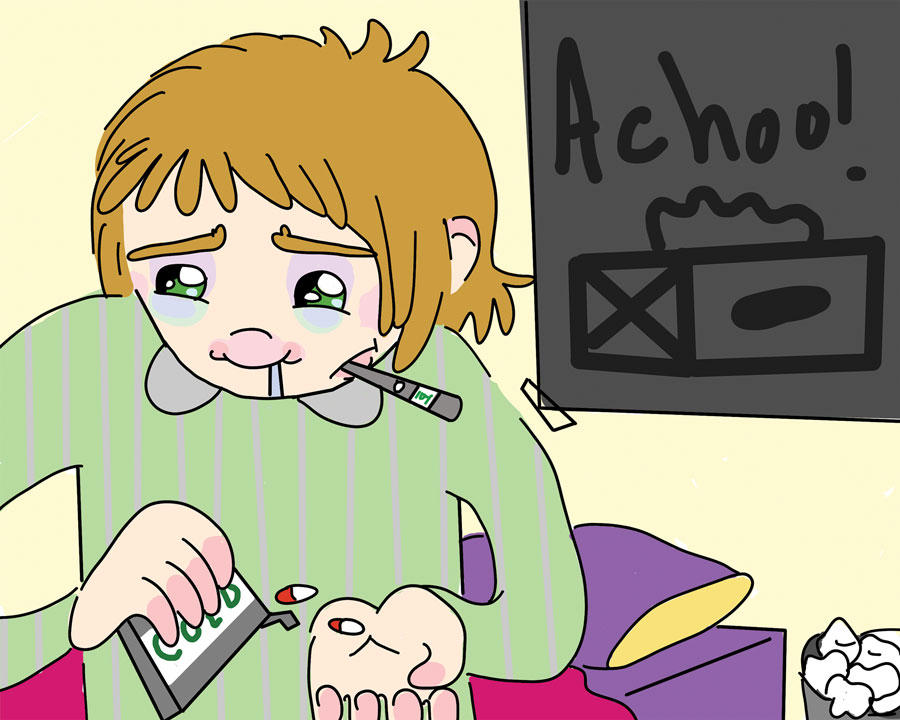
Every semester, illness plagues students and faculty alike, spreading like wildfire throughout campus.
These illnesses often hinder students’ abilities to get to class and complete assignments.
Nurse practitioner at the Center for Health and Wellness on campus, Deb Coltey, said that she sees students come in for treatment everyday.
“Things tend to come in clusters because [students] are being exposed to all these new germs. They get sick quite frequently. I think part of it is being exposed to new bacteria and new kinds of viruses,” Coltey said.
Coltey continued that a large part of this issue stems from living in close quarters with one another.
Medical director at the Cheshire Medical Center walk-in clinic Marika Ostroski also said that living environment plays a large role in the spread of illnesses. “If it’s a contagious illness, likely it is being spread from one student to another because of proximity in terms of living environment and possibly not the best attention paid to hygiene,” Ostroski said.
Ostroski said that proper hygiene could help prevent students from getting sick or spreading illnesses.
“Hand washing is definitely a good idea, the more often you wash your hands regularly the better,” Ostroski said.
Coltey agreed and said that she thinks hand washing is important in preventing illness.
Sarah Morrison // Equinox Staff
“I wash my hands fifty times a day, maybe even more. I’m with sick people everyday, all the time, and I rarely get sick,” Coltey said.
As far as hand washing for on-campus students, first-year student Jane Scafati said that she gets sick often and wishes she could wash her hands as often as advised.
She also addressed how living on campus prevents her from doing so.
“They don’t have soap in the bathrooms, so that’s a problem,” Scafati said. Ostroski also said that it is important to make sure that food is cleaned properly before it is consumed.
“You don’t want to be washing your dishes in the same place you brush your teeth and go to the bathroom just because you run the risk of crossing bacteria from the bathroom to what you are eating,” Ostroski said. Additionally, Ostroski said that she recommends not sharing certain items when sick, to prevent spreading the illness.
“Sharing drinking containers, utensils, toothbrushes, all things you wouldn’t want to be sharing if someone is sick in your living environment. Sharing towels is another way people can share germs,” Ostroski said. She also said that those who are sick should avoid being around others whenever possible. “Staying alone [is important], not isolating yourself, but not being really close to other people when you’re sick or have a fever,” Coltey said.
Ostroski agreed that staying alone is a good idea when sick.
“Piling up on a bed together to study probably is not a good idea if someone has a cough, runny nose or is sneezing,” Ostroski said. Furthermore, Ostroski said that she advises against smoking.
“Avoiding smoking or people who are smoking, secondhand smoke, can improve your chances of not getting sick because the lining of your lungs and nasal passages are more likely to harbor infection if you’re exposed to these toxins,” Ostroski said. Along with viruses and infection, Coltey and Ostroski said that STDs are good examples of illnesses that can be avoided, but are still spread from student to student.
“Get yourself tested so that you know if you have anything so that you can let your partner know. Many things are asymptomatic,” Coltey said.
“Obviously this is the age group that can tend to be sexually active and safe sex is important, avoiding alcohol and other substances that can hinder your decisions so that you maybe would expose yourself to something you would otherwise be more careful about [is important],” Ostroski said. Coltey said that the health center offers condoms to students to help encourage safe sex.
While there are a number of ways to avoid getting sick, it still happens to many students throughout the semester.
The Center for Health and Wellness as well as the Cheshire Medical Center are facilities that students can take advantage of when they find themselves ill.
Coltey said that getting a flu shot is one service that she recommends students take advantage of. “We have flu clinics every Monday from three to four where people can get flu shots. They’re fifteen dollars for students,” Coltey said.
Aside from flu shots, students can utilize the health center any time they may feel the need.
“Depending on what [a student] needs, whether it’s over-the-counter medication, advice, prescriptions or further care, we will refer them if needed,” Coltey said.
The walk-in clinic at Cheshire Medical is also an option for students and community members alike.
“If someone is sick enough that they are dehydrated and haven’t been able to keep up with their fluid intake, we can give IV fluids. We can test for things by blood tests or other tests we have to pick up on illnesses,” Ostroski said. Sophomore Paige Willhoite said that she often gets sick during the winter and has visited the health center on campus before.
“I thought the health services were good, I went there last year and they helped me a lot,” Willhoite said.
Likewise, her twin sister Lauren Willhoite said that while she has never needed to visit the health center she would not be opposed to doing so.
“I’m sick now. I’ll usually just get medicine from Walmart, drink a lot of water and carry hand sanitizer. I’ve never been there but if I were to get worse I definitely would,” Lauren said.
The Center for Health and Wellness has walk-in hours Monday through Friday for students in need of service. Appointments can also be made outside of walk-in hours to ensure that every student that needs to utilize the facilities offered is able to do so.
Devon can be contacted at droberts@kscequinox.com