

It’s no secret that how people get their news is changing. Revenue of newspapers nationwide continue to fall year after year, declining almost every year since 2005, according to stateofthemedia.org. This decline in sales hit a low when revenue dropped by $13,284 billion between 2008 and 2009.
The State of the News Media is an annual report on American journalism done by the Pew Research Center. According to their website, the study, “consists of data originally generated by other people or organizations that the Pew Research Center then collected and aggregated.” This information is then analyzed with the use of graphs, charts and explanations.
Philip Bergeron / Graphic Design Editor
While circulation revenue has remained pretty stable over the past 20 years, advertisement sales have taken the biggest hit.
According to the study referenced above, advertisement revenue from media has dropped from $50 billion to just over $20 billion from 2005 to 2012. This is significant because, advertising is the reason many newspapers stay in business.
Television has taken a similar, if less significant, decline in viewership. According to a 2012 study by the Pew Research Center, this decline is especially high among young people, ages 18-29. Just 34 percent of this age group said that they watched television news yesterday, a 15 percent decline from 2006.
Genesis Pena, a sophomore at River Valley Community College, said she goes to CNN or NBC for her news, depending on the program. She doesn’t read the newspaper at all, finding most hold some bias on what they report.
Television remains the supreme form of news medium even with a decline in younger viewers. Another survey by Pew done in 2013 found 69 percent of Americans cited television as their main source of news.
But since 2009 another medium has found a sharper spike in usage than all the rest: the internet. “Fifty percent of the public now cites the internet as a main source for national and international news,” Andrea Caumont, author of the report, said.
Does any of this really matter, though? If well-informed citizens are important, then yes. In a 2012 Pew Research Center News Consumption Survey people were asked these questions: “Which party controls the House of Representatives, what is the current unemployment rate, what nation does Angela Merkel lead and which presidential candidate favors taxing higher income Americans more than others?” Only 14 percent of Americans surveyed could answer all four questions correctly.
Americans are getting more and more news online. But what draws people to the web rather than picking up a paper or turning on their local news station?
“I get most of my news from Facebook,” Keene State College first-year student Keira Valaitis said. “If I see someone post an interesting article or something I’ll click on it for more information,” she added.
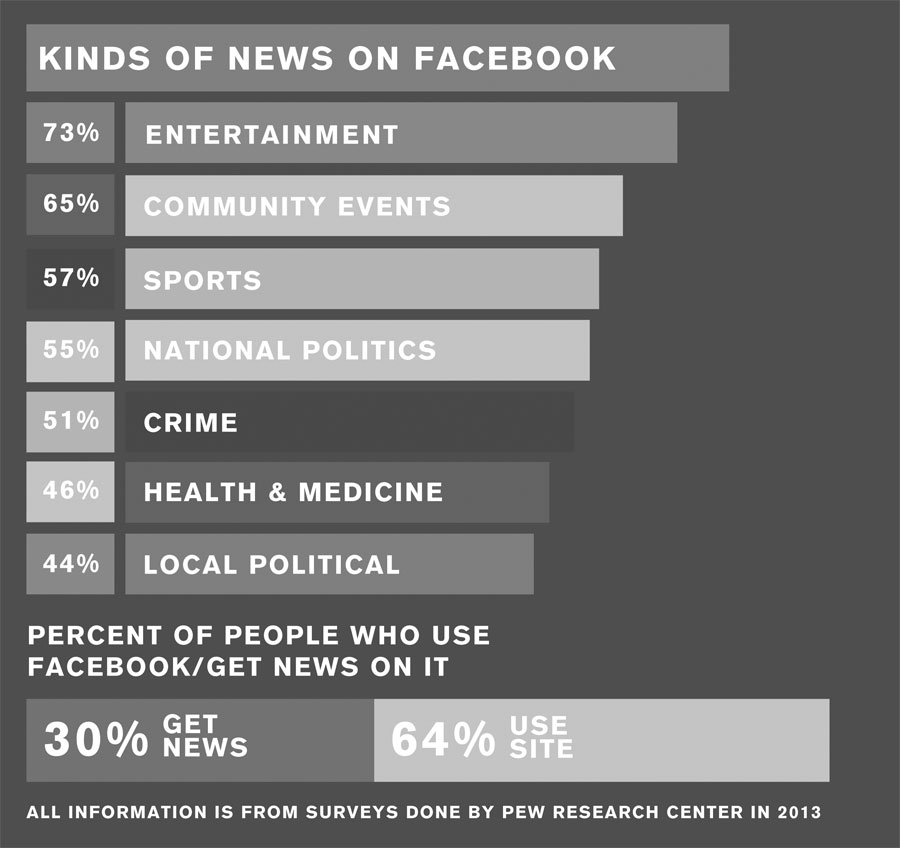
A more recent study done by Pew Research Center focused on the connection between social media and how people obtain news. The report titled, “How Social Media is Reshaping News” and published in September of 2014 stated that roughly 64 percent of adults in the country use Facebook. Of this 64 percent, 30 percent of adults use Facebook to get news.
“It’s both good and bad people look at Facebook links for news. Good, because it gives you information right away, but bad because Wiki[pedia] — it can all be bullshit,” Pena said.
Maybe the increased importance of social media could be positive for news. After all, if people are spreading news through “sharing” or “retweeting,” the news they share will potentially reach more people. Unfortunately, according to a Facebook news survey conducted by Pew, 73 percent of Americans see news on entertainment, 18 percent more than national government and politics. Share responsibly.
Skyler Frazer can be contacted at sfrazer@keene-equinox.com