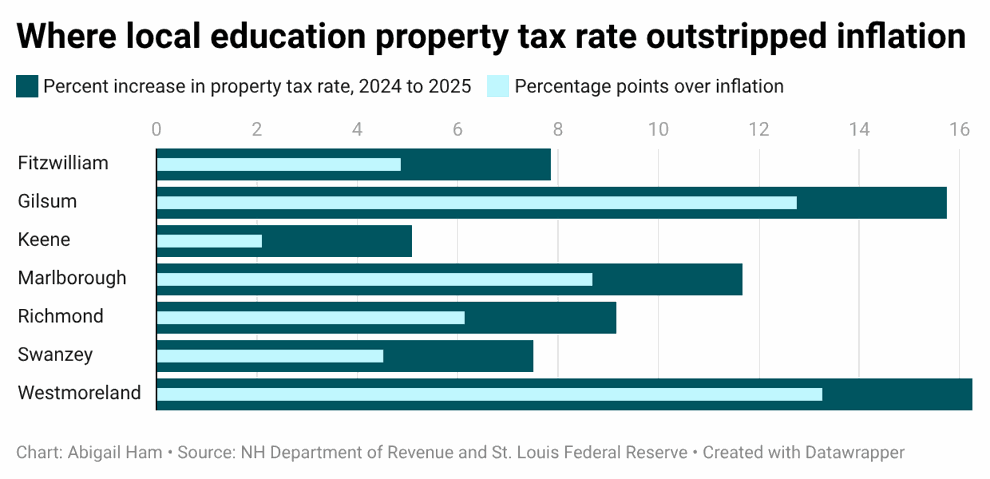


School property taxes outpaced inflation in several local communities, including Keene, Swanzey and Westmoreland, last year, which may be a consideration for voters mulling a question on the Nov. 3 general election ballot.
Voters will be asked whether to cap their local school district’s property tax growth to the rate of inflation and tax revenue increases arising from new construction. A separate part of the question is intended to limit a school district’s central office administrative expenses.
Last week, the N.H. Supreme Court cleared the way for the question to appear on the ballot, denying a request for an emergency preliminary injunction by two voters suing the state.
Public school advocates say school district costs, including for transportation, heating and building maintenance, sometimes outpace inflation and that caps could force significant cutbacks in offerings to students.
The Republican-led N.H. Legislature and Gov. Kelly Ayotte put the question on the ballot in an effort billed at empowering people to slow increases in their property taxes.
Some GOP leaders contend school districts have been overspending, while education officials say the state isn’t covering enough public school costs.
One thing both sides agree on is that New Hampshire, which has no overall income tax or sales tax, relies heavily on property taxes for funding schools and local government and has some of the highest rates in the nation.
Local property taxes in New Hampshire increased 59 percent between 2009 and 2023, while inflation was at 41 percent for the same time period, according to the N.H. Fiscal Policy Institute and the U.S. Labor Department’s Consumer Price Index.
One driver of this tax increase was rising costs for health insurance plans state and local governments provide to public employees, costs that grew by 73 percent during this period, according to the N.H. Fiscal Policy Institute.
In Keene, the school property tax rate increased from $15.16 per $1,000 of assessed valuation in 2024 to $15.93 in 2025, according to the N.H. Department of Revenue Administration.
That equates to a 5 percent increase. Meanwhile, inflation as measured by the Consumer Price Index for Urban Consumers – Northeast increased 3 percent from 2024 to 2025.
Other local increases outstripping inflation from 2024 to 2025 include:
Westmoreland, $13.48 to $15.67, or about 16 percent.
Gilsum, $7.43 to $8.60, or about 16 percent.
Marlborough, $17.81 to $19.89, or about 12 percent.
Richmond, $11.27 to $12.30, or about 9 percent.
Fitzwilliam, $11.07 to $11.94, or about 8 percent.
Swanzey, $10.26 to $11.03, or 7.5 percent.
House Bill 1300, the legislation that created the ballot question, mandates that its passage requires a three-fifths majority of the voters served by the school district. It excludes from the cap a district’s bonded capital costs for the acquisition, renovation or construction of real property.
The question is set to appear on the general election ballot this year and in 2028. If approved this year, it would apply to a school district’s budget beginning in the 2028 fiscal year. If approved in 2028, it would apply in the 2030 fiscal year.
HB 1300 will expire on Jan. 1, 2032, along with any school district tax cap or administrative unit cap approved under this law.
Here’s how the ballot question reads:
“Shall the [name of municipality] limit property tax growth for [name(s) of school district(s)] under RSA 32:5-i? If adopted for a two-year period: (1) the local property tax levy may not grow beyond the prior year’s amount, adjusted for inflation and new construction; (2) SAU central office spending may not exceed 6 percent of total school district appropriations; and (3) bonded capital costs are excluded from both limits. These caps apply only to administrative operations of the SAU central office and do not affect classroom instruction, school-based services, or other municipal expenditures. These limits may be overridden as provided in RSA 32:5-i. Adoption requires a three-fifths (3/5) majority vote.”
A “no” vote means the local school property tax rate remains flexible. A “yes” vote means the rate of growth is capped for two years.
Rick Green can be reached at 603-352-1234,
extension 1435, or rgreen@keenesentinel.com.
These articles are being shared by partners in the Granite State News Collaborative. Don’t just read this. Share it with one person who doesn’t usually follow local news — that’s how we make an impact. For more information, visit collaborativenh.org.