

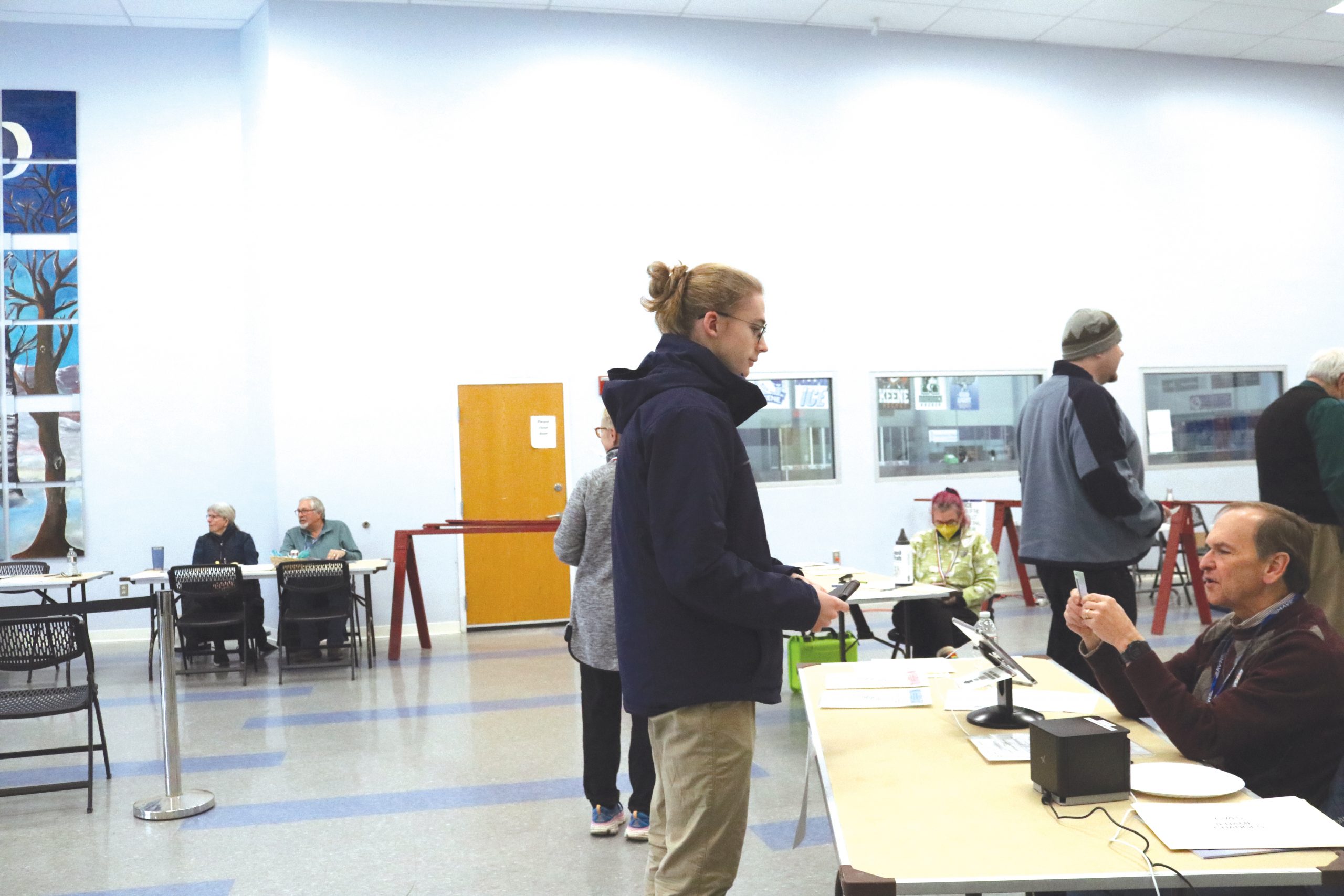
On Oct. 22, the Supreme Court came to the decision that New Hampshire “can direct election officials not to consider student IDs when verifying voters’ identities, ahead of the midterm elections,” according to an article by The New York Times. One of the reasons given for the court’s decision was not wanting to alter election rules so close to the election.
With the signing of House Bill 323 into law in April, questions have been raised since then about the validity of using student IDs as proper identification at voting stations. House Bill 323 requires the presentation of a government-issued photographic means of identification in order to vote.
Also in April, David Scanlan, secretary of state, “released a directive advising that student IDs cannot be used as proof of ID when registering to vote, requesting an absentee ballot, or checking in to vote in an election,” according to InDepthNH.
The law has been challenged in court by the Coalition for Open Democracy, as the organization wants the original law and Scanlan’s directive to be enjoined.
Earlier this month, a motion proposed by Scanlan calling for a stay on the lawsuit going against the repeal of student IDs as proper forms of identification was denied by the First Circuit Court of Appeals. An emergency stay was then requested from the Supreme Court, which ended in the Supreme Court’s statement on Oct. 22.
Keene City Councilor and Keene State graduate Jacob Favolise expressed that he doesn’t think the law will have a large impact on young voters in an email statement.
“Even without the recent court ruling that says student IDs actually could be used in certain circumstances, I don’t know how much of an impact this law will have in Keene,” Favolise stated. “The law has not changed with respect to college student eligibility to vote. The law has not changed with respect to out-of-state driver’s licenses being accepted. You can still use a passport. Those are the kinds of changes where you’d expect to see a bigger impact.
“The DMV and City Hall are also within walking distance to campus, so if a student needs to get a free voter ID card, they can get a voucher from the City Clerk’s office and then take it to the DMV, and get a free voter ID,” Favolise went on. “So, there are options beyond student IDs, which I think relatively few Keene State students were actually using to vote to begin with.”
With the changes to voting regulations and registration requirements, voters should also know who the candidates are for this upcoming election.
The retirement of Senator Jeanne Shaheen has created an open U.S. Senate seat for which Democratic candidate Chris Pappas and Republican candidate John Sununu are vying.
Pappas, who has served as the U.S. representative for New Hampshire’s District 2 since 2019, served three terms on the Executive Council for New Hampshire from 2013 to 2019. Some of Pappas’ stances on pressing issues include supporting abortion rights, advocating for climate change, lower costs for health insurance and increasing affordability for college students.
Sununu, meanwhile, is the son of former governor John H. Sununu and older brother of former governor Chris Sununu. Sununu supports lower taxes, individual rights, limited government oversight and national security. Sununu served the state as a U.S. senator from 2003 to 2009 and New Hampshire’s first congressional district as a U.S. representative from 1997 to 2003.
In the governor’s race, Kelly Ayotte is running for the Republican Party, Cinde Warmington for the Democratic Party and Stephen Villee for the Libertarian Party. Ayotte is currently serving as the 83rd governor of New Hampshire.
The New Hampshire statewide general election will be held on Nov.3.
Terri Hood, city clerk for Keene, did not respond for comment.
Chloe Erno can be contacted at
cerno@kscequinox.com