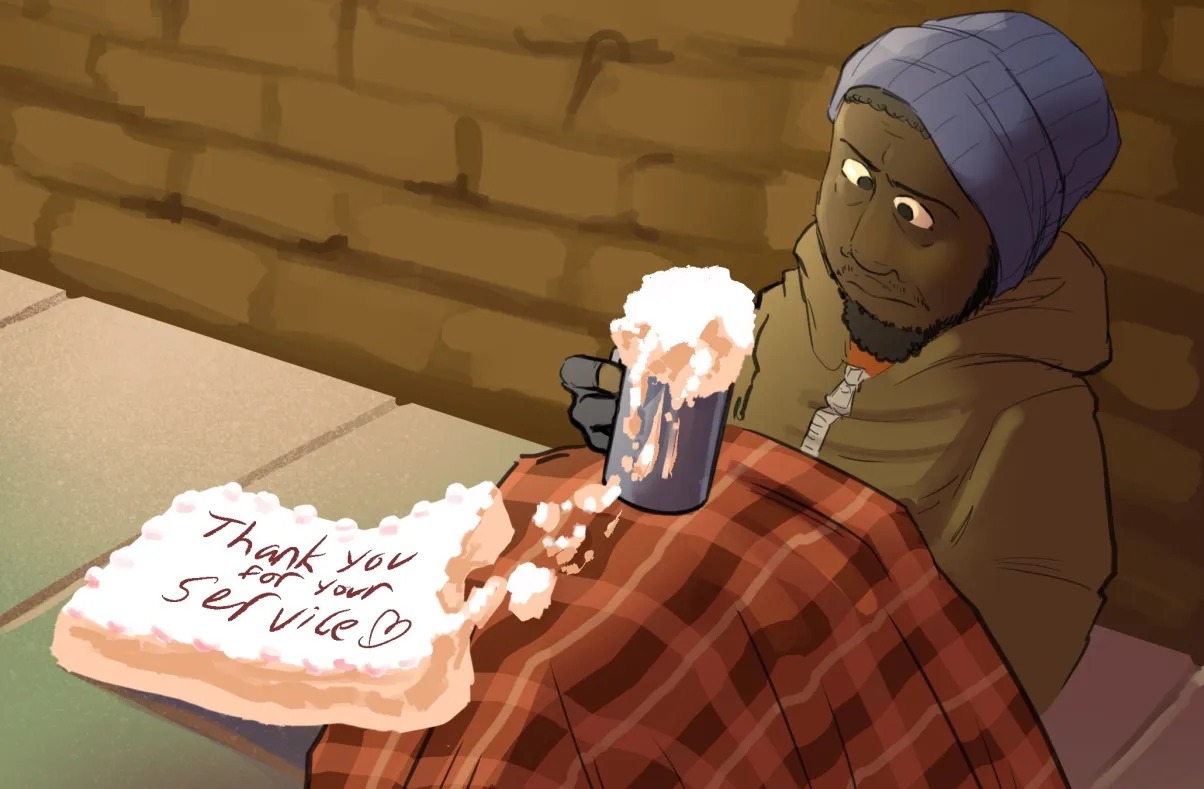
The United States celebrates Veterans Day every year to honor those who served in the U.S. Armed Forces, both living and dead, for the sacrifices they made.
The November 11 holiday, established in 1938 and formerly named Armistice Day, was to honor the “eleventh hour of the eleventh day of the eleventh month” of 1918 that signaled the end of World War I, according to The History Channel. The article talked about the current understanding of the holiday as well, which was established in 1954 when President Dwight D. Eisenhower signed legislation naming the holiday Veterans Day, honoring all who served.
The Equinox feels as though most students simply see it as a day off, ignoring the reasoning behind the day. As a campus community, even just taking the time to recognize and understand why we have Veterans Day goes a long way. We should be doing more than a small “Thank you for your service.”
With the U.S. being the wealthiest nation in history, we should be able to afford to house our veterans, not cutting the Department of Veterans Affairs’ budget, as President Donald Trump’s Department of Government Efficiency did in the first months of his second term. The U.S. currently has the single-most funded military in the world with a $831 billion budget passed, according to the House Appropriations Committee website. Placing U.S. military spending at 30 percent of total military spending globally.
If we are dedicating a day to veterans, we should dedicate more time and effort outside of a singular day. You may remember some sort of veterans celebration in elementary school, perhaps cards for local veterans. Initiatives like those make more of a difference than 10 percent off at your local Bass Pro Shop or one free meal at IHOP.
The U.S. government seems to praise veterans for their service, talking about how much the country loves them, yet it lacks regard for the problems they face after service. If our country truly loved those who previously served in the military, why are they reducing staff within the VA?
Many current and former clinicians from the VA even signed an open letter to VA Secretary Doug Collins, warning that staff shortages are threatening veterans’ health, according to reporting done by the National Public Radio (NPR).
While stigmatization around Post-Traumatic Stress Disorder (PTSD) has improved somewhat, we believe it is still a very prevalent issue. The National Center for PTSD reports that at some point in their lives, 7 out of every 100 veterans will have PTSD compared to the six percent of adults. Seven percent may not look like much, but it’s approximately 25 million people.
As a country, we should be better serving our veterans, especially considering the sacrifices they have made for our country. That comes in the form of increased services so they have access to quality, efficient medical care, not cutting VA staffing and funding, which further exacerbates patient wait times and discourages veterans from utilizing their benefits.
Another significant issue facing veterans is homelessness; a severe side effect of insufficient medical services, both physical and mental health.
“The U.S. Department of Housing and Urban Development’s January 2024 Point-in-Time (PIT) count estimated 32,882 veterans were experiencing homelessness on a single night,” according to the National Coalition for Homeless Veterans. We feel it is absolutely disgraceful there are nearly 33,000 unhoused veterans in the U.S.
While New Hampshire has one of the lowest rates of veteran homelessness, with approximately 150 unhoused veterans according to the N.H. Department of Military Affairs and Veterans Services website, more can be done. Guaranteed housing access should be one of our government’s top priorities with regard to veterans’ services, as well as creating programs for veterans to more easily access services and voice concerns.
So on Veterans Day next year and in the time between, let’s not just consider this a day of celebration but one of reflection as well. Let’s reflect not on what we feel or think veterans are, but what they truly are: a select and important group of individuals, maybe a relative or friend. A select group of individuals, who, like many other at-risk groups, need our support as well and not to be pushed to the wayside, like our government has done for so long.