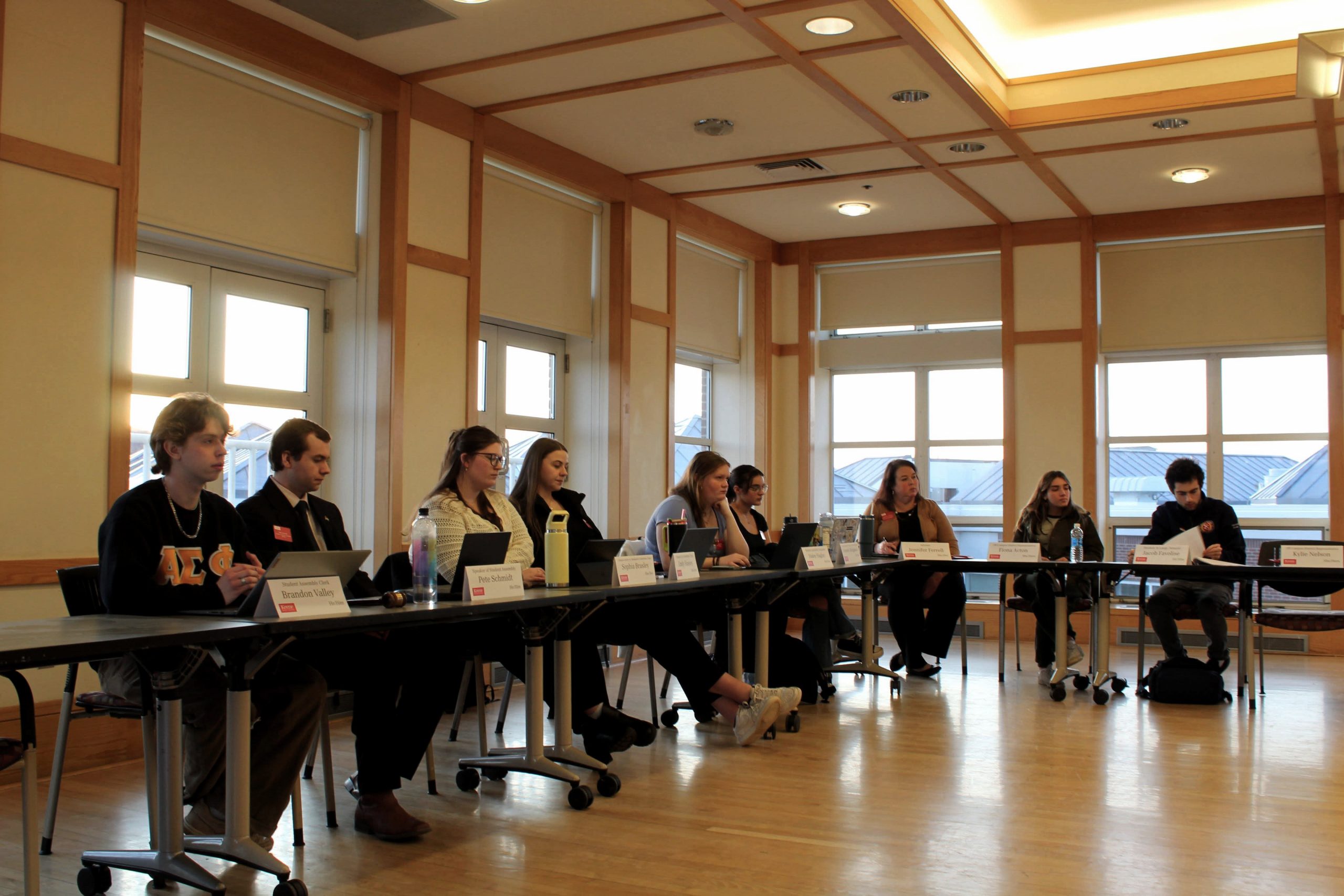


The Keene State College Student Assembly viewed a short presentation from the KSC Office of Community Standards, which included a breakdown of Alcohol and Other Drugs (AOD) statistics and detailed how the college plans to accommodate the recently enacted Stop Campus Hazing Act (HR 5646) at its most recent meeting.
Assistant Dean of Students and Co-Chair of the AOD Committee Kat Dougherty delivered the presentation, which described how HR 5646 will change KSC’s annual Clery report to include information on hazing.
The Annual Security Report (ASR), a mandate under the Jeanne Clery Campus Safety Act that requires colleges and universities that participate in federal financial aid programs to collect and publicize campus crime statistics, previously did not include requirements for hazing statistics to be included within the report.
According to Dougherty, HR5646 requires colleges now add hazing statistics to future ASRs. She explained that KSC will be adding those statistics in future reports.
“What is changing from [the Stop Campus Hazing Act] is that hazing is now considered a Clery reportable crime. Hazing has never been in the Clery Act so specifically in the past, so moving forward, there will be a specific section in our annual report pertaining to hazing,” said Dougherty.
According to Dougherty, KSC has been publicizing hazing statistics as a college practice since before the H.R.5646 mandate.
“What the [the Stop Campus Hazing Act] has been asking us to do is stuff we’re already doing, we just have to change a few things. Keene State has already been being more transparent than this act has asked us to be,” said Dougherty.
Dougherty also outlined AOD statistics dating from 2017 to 2024, with both fall and spring semester information included.
According to the presentation given by Dougherty, a general trend shows that violations are more common in the fall semester, as well as more common among first-year students.
“We tend to see first-year students are predominately students that are getting documented and found responsible for policy violations, and that’s data we have over time, but we also see more violations of policy in the fall than in the spring,” said Dougherty.
“I think that’s for a number of reasons, a lot of which is likely that first-year students are acclimating to the community and learning what the college’s expectations are,” added Dougherty.
Other business discussed at the student assembly meeting included an update from Student Government Advisor and Associate Vice President of Student Engagement Jen Ferrell regarding the vacant role of coordinator of student organizations and leadership, previously held by Brandon Carta.
According to Ferrell, changes to the position’s job listing are expected to entice a larger pool of candidates.
“Upon Brandon [Carta]’s departure, there was a search process that ended up being unsuccessful because they didn’t have any candidates that moved to the final stage. At the end of the fall semester, that position was closed, and the job description was updated and launched in the spring semester when all of the folks who are looking for those types of roles are generally looking for them,” said Ferrell.
Additionally, the meeting heard concerns from senior and Student Government Member-At-Large Jacob Favolise regarding proposed changes to the KSC Senate bylaws that would restrict eligibility for leadership positions within the organization.
“There are different opinions in the senate about the extent to which leadership positions, such as the chair and vice chair and the chair positions for each of the subcommittees within the senate, should be open to all senators or just to some senators,” said Favolise, who also serves on the senate.
“I fall in the camp that this is a college senate, and we should not be creating a class of membership where some senators have more rights than others,” added Favolise.
Additionally, The Equinox’s updated organizational constitution was approved at the meeting.
Senior and Managing Executive Editor Charlotte King and junior and Administrative Executive Editor Nathan Hope attended the meeting, where changes such as the organization’s policy on artificial intelligence generated content, titles of members, and student ownership of content were approved.
Although the constitution was approved, representatives informed The Equinox that stipends paid to members of the organization’s e-board would have to be lowered due to recent legislation passed by student assembly which limits stipend allocations to no more than the amount of four Class B stipends per organization, or $4,000
KSC Karate was scheduled to present its constitution but did not make an appearance.
Ryan Pacheco can be contacted at
rpacheco@kscequinox.com