

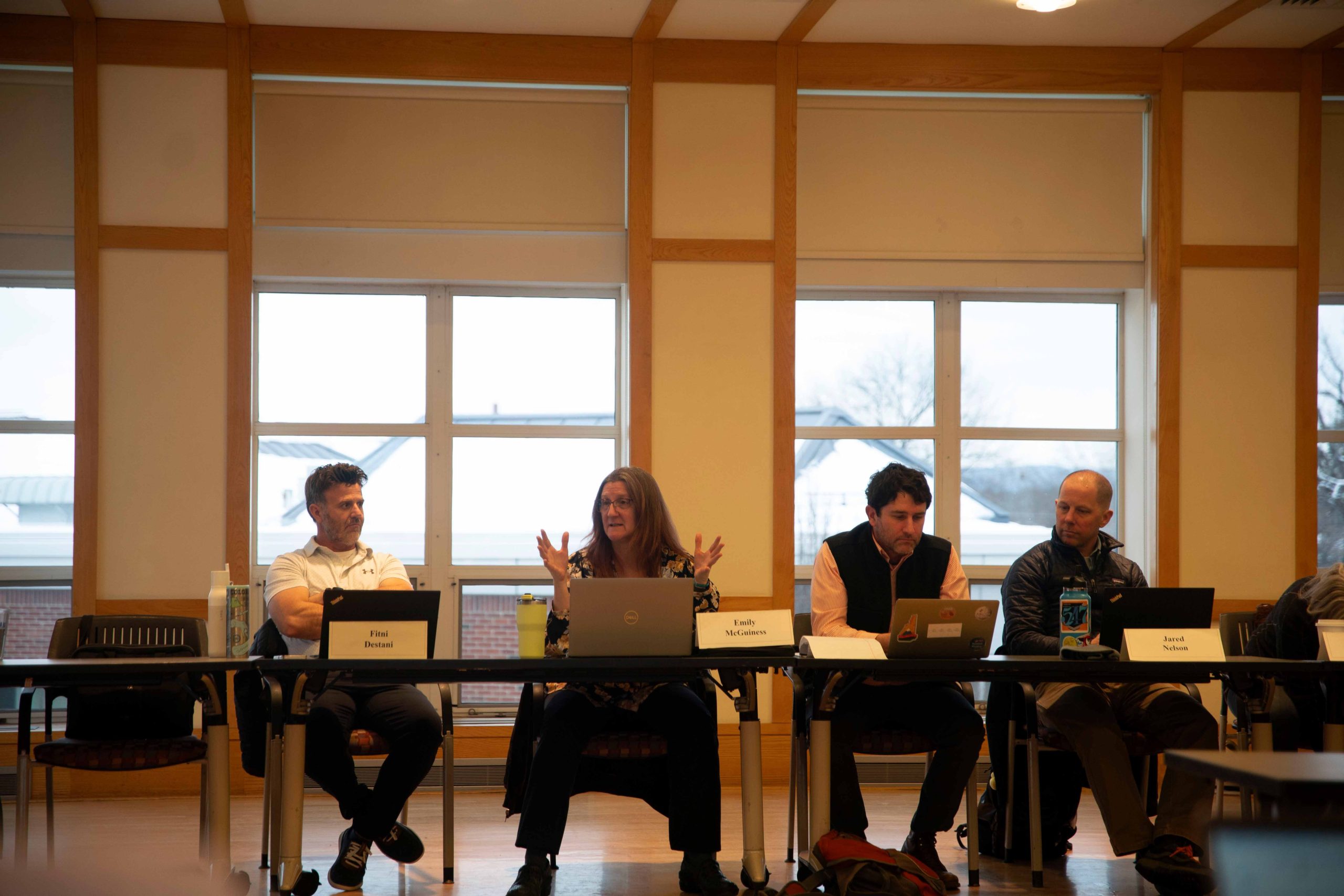
The Keene State College Senate met to discuss proposed bylaw revisions and the approval of a program, as well as the inactivation of another, during the 540th meeting of the legislative body.
The Senate Curriculum Committee (SCC) Chair and Professor of History, Nick Germana put forward proposals to approve a minor in sports broadcasting and the inactivation of the Master of Arts in Genocide Prevention and Human Security program.
“These are things we have actually voted on, but for one reason or another, we didn’t get to make it into the report that happens every year,” Germana said of the proposals.
The senate then unanimously approved the minor in sports broadcasting via voice vote.
As for the master’s program, Germana said the inactivation was in relation to the senate’s previous approval of the new Master of Arts in Holocaust and Genocide Studies, which effectively took the place of the old program.
Senator and Professor of Music Joe Darby raised a question regarding the difference in language between an inactivation and a deletion of a program or course.
Jennifer Zoll, registrar specialist, was in attendance at the meeting and responded to the question.
“Inactivation simply means it’s not currently active, but it can be returned at some point in the future if it’s decided to go back to that name,” Zoll said.
Zoll added inactivation would be the correct terminology, as the registrar’s office never has deleted courses or programs within its system, it simply inactivates them.
Germana agreed the terminology of deletion was incorrect and noted it would be changed in future meetings if the committee were to make similar motions.
“All of those [HGS] courses, or most of them, were recreated as new things, so it’s just a complete switchover from this to what we approved earlier this academic year,” Germana said.
The senate approved the inactivation of the program unanimously via voice vote.
Another key point of discussion during the meeting was the proposed bylaw revisions to the senate, specifically a revision on who can and cannot serve as a chair of a senate committee or subcommittee.
The proposed revision would mandate either a full-time or tenured full-time faculty member to chair a committee or subcommittee and would bar adjunct faculty, staff or students from doing so.
Senate Chair and Associate Professor of Mathematics Karen Stanish explained the reasoning for the proposed change.
“The reason we’re putting this forward is that tenure does offer a certain class of protection that certain other folks on campus don’t have in terms of job security,” Stanish said.
Senator and Community Director for Carle Hall Isabelle Handy rose in opposition to the change.
“In this room, we have representatives from all around campus: Faculty, staff and students who all feel united under a common goal to make sure the academic experience for students is the best it can possibly be,” Handy said.
Handy raised concerns the change would limit the ability of adjunct faculty, staff and students to participate equally with others in the body.
“I believe that a person’s ability and responsibility to hold a position on this body or in the committees has less to do with the title or the role and more to do with the commitment to their work,” Handy said.
Senator and Lecturer of History John Lund spoke in support of Handy’s remarks.
“I get both sides of the argument, it’s possible to hold two truths, but I think in the spirit of community, it should be open to everyone who really wants to step forward,” Lund said.
Germana said certain political pressures come with being a chair on the senate and having the protection of tenure is valuable.
Outside of the chair question, the new bylaw revision proposals would merge the Academic Standards Committee (ASC) and the Academic Policy Committee (APC), as was the case in previous years, and also create a new committee that would oversee the general education program, among other things.
As for the merger, Senator and senior Jacob Favolise, who previously served on the ASC, said the workload was not comparable to that of the APC and that questions of which committee would have domain over which policy issue became difficult.
The senate plans to vote on the bylaw revisions during the body’s March meeting.
Nathan Hope can be contacted at
nhope@kscequinox.com
This article has since been updated to correctly reflect Karen Stanish’s title. The Equinox apologizes for this error.