

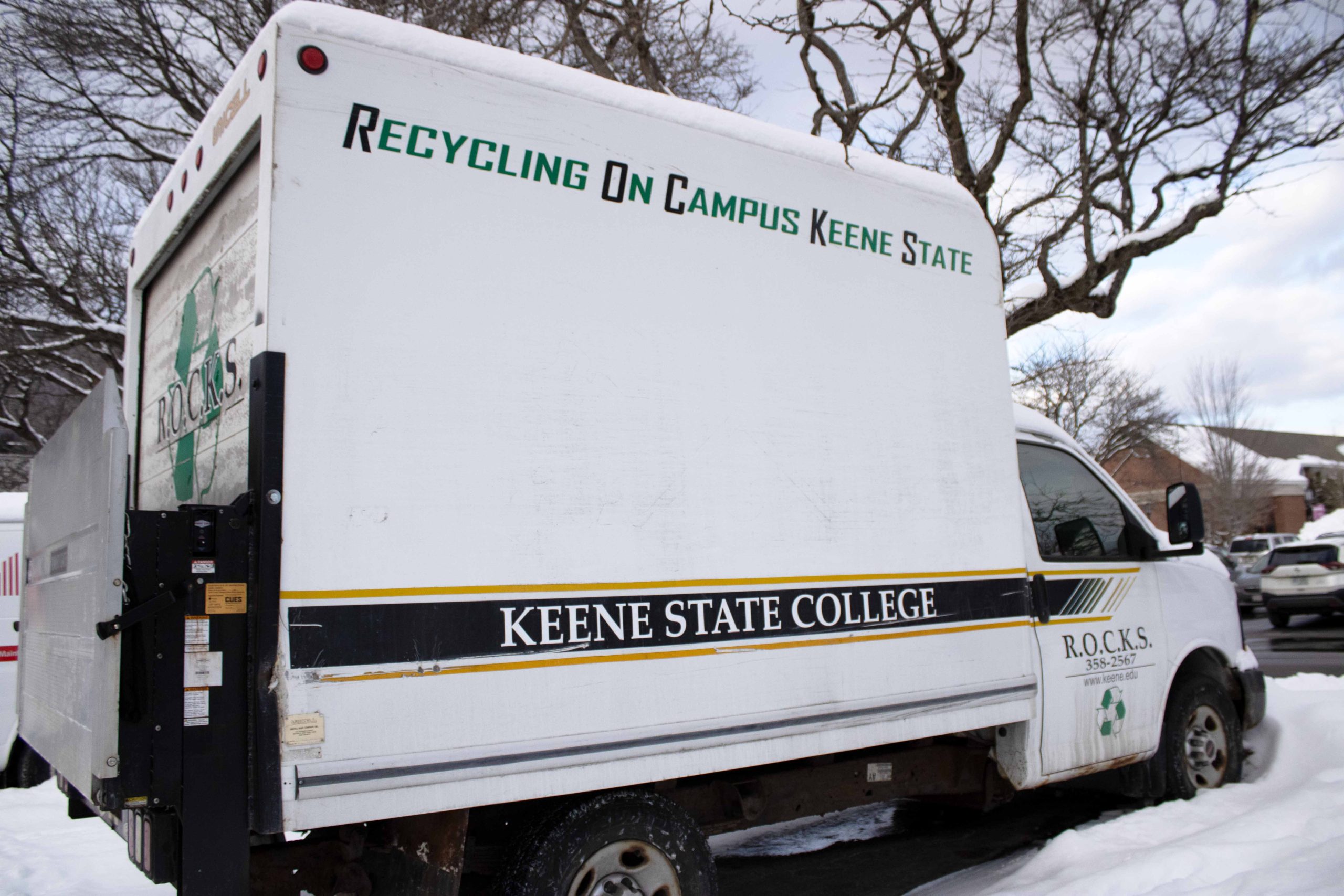


Those roaming campus may encounter box trucks labeled “R.O.C.K.S.” – but what does it stand for?
Sustainability Coordinator Kate Witte explained the trucks’ past and current role in campus operations.
“Our custodial service is C&W [Services] and they will use the box truck to collect recycling and trash from inside campus buildings … They use that for transporting heavier waste,” Witte said.
Once C&W deposits the waste to larger dumpsters, Waste Management hauls the material to external facilities for processing, Witte said. In those facilities, the recycling is sorted into categories such as plastics versus paper for further processing.
Witte also gave the backstory on R.O.C.K.S. and how Keene State recycling previously operated.
“Recycling On Campus at Keene State [R.O.C.K.S.] started in the 1980s,” Witte said. “We used to have a full-time recycling coordinator on campus and they had student employees under them … There were these blue bags that were R.O.C.K.S. bags that every student would get for their dorm room so it was like, you could put bottles and cans, cardboard and mixed paper into these bags, and then student employees from the R.O.C.K.S. program would pick them up.”
Witte said R.O.C.K.S. ceased around the time the COVID-19 pandemic hit when it was uncertain what practices might pose risks of transmitting the virus. Even as the college adapted to a post-pandemic reality, the program was found to be less efficient than the single-stream method that was adopted as a replacement.
“Since we switched to single-stream in 2021, we’ve done better on recycling because people don’t have to spend quite as much time thinking about like, ‘Is this recyclable? Is it not?’ And so that has helped improve the amount that’s being recycled and our diversion rate from landfill to recycling facilities,” Witte said.
In a follow-up email, Witte stated the college hauled 951 tons of trash and 319 tons of recycling in total during 2024.
“There is certainly room for improvement and a lot of that will come down to folks properly sorting trash from recycling and simply buying less single-use items!” Witte added in the statement.
Witte said encouraging these best recycling practices is a large part of what the sustainability interns in her office work on.
In a January email to Holloway Hall residents, Community Director Marco Pazmiño stated, “Regarding your personal trash, there are dumpsters outside for these items. The dumpsters are located by Holloway. Note that there are no longer recycling so be sure to use the other dumpster if one of the dumpsters is filled.”
Witte said she felt confident students would still take the extra steps necessary to continue recycling in other nearby receptacles.
“Our students are pretty mindful of what they’re doing, so I think once we just get some updated signage and make it maybe a little bit less confusing [we can] have even higher rates of success,” Witte said.
David Merritt and David Streeter from C&W Services did not respond to requests for comment.
Charlotte King can be contacted at
cking@kscequinox.com