

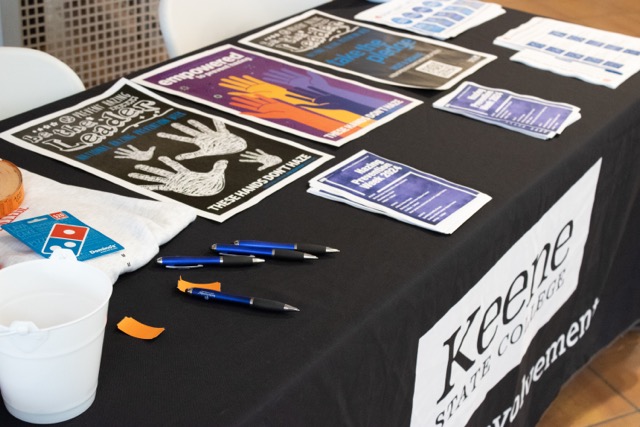
Keene State College participated in this year’s National Hazing Prevention Week which included various events.
Senior Coordinator of Student Involvement and Well-Being Emily Alexander spoke on what hazing is.
“Hazing is related … to joining a group or maintaining membership in a group, there’s a few different components to it,” said Alexander. “Typically individuals are asked to do some type of behavior or experience something that was harmful or detrimental … and often they experience peer pressure.”
According to the Hazing Prevention Network website, the week is a time for individuals, communities and institutions to increase education and awareness about hazing and its effects. This year’s theme for the week, according to the website, is “Be the leader. Prevent hazing.”
KSC’s Office of Student Involvement held three different events in accordance with the theme and to provide general awareness of hazing. Students were also able to enter a raffle during these events for a chance to win a hat, a sweatshirt or a gift card to Domino’s. The first was a video screening in the Mountain View Room in the student center on Monday, Sept. 23. The video was a documentary titled “We Don’t Haze.”
“We watched a 20-minute video on what hazing actually does and the impact that it has on the communities around us,” said junior Lex Gargan, the wellbeing program manager with Student Involvement. “It shared some striking statistics.”
The documentary centered around families who had lost a loved one to hazing rituals and the effects it had. According to the documentary, hazing is the fifteenth leading cause of death for young adults in the United States.
“There was a good discussion afterwards with all the people about … the signs of hazing,” continued Gargan. “That way they are all aware if they are being hazed, because it’s hard to spot.”
The second event was A Day To Wear Purple on Tuesday, Sept 24. Student involvement staff tabled in the student center and encouraged students to wear purple and trace their hands on a sheet of paper. Purple is the color chosen by the Hazing Prevention Network to represent hazing awareness and prevention “We’re having folks trace their hands [to] show that they don’t support hazing,” said Alexander. “[It’s] a good way for people to … interactively come and chat with us about the Hazing Prevention Week.”
There were also several printed infographics available for students to take, outlining different signs of a healthy or unhealthy group and how to intervene to prevent hazing in any setting.
The final event was a workshop titled Building Healthy Groups held in the Madison Street Lounge on Thursday, Sept. 26. This workshop was open to students and was designed to raise awareness about both what hazing looks like and its impact, as well as how to create healthy relationships within groups and the positive impact they can have. The workshop opened with a presentation, followed by participants breaking into small groups to discuss how hazing could happen in regards to specific activities. The groups also discussed how student organizations and participants were involved in taking steps to create a healthy environment for all involved. Students stated that the event was something they felt was important.
“It’s important to us to have our chapters understanding what is considered hazing, how to not do it, how to report it,” said senior Ashleigh Moroni, who is a member of the Phi Sigma Sigma sorority and vice president of recruitment of the KSC Pan-Hellenic Council. “I just want to learn more about [hazing] … the seriousness of it, the severity of it, how to prevent it and how to make our chapter a positive community as a whole,” said junior Abigail Hall, a member of Phi Sigma Sigma. “I thought [the workshop] was great, it was very informative about community values and how to treat one another.”
Orion Corbin can be contacted at
ocorbin@kscequinox.com