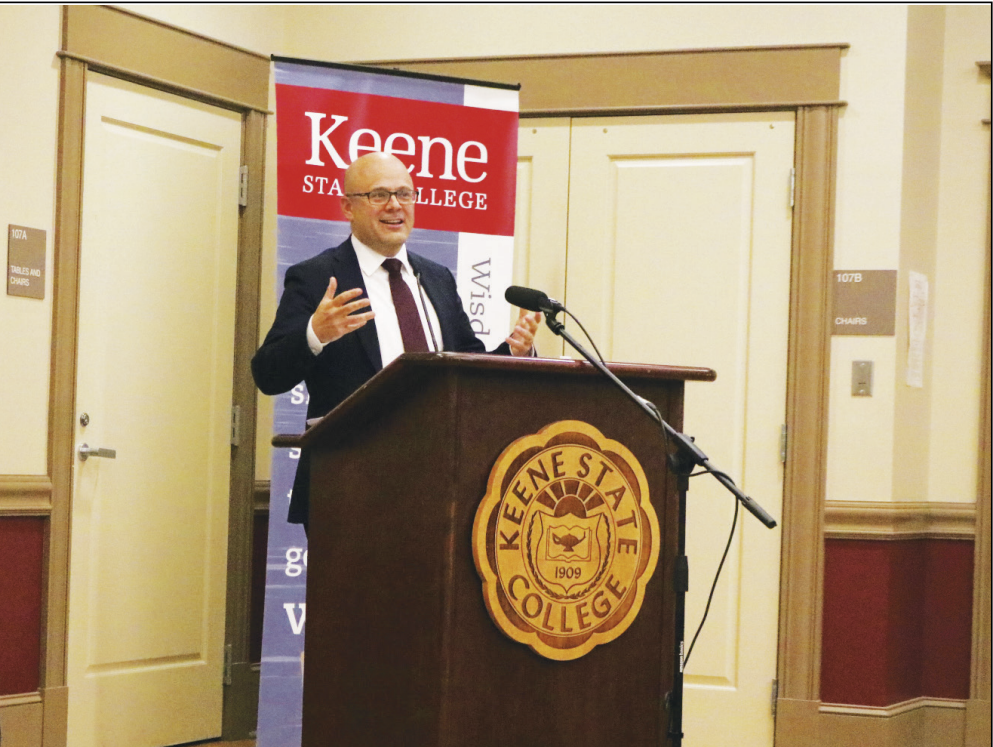
Author and political science professor at Harvard University Daniel Ziblatt gave a warning on the assassins of democracy during his lecture on Wednesday, Nov. 1 at the Alumni Center’s Norma Walker Hall. The lecture, which focused on identifying warning signs of a vulnerable democracy, was attended by community members and students.
Orion Corbin, ‘25, journalism major, attended the lecture. “I thought the lecture was really interesting and engaging, and I really liked a lot of his points. I’ve never really liked the idea of the electoral college, and I like how he mentioned getting rid of it. I don’t see why the popular vote shouldn’t pick the president in a democratic country,” Corbin said.
“Political science offers a criteria to determine how committed a political party is to democracy. Juan Linz developed such a criteria in the 1970s, which asserts that commitment to democracy means a politician must accept the results of an election, reject the use of violence to gain or hold on to power and break from anyone who breaks either of those first two rules,” Ziblatt said.
Ziblatt continued to describe the importance of breaking from those who reject the first two of Linz’s rules. “Anti-democratic extremists don’t often break democratic regimes on their own. Mainstream politicians who enable them often play a big role in helping normalize anti-democratic actions. Democracy’s assassins always have accomplices.”
Ziblatt has extensively studied European politics. Ziblatt expressed concerns over similarities between events that have weakened European democracies and trends emerging in the United States and offered some possible solutions to strengthen American democratic systems. Eliminating the Electoral College, imposing term limits on judges, and weakening the senate filibuster by requiring senators to be present for the duration of their filibuster are some of the recommendations Ziblatt made.
“I think imposing 18-year term limits on justices would reduce a lot of the passion and dysfunction out of the current [Supreme Court nomination] system. Every time there’s a nomination, it becomes a very high-stakes game because the nominee will be there for life. With term limits, every president could get two nominations automatically as justices nearing the end of their term retire,” Ziblatt said in a follow-up after the lecture.
The lecture was a part of the James D. Ewing World Affairs Lecture series, which seeks to bring speakers to Keene State College who address world affairs issues. The series is named after James D. Ewing, who owned and published The Keene Sentinel from 1954 to 1993.
Philip Barker, a KSC political science professor, recommended Ziblatt for this installment of the lecture series. “Some of the lecture organizers reached out to me about getting a guest speaker to come to campus to talk about democratic decline, and Ziblatt was the first who came to mind. He and Levitsky are in many ways the global leader in the conversation of democratic struggles we’re seeing globally and domestically. One of the books they’ve co-authored, How Democracies Die came out in 2018 and covers the rise of populism around the world. Their predictions aligned almost perfectly with what we saw during the 2020 presidential election and the insurrection on January 6,” Barker said.
“Their work is really easy to understand and accurate, which is why I have my students read the intro of How Democracies Die. It really helps to make sense of what’s happened in the last few years.”
Barker expressed concerns about the consequences of electing politicians who don’t uphold democratic principles. “We want to elect people who have respect for the democratic process. We all have policy preferences, but the main thing I want to see is politicians who respect democracy and adhere to the norms of democratic contests. We want to choose people who are willing to compete in free and fair elections and accept the results of those elections. That’s what guarantees us the chance to do it again in four years.”
Ziblatt has published multiple books on issues relating to the health of democracy, including his newest book, Tyranny of the Minority, which he co-authored with fellow Harvard political scientist and author Steven Levitsky. The book examines the ways in which democracy can be subverted, and makes recommendations for possible reforms.
Ryan Pacheco can be contacted at
rpacheco@kscequinox.com