
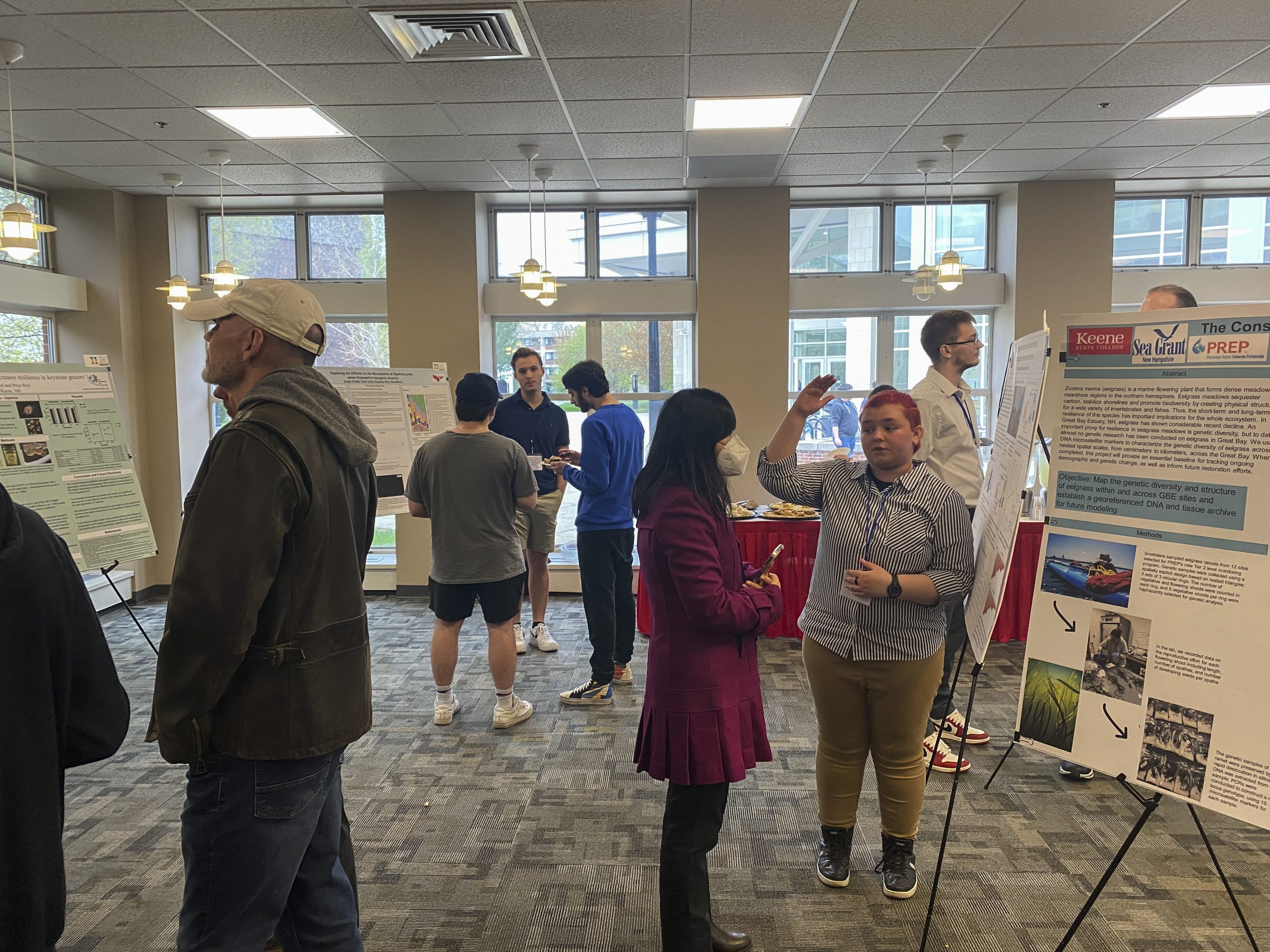
A day of presentations, panels, music and rooms of the student center filled with posters.
The 23rd annual Academic Excellence Conference (AEC) was held in the Putnam Science Center, as well as the L.P. Young Student Center.
Students showed off what they did throughout the semester and years to people listening to what they had to say.
“We try to think as broadly as possible about the full academic experience of students,” Kimberly Schmidl-Gagne, accreditation and assessment officer, said.
All students are welcome and encouraged to register to participate in the conference to show off what they have been working on, she said.
This year 131 students were at the conference presenting in some way or another, with some presenting their work multiple times, Schmidl-Gagne said.
Senior Samrat Adhikari researched biofabrication. He was given the opportunity to test bacterial growth on three-dimensional bio-printed scaffolding to see if there was any conflict.
In the end, he said he found that bacterial growth was not promoted on the material.
“It was a way to apply what I learned in class but also [do it] in real-time,” Adhikari said.
Even though this was not his first time presenting, “It’s really good to meet the people that ask the questions, so as always exciting,” he said.
A student from the master’s program at Keene State presented as well. Helena Silva Horikawa, who is working on a master’s of science in public health nutrition, researched obesity rates in N.H. What she found was that N.H. has the second highest obesity rate in New England. Silva Horikawa said she found that a lot of it can be attributed to portion sizes.
She worked to create a tool kit and did lectures on how to eat healthily and have a balanced plate for adults.
Silva Horikawa said presenting was a lot of fun and exciting.
“I worked on this for two semesters now, It’s good to be finally presenting,” she said.
Senior Aleksey Wirth also presented a poster during the poster session.
He said he did his research on the effectiveness of salamander crossings. He said he was able to team up with the Harris Center to work with them on the crossings and come up with averages to determine the effectiveness.
Wirth said he originally became interested in the subject after learning that amphibian populations were on the decline.
What Wirth found were streets that did not fully close for the crossings had a triple to five times higher mortality rate versus the ones that did fully close.
Even though people already know that a street that is fully closed for these crossings would be more effective, putting it into numbers gives people a new perspective, he said.
He noted that working on the project was a very positive experience for him and so was presenting.
“There’s been some excellent conversations had,” Wirth said.
Tim Bruns can be contacted at