Spending plans discussed at the state house Monday included hundreds of job cuts as well as slashing funding for the arts and for a state watchdog for children.
Amid declining state revenue, lawmakers have been working to identify hundreds of millions of dollars in reductions required for the two-year state budget that will go into effect July 1.
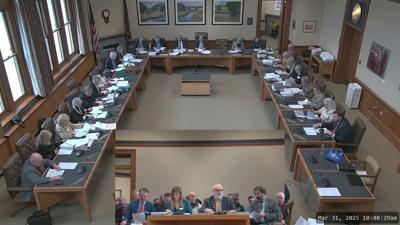
Rep. Dan McGuire, R-Epsom, explained the enormity of the task before the House Finance Committee Monday.
“Every decision we make affects every other decision,” he said. “If we spend more here, we have to spend less there. This is a giant exercise in making tradeoffs, and we tried to figure out what things have higher priority than others.”
In February, Gov. Kelly Ayotte submitted a $16 billion budget for the N.H. Legislature to consider, about $800 million more than the 2024-25 spending plan. But fiscal experts in the House found her revenue projections were too high, meaning major spending cuts would be needed.
Three subcommittees of the House Finance Committee, including one led by McGuire, have been coming up with potential reductions. Ultimately, the full House and Senate will be tasked with agreeing on a new budget to submit to Ayotte for her approval.
Rep. Nicholas Germana, D-Keene, said in an interview last week that people will be surprised at the high level of cutbacks in state spending that will be required.
“On the House side, we’ll be looking to find $700 million to $800 million in reductions to what the governor proposed to try to cover the gap that exists right now,” Germana said. “And it’s going to mean massive cuts for state services.”
Health and social services, education and transportation are three of the biggest areas of state spending and so will be targeted for cuts, he said.
“What municipalities are going to be looking at is we’re either going to have to pay for a lot of those services ourselves through increased property taxes or doing away with a lot of services for the people who are most vulnerable,” Germana said.
McGuire told the House Finance Committee on Monday that his subcommittee recommended cutting $1.7 million in spending on the N.H. State Council on the Arts, which provides money for programs statewide.
Rep. Laura Telerski, D-Nashua, asked McGuire whether any economic analysis had been done on this cut, since the arts can drive tourism.
McGuire said no such analysis was done.
“The arts is a huge business — concerts, paintings, books — and is a big, big deal,” he said. “This is a very tiny part of the state budget. Compared to other things that could be cut, this just didn’t reach the level of necessary funding. It’s a want to have, nice to have, kind of thing, but not a must have in my opinion.”
He also said the state’s Office of the Child Advocate is on the chopping block. Eliminating it as proposed would save about $2 million in the next budget.
Ayotte has publicly opposed eliminating that office, which serves as a watchdog of the state’s child welfare and juvenile justice systems.
McGuire said his subcommittee has recommended cutting 293 state employee positions, including 191 from the Department of Corrections, 34 from the Liquor Commission, 15 from the Human Rights Commission and 14 from the Department of Business and Economic Affairs.
Other cuts being considered would eliminate:
The state’s Family Planning Program, which uses state and federal funds to support reproductive and sexual health care services.
The Housing Appeals Board, which allows people to challenge local land use board decisions.
The Women, Infant and Children’s Farmers’ Market Nutrition Program, which helps pregnant women and nursing mothers purchase local food at farmers markets.
Among all the proposed cuts, lawmakers also plan to increase spending in some areas.
Last week, the N.H. Senate passed a bill that would eliminate income eligibility requirements for the state’s voucher system, which provides taxpayer money to help parents send their children to private, religious and home schools.
Reaching Higher NH, a nonprofit organization that advocates for public schools, said the change could cost the state about $102 million in the 2025-26 school year. In the current school year, the program will cost the state $26 million.
The N.H. Fiscal Policy Institute, a Concord-based nonpartisan, independent research nonprofit, said in a March 12 issue brief that the state is facing substantial decreases in revenue:
“These revenue decreases are primarily the result of slower growth in national corporate profits, which accelerated substantially in the years following the start of the COVID-19 pandemic, and State policy choices that have reduced revenue, including the elimination of the Interest and Dividends Tax in 2025.”
Republican-led efforts discontinued that tax on investment wealth this year, which had been supplying more than $150 million yearly to state coffers.
Federal pandemic spending, which also boosted revenue for the state, is also no longer available.
Finally, corporate profits declined after spiking when the COVID pandemic eased. The state has also reduced corporate taxes in recent years.
Rick Green can be reached at 603-352-1234, extension 1435, or rgreen@keenesentinel.com.
These articles are being shared by partners in the Granite State News Collaborative. For more information, visit collaborativenh.org.